
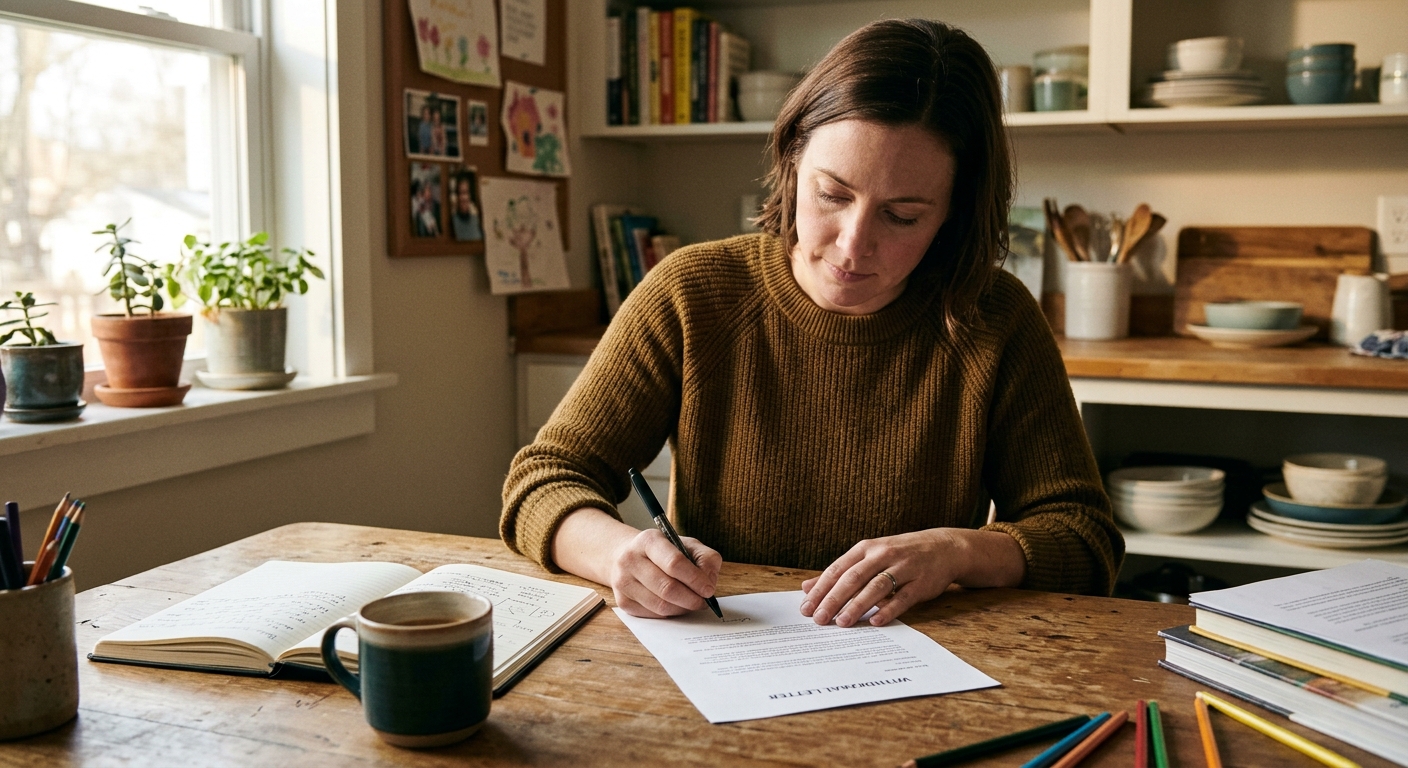
Pulling a child out of school in Missouri is mostly a paperwork question — and a shorter one than most parents expect. Missouri homeschool requirements live in a single statute, and once the hour rules make sense, almost everything else is your choice. This guide walks through the withdrawal letter, the log, curriculum and online options, the diploma, and where to find other Missouri families.
Quick Answer
Missouri does not require you to file a notice of intent with the state or your district. Send a short, dated written withdrawal letter to your current school's principal, keep a copy, and begin operating as a home school under Missouri Revised Statutes section 167.031. From that point, your job is logging 1,000 instructional hours a year and keeping samples of your child's work.
TL;DR
- The withdrawal letter is a courtesy, not a filing — but send it anyway. A dated copy ends attendance questions before they start. See the sample letter wording
- The hour rule is the real requirement. Section 167.031 sets 1,000 hours a year, with 600 in core subjects and 400 of those at your home location. Read how the hour split works
- No curriculum is more legal than another in Missouri. The state approves nothing and reviews nothing, so choose for fit and ease of logging. Compare the four main curriculum approaches
- Full-time virtual public school is not homeschooling. Enrolling there makes your child a public school student again. Understand the online program categories
- Parents issue the diploma. Missouri sets no graduation requirements for home schools. See how transcripts and diplomas work
In This Article
- What Does a Missouri Homeschool Withdrawal Letter Need to Say?
- How Many Hours Does Missouri Require, and How Do You Log Them?
- Which Curriculum Options Work Well for Missouri Families?
- Do Online Homeschool Programs Count Toward Missouri's 400 At-Home Hours?
- How Does a Missouri Homeschooler Graduate and Get a Diploma?
- What Does the Record-Keeping Actually Look Like Week to Week?
- Where Can Missouri Families Find Support Groups and Co-ops?
- Frequently Asked Questions
What Does a Missouri Homeschool Withdrawal Letter Need to Say?
Five things: your child's full name, date of birth, current grade, the date home schooling begins, and one sentence stating that you are establishing a home school under Missouri Revised Statutes section 167.031.
A Missouri homeschool withdrawal letter is a written notice to the school where your child is currently enrolled, telling them the child is leaving to be educated in a home school. It is not an application. The school does not approve it.
Keep it to one paragraph. Something like this works:
[Date]
[Principal's Name], Principal
[School Name and Address]
Dear [Principal's Name],
This letter is written notice that [Child's Full Name], date of birth [DOB], currently enrolled in grade [Grade], is withdrawn from [School Name] effective [Date]. Beginning on that date, [Child's First Name] will be educated in a home school established under Section 167.031 of the Revised Statutes of Missouri. Please update your attendance records accordingly and confirm receipt in writing.
Sincerely,
[Parent Name, Address, Phone]
Your withdrawal checklist
- Send it so you can prove it arrived — certified mail with return receipt, or hand delivery with a signed, dated acknowledgment.
- Keep your own dated copy. This is the document that answers any later attendance question.
- Request records you may want, such as prior report cards or an IEP, in the same letter.
- Return school property — laptops, library books, instruments — and ask for a receipt.
- Consider the optional Declaration of Enrollment. Missouri allows a parent to file a declaration with the county recorder of deeds or the state education department. It is voluntary, and it simply creates a dated record that your home school exists.
That optional declaration confuses a lot of families, because many states require a mandatory filing with a deadline. If you are comparing states or planning a move, it helps to understand what a notice of intent actually is before deciding whether to file anything at all.
⚠️ Missouri's optional declaration is not a permission slip, and skipping it does not make your home school unlawful. Treat it as record-keeping, not compliance.
How Many Hours Does Missouri Require, and How Do You Log Them?
Missouri Revised Statutes section 167.031 sets the standard: 1,000 hours of instruction per school year, with at least 600 hours in reading, mathematics, social studies, language arts and science, and at least 400 of those 600 core hours taking place at the regular home school location.
The remaining 400 hours of the 1,000 can be almost anything instructional — art, music, physical education, coding, a trade skill, a museum day.
Missouri homeschool requirements at a glance
| Requirement | What the statute sets out |
|---|---|
| Total instruction | 1,000 hours per school year |
| Core subjects | 600 hours in reading, math, social studies, language arts, science |
| Location rule | 400 of the 600 core hours at the regular home school location |
| State notification | None required |
| Testing | None required |
| Records | Hour log, work samples, evaluations or grades |
A home school record under Missouri law is the combination of three things kept together: a plan book or daily log showing subjects and hours taught, samples of the child's academic work, and a record of evaluations or grades.
Logging is the habit that makes or breaks the year. Entering hours daily takes a minute; reconstructing nine months of them in June is a different task entirely. If you want a practical system for this, our guide to how to track homeschool hours covers what counts as an hour and how to tag it.
Two timing details matter. Children under compulsory attendance age are not yet subject to the hour rule, so a five-year-old does not need a log. And the rules apply only while your child falls inside Missouri's compulsory attendance window.
Families comparing options across state lines can check our homeschool requirements by state reference, since the hour-based model Missouri uses is not how most states write their laws.
Key takeaway: Missouri trades paperwork filings for an hour log — you report to nobody, but you keep records that could be produced if ever asked.
Which Curriculum Options Work Well for Missouri Families?
Missouri approves no curriculum and reviews none. So the useful question is not "is this allowed?" but "does this make the 600/400 hour split easy to document?"
| Approach | Example programs | Typical cost | Hour-logging ease | Core-subject coverage |
|---|---|---|---|---|
| Boxed all-in-one | Sonlight, Abeka | Usually among the higher-cost options | Easiest — lessons map directly to subjects | Full five core subjects |
| Free or low-cost online | Khan Academy, Easy Peasy All-in-One | Published as free to use | Easy — platforms often show time or lesson completion | Varies by grade and subject |
| Eclectic / unit studies | Mixed publishers plus library resources | Moderate, spread across purchases | Moderate — one activity may span several subjects | Strong, but you track the gaps |
| Unschooling-leaning | Interest-led, parent-assembled | Lowest material cost | Hardest — requires deliberate retroactive logging | Depends entirely on documentation |
Costs change constantly, so check current pricing directly with each provider before budgeting.
A few practical notes on each. Boxed curricula hand you a daily schedule, which converts into a clean hour log almost automatically — attractive if the documentation side worries you. Free online curricula cost nothing to try, which matters in a first year when you are still learning your child.
Unit studies are efficient for teaching siblings together, but a single Civil War project might legitimately count toward social studies, language arts and art. Decide upfront how you split that time rather than guessing in May.
Interest-led approaches are fully legal in Missouri. They simply put more weight on your log, because a day spent at a creek becomes science and language arts only if you write it down that way.
For deeper subject-by-subject help choosing, browse our homeschool curriculum guides.
Key takeaway: No curriculum is more "legal" than another in Missouri. The only real difference between them is how much work it takes to turn your teaching into a defensible record.
Do Online Homeschool Programs Count Toward Missouri's 400 At-Home Hours?
Yes — if the instruction happens at your regular home school location. The statute addresses where the teaching occurs, not what medium it uses. A math lesson on a laptop at your dining table counts the same as the same lesson in a workbook.
The important distinction is between three categories that all get called "online homeschool in Missouri":
- Full-time virtual public school. Missouri's course access program enrolls your child as a public school student taking state-funded online courses. This is public schooling delivered at home.
- Accredited private online academies. Your child enrolls with a private school that issues its own transcript and diploma. Reporting duties follow the academy's policies rather than the home school statute.
- Self-paced curriculum you administer. You buy or use a program, you deliver and supervise it, you keep the records. This is home schooling under section 167.031.
⚠️ The single most common Missouri mix-up: enrolling full-time in a virtual public school means you are not homeschooling. Your child becomes a public school student, the hour log and home school provisions no longer govern your situation, and withdrawing later starts the process over.
Only the third category keeps you inside the home school framework. If that is the route you want, our guide to choosing an online homeschool curriculum walks through how self-paced programs differ in structure and parent involvement.
One logging tip for screen-based work: record the hours your child is actually engaged in instruction, not the hours the tab was open. Many parents note start and stop times in the same log entry as the subject tag.
How Does a Missouri Homeschooler Graduate and Get a Diploma?
Missouri sets no graduation requirements for home schools. The parent determines when the student has completed high school, and the parent issues the diploma.
A homeschool transcript is a parent-prepared record of courses taken, credits earned, grades awarded and dates of completion. It is the document colleges, employers and recruiters actually read — the diploma itself is a one-page formality.
The common convention for converting your hour log into credits is roughly 120 to 150 hours of instruction per one-credit course. Pick a figure, apply it consistently across all four years, and note your method on the transcript.
Three practical points for Missouri high schoolers:
- Scholarship programs have their own rules. Missouri's A+ Scholarship program has specific eligibility criteria tied to attendance at designated schools, and homeschoolers should confirm current requirements directly with the state education department and the participating school before counting on it.
- Dual credit is widely available. Many Missouri community colleges enroll high-school-age students in college courses. Those credits strengthen a parent-issued transcript considerably.
- Acceptance varies by institution. Parent-issued diplomas are routinely used for college applications and employment, but admissions and enlistment policies differ. Ask the specific college or recruiter what documentation they want, well before you need it.
Keep a portfolio alongside the transcript — major papers, lab reports, project photos, reading lists. It makes an unaccredited transcript far easier for an admissions officer to trust.
Key takeaway: In Missouri, you decide when high school is finished. The work is in producing records credible enough that other people accept your decision.
What Does the Record-Keeping Actually Look Like Week to Week?
Light daily, heavy only if you postpone it. Spread across a 40-week year, 1,000 hours works out to roughly 25 hours a week — about five hours a day, including everything.
A realistic week might distribute like this:
- Math — 4 hours, core
- Language arts and reading — 5 hours, core
- Science — 3 hours, core
- Social studies — 3 hours, core
- Art, music, PE, life skills, electives — 10 hours, non-core
That puts 15 core hours on the board each week, which comfortably clears the 600-hour core minimum over a full year while leaving room for sick days and travel.
Your work-sample file needs less than most parents imagine. One or two pieces per subject per month is plenty: a math page showing worked problems, a writing sample, a lab sketch, a photo of a finished project. Dating each item is what makes the file useful. Many families now keep this digitally — see our guide to building a digital portfolio of work samples.
If the part you dread is the documenting-after-teaching — writing up what was covered, filing the sample, reconstructing the hour log on Sunday night — that is the specific piece a home education companion like LearnSpark handles. It builds the lesson plan from where your child actually is, then keeps the progress notes and mastery records updating as you deliver it, so your Missouri records accumulate during the teaching rather than after it. What you get back is the evening you would otherwise spend rebuilding the week from memory.
Where Can Missouri Families Find Support Groups and Co-ops?
Missouri has a statewide advocacy organization plus a dense network of regional co-ops. Families for Home Education (FHE) is the long-running statewide group, based near Jefferson City, that tracks homeschool legislation at the Missouri Capitol. Missouri Association of Teaching Christian Homes (MATCH) is a statewide faith-based organization that also hosts an annual conference.
Below that, groups cluster around the population centers — St. Louis and St. Charles County, the Kansas City metro and Lee's Summit, Springfield and southwest Missouri, and Columbia in mid-Missouri. Most are found through local Facebook groups, library bulletin boards and church noticeboards rather than websites.
How do you vet a co-op before committing?
- Statement of faith — ask whether signing one is required, and read it. Many Missouri co-ops are explicitly Christian; others are secular or inclusive.
- Cost per semester — ask for the full figure including materials, facility fees and curriculum purchases, not just tuition.
- Parent-teaching requirement — many co-ops require every parent to teach or assist a class. Confirm the hours before you join.
- Attendance expectations — some drop you after a set number of absences, which matters if you travel.
- Age range and class sizes — check there is an actual cohort for your child's age, not one other student.
- Trial visit — ask to observe a session before paying.
Co-op hours taught away from your house count toward your 1,000 total, but remember they do not count toward the 400 core hours that must happen at your regular home school location. Plan that split before you sign up for a full day out each week.
Summary
Missouri homeschool requirements come down to a short list: send a dated withdrawal letter, log 1,000 hours with 600 in core subjects and 400 of those at home, and keep work samples and evaluations. Nobody approves your curriculum, nobody tests your child, and you issue the diploma yourself. The freedom is real — and the hour log is the one habit that protects it.
Frequently Asked Questions
Do I have to notify the state of Missouri that I'm homeschooling?
No. Missouri requires no notice of intent to the state or to your local district. You may voluntarily file a Declaration of Enrollment with your county recorder of deeds or with the state education department, which simply creates a dated record that your home school exists. Most Missouri families send a withdrawal letter to the school and nothing else.
Does Missouri require homeschool standardized testing?
No. Missouri home schools are not required to administer standardized tests or submit assessment results to anyone. Some parents choose to test voluntarily — through nationally available assessments ordered privately — purely for their own benchmarking or to satisfy a grandparent. If you do test, the results are yours and belong in your records, not in a filing.
Can my homeschooled child play public school sports in Missouri?
It depends on the district. Missouri high school athletics are governed by the state activities association, whose eligibility rules generally tie participation to enrollment status, and individual districts set their own policies on part-time enrollment. Some districts allow homeschooled students to enroll part-time and participate; others do not. Call the athletic director directly and ask before the season starts.
What age does Missouri's compulsory attendance start and end?
Missouri's compulsory attendance law applies from age seven through age seventeen, or until the student completes sixteen credits toward graduation. The 1,000-hour requirement applies within that window. Children under seven are not yet covered, so a kindergarten-age child does not need an hour log — though many parents start one anyway to build the habit.
Information about third-party platforms reflects publicly available details at the time of writing and may have changed. Please verify directly with the provider. See our Terms of Use for more.