
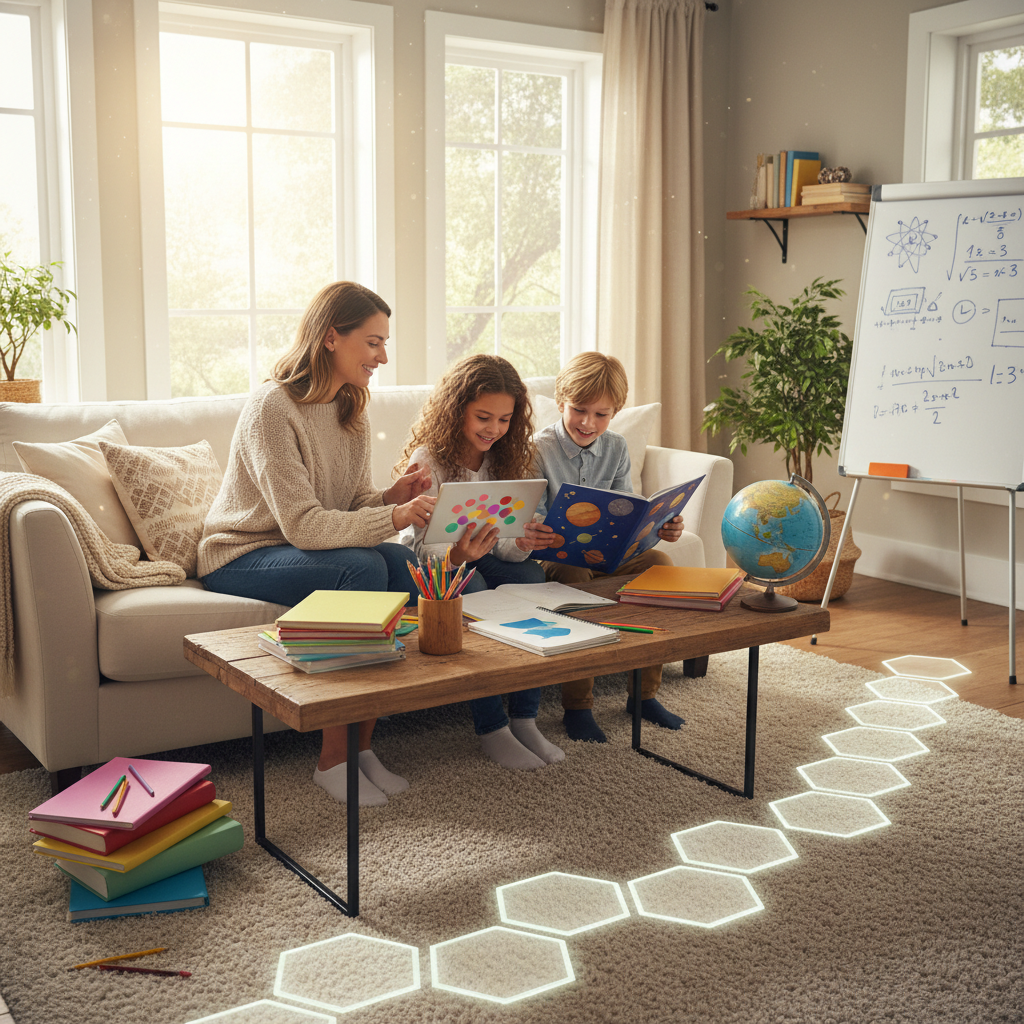
Does the search for the perfect online homeschool curriculum feel like navigating an endless sea of options? You scroll through countless websites, each promising the world, but you’re left with more questions than answers. You worry about choosing a program that’s too rigid, one that won't spark your child's curiosity, or one that simply doesn't align with your family's unique values and desire for freedom.
It’s time to trade that overwhelm for confidence. This guide was created for modern families like yours—families who believe learning should be an adventure, not a checklist. We'll help you cut through the noise to find a flexible and engaging learning solution that truly fits. You’ll discover how to identify your child’s learning style, ask the right questions, and choose a path that empowers you as an educator and fosters a lifelong love of learning in your child, wherever your journey takes you.
What Is an Online Homeschool Curriculum, Really?
When you hear "online homeschool curriculum," you might picture a child staring at a screen for six hours a day, mimicking a traditional classroom. But that's only a tiny piece of the story. The reality is a vibrant spectrum of tools and philosophies, each designed for a different kind of family. The landscape of Homeschooling in the United States has evolved dramatically, and your choice of an online homeschool curriculum now offers a world of possibilities. It’s less about finding a program and more about finding a philosophy that gives your family the freedom and confidence to learn your way. Today, most approaches fall into one of three main models.
The 'School-in-a-Box' Model: All-in-One Curricula
This is the most traditional approach, digitized. Think of comprehensive, pre-packaged programs (like Time4Learning) that cover every subject for a specific grade level. They provide a clear, linear path from start to finish.
- Pros: They offer complete structure with virtually no planning required from you. The path is clear, and progress is easy to track.
- Cons: This rigidity can feel restrictive, leaving little room for a child's unique interests or a flexible travel schedule. They can also be a significant financial investment.
The 'À La Carte' Approach: Building Your Own
Here, you are the architect. You mix and match individual resources—like videos from Khan Academy, live classes from Outschool, and workbooks—to build a completely custom education for your child.
- Pros: This approach offers maximum personalization and can be very budget-friendly. It allows you to follow your child’s curiosity wherever it leads.
- Cons: The planning burden is immense. It requires constant research and organization from the parent, and it's easy to create unintentional learning gaps.
The 'LearnSpark Co-Pilot' Model: The Best of Both Worlds
A new wave of adaptive platforms, like LearnSpark, offers a revolutionary middle ground. Instead of a static curriculum, these tools use LearnSpark to generate personalized lessons that align with your child’s interests and your family’s adventures.
- Pros: You get the structure and confidence of a plan without the rigidity. It saves hours of planning and effortlessly adapts to your lifestyle.
- Cons: It requires more parent engagement than a 'school-in-a-box,' as it’s designed to empower you as the guide, not replace you.
How to Choose: 5 Key Factors for Your Family
The sheer number of options can feel overwhelming. But finding the right online homeschool curriculum isn’t about picking the “best” one—it’s about discovering the best fit for your family’s unique rhythm and goals. Before you compare features, take a moment to reflect on these five key factors. This clarity will empower you to choose with confidence and joy.
1. Your Homeschooling Philosophy: Structured vs. Interest-Led
Does your child thrive with a predictable daily schedule and clear assignments? A structured, or "school-at-home," approach might be perfect. Or do they light up when exploring their own passions? An interest-led model fosters curiosity and organic learning. While your philosophy guides the daily rhythm, ensure your plan aligns with your local state homeschooling requirements to cover all necessary subjects and reporting.
2. Flexibility & Lifestyle: Is Your Classroom on the Road?
Your lifestyle is your classroom's blueprint. If you’re a worldschooling family, you need a program that’s as mobile as you are—accessible from anywhere, anytime. Consider if you need a curriculum that can pause for a spontaneous museum visit or adapt to different time zones. True freedom comes when your education fits your life, not the other way around.
3. Content & Worldview: Secular vs. Faith-Based
This is a foundational choice for many families. Some curricula are built around a specific faith perspective, weaving it into every subject. Others are secular, presenting information from a neutral viewpoint. Always review sample lessons to feel the tone and perspective. The goal is to find content that resonates with your core family values and worldview.
4. Parental Involvement: How Hands-On Do You Want to Be?
Be realistic about the time and energy you can dedicate each day. Some programs are "open-and-go," with video lessons and auto-graded assignments requiring minimal prep. Others position you as a co-creator, involving you deeply in lesson planning. Modern LearnSpark tools can offer a beautiful middle ground, reducing your prep time while keeping you at the heart of your child’s learning journey.
5. Your Child's Learning Style & Needs
Finally, consider how your child learns best. Are they a visual learner who needs videos and graphics? A kinesthetic learner who needs hands-on projects? Or an auditory learner who retains information from listening? The most effective online homeschool curriculum will be one that speaks their language, making learning feel natural, engaging, and joyful.
Comparing the Top Types of Online Homeschool Programs
Instead of an endless list of brands, let's look at the types of programs available. Understanding the core model behind an online homeschool curriculum is the key to finding a solution that brings confidence and joy to your family's learning journey, not more overwhelm.
Best for Structure & Simplicity: All-in-One Platforms
These comprehensive platforms bundle lessons, quizzes, and record-keeping into a single, open-and-go package. They provide a clear path forward, making them a reassuring choice for parents new to homeschooling or those needing to meet specific state requirements with ease.
- Examples: Time4Learning, Power Homeschool
- Ideal For: Families seeking a traditional school-at-home structure and straightforward compliance.
- What to Watch For: The pre-set path can feel rigid, potentially limiting interest-led deep dives and leading to screen-time burnout.
Best for Ultimate Customization: Free & Individual Resources
For the parent who loves planning, piecing together a curriculum from various free and low-cost resources offers ultimate control. This approach allows you to tailor every subject to your child's unique interests and pace, making it a highly flexible and budget-friendly option.
- Examples: Khan Academy, Easy Peasy All-in-One Homeschool
- Ideal For: Self-motivated parents, eclectic homeschoolers, and families on a tight budget.
- What to Watch For: This freedom comes with a significant planning burden and the risk of creating unintentional educational gaps.
Best for Freedom & Adaptability: LearnSpark Platforms
A modern approach that blends structure with true flexibility. Instead of a fixed curriculum, these platforms act as an intelligent co-pilot. They empower parents to create personalized lessons on the fly, perfectly aligned with their child's curiosity and learning level. For families who travel or embrace interest-led learning, this adaptability is a game-changer.
- Example: LearnSpark
- Ideal For: Worldschoolers, unschoolers, and any family who wants to turn the world into their classroom.
- How it Works: An LearnSpark assistant like SparkAI can generate a math lesson about currency exchange in Paris or a history lesson about the ruins you just explored, making learning relevant and effortless. See how an LearnSpark co-pilot can simplify your worldschooling journey.
The Future is Flexible: Why LearnSpark is a Game-Changer for Homeschooling
The conversation around homeschooling is changing. It's moving beyond the question of "Which curriculum should I buy?" to "How can we build a learning lifestyle?" The right technology doesn't replace you as the teacher; it empowers you to be a more confident and connected guide. Modern LearnSpark-driven platforms are transforming the very idea of an online homeschool curriculum from a rigid set of books into a dynamic, intelligent partner for your family's journey.
Trade Lesson Planning for More 'Aha!' Moments
Feeling buried under hours of lesson planning? Imagine reclaiming that time for what truly matters. LearnSpark assistants, like LearnSpark’s SparkAI, generate tailored lesson plans in minutes, not hours. Need a history lesson that engages both a 7-year-old and a 12-year-old? It can create a multi-level plan effortlessly, freeing you to focus on those incredible 'aha!' moments of discovery together.
Turn the World Into Your Classroom, Effortlessly
True learning happens when it connects to real life. Instead of just reading about a place, what if your family's adventures became the curriculum? With an LearnSpark tool, you can instantly create lessons on the go. For example, a trip to Paris could inspire lessons on:
- Art History: A personalized guide to the masterpieces at the Louvre.
- Engineering: A lesson on the structural genius of the Eiffel Tower.
- Culture: Simple French phrases and etiquette for navigating the city.
This is learning that flows naturally from curiosity, not a rigid checklist.
Track Progress with Confidence, Not Stressful Tests
The number one fear for many homeschooling parents is, "Are my kids falling behind?" The old model of high-stakes testing is being replaced by something far more insightful. Modern platforms track the mastery of concepts over time, giving you a clear, visual understanding of your child's progress without the pressure. This allows you to see exactly where they're thriving and where they might need support, offering true peace of mind.
This new generation of online homeschool curriculum tools puts you back in the driver's seat, armed with powerful resources that adapt to your family. It's about having structure without rigidity and freedom with the confidence that you're providing a world-class education. Platforms like LearnSpark are pioneering this shift, helping families trade overwhelm for the joy of shared discovery.
For many families, this flexible learning lifestyle is made possible by running an online business. If you're exploring ways to grow your venture to better support your family's educational adventures, you can discover 2X Sales for digital marketing solutions.
Your Journey to a Joyful Education Starts Here
Choosing the right online homeschool curriculum is less about finding a rigid set of rules and more about discovering a partner for your family’s unique adventure. The most important takeaway is to prioritize flexibility and find a system that adapts to your child—not the other way around. The future of homeschooling is here, and it’s powered by intelligent tools that make personalized learning simpler and more joyful than ever before.
If you’re ready to trade curriculum overwhelm for educational freedom, LearnSpark is designed for you. It's the perfect tool for worldschooling and travel, with LearnSpark lessons tailored to your child's interests. You can finally provide a structured education and track progress with joy and confidence, turning the entire world into your classroom.
Start Your Worldschooling Journey. Create Your Free Account Today. Your family's next great adventure in learning awaits.
Frequently Asked Questions About Online Homeschooling
What's the difference between online school and an online homeschool curriculum?
Online school mimics a traditional classroom with set schedules, live instruction, and external teachers. It's essentially school at home. An online homeschool curriculum, however, is a flexible tool that empowers you as the parent-educator. It provides the structure and resources, but you set the pace, adapt lessons to your travels, and guide your child’s learning journey. This puts the freedom and joy of discovery back into your family’s hands.
How much does an online homeschool curriculum cost on average?
Costs vary widely, giving you options for any budget. You can find free resources or individual courses for under $50. Comprehensive, all-in-one platforms typically range from $30 to $150 per month per child. These often provide the most value by bundling lesson plans, progress tracking, and adaptive learning into one simple package. This investment gives you the confidence to focus on the adventure, not the admin.
Do I need to be a certified teacher to homeschool my child effectively?
Absolutely not! Your greatest qualification is that you know your child best—their passions, their struggles, and their unique spark. A great curriculum is designed to empower you, providing the lesson plans, structure, and expert-backed content you need to feel confident. Your role is to be a curious, engaged guide, facilitating discovery and connection on your journey together. You’ve got this.
How do online programs handle different learning styles?
The best programs are built for flexibility. They cater to different learning styles by offering a mix of video lessons for visual learners, interactive games for kinesthetic learners, and text-based resources for readers. Modern platforms often use adaptive technology that adjusts the difficulty and presentation of material based on your child's progress. This ensures the content is always engaging and tailored to their unique way of learning, turning curiosity into confidence.
Can I use an online curriculum for a child with special learning needs?
Yes, many families find an online homeschool curriculum is a wonderful fit for children with special learning needs. The key is choosing a platform that offers true flexibility and personalization. Look for features like self-paced learning, multi-sensory lessons, and the ability to customize assignments. This allows you to create a calm, supportive environment where your child can learn at their own speed, free from the pressures of a traditional classroom.
How do I make sure my child gets enough social interaction while homeschooling?
Homeschooling opens up a world of social opportunities beyond the classroom! You can connect with local homeschool co-ops, sports teams, and community classes. For worldschooling families, social interaction happens naturally through travel—meeting new people, engaging with different cultures, and learning alongside fellow explorers. This approach fosters a deeper, more authentic kind of social connection based on shared interests and real-world experiences.