
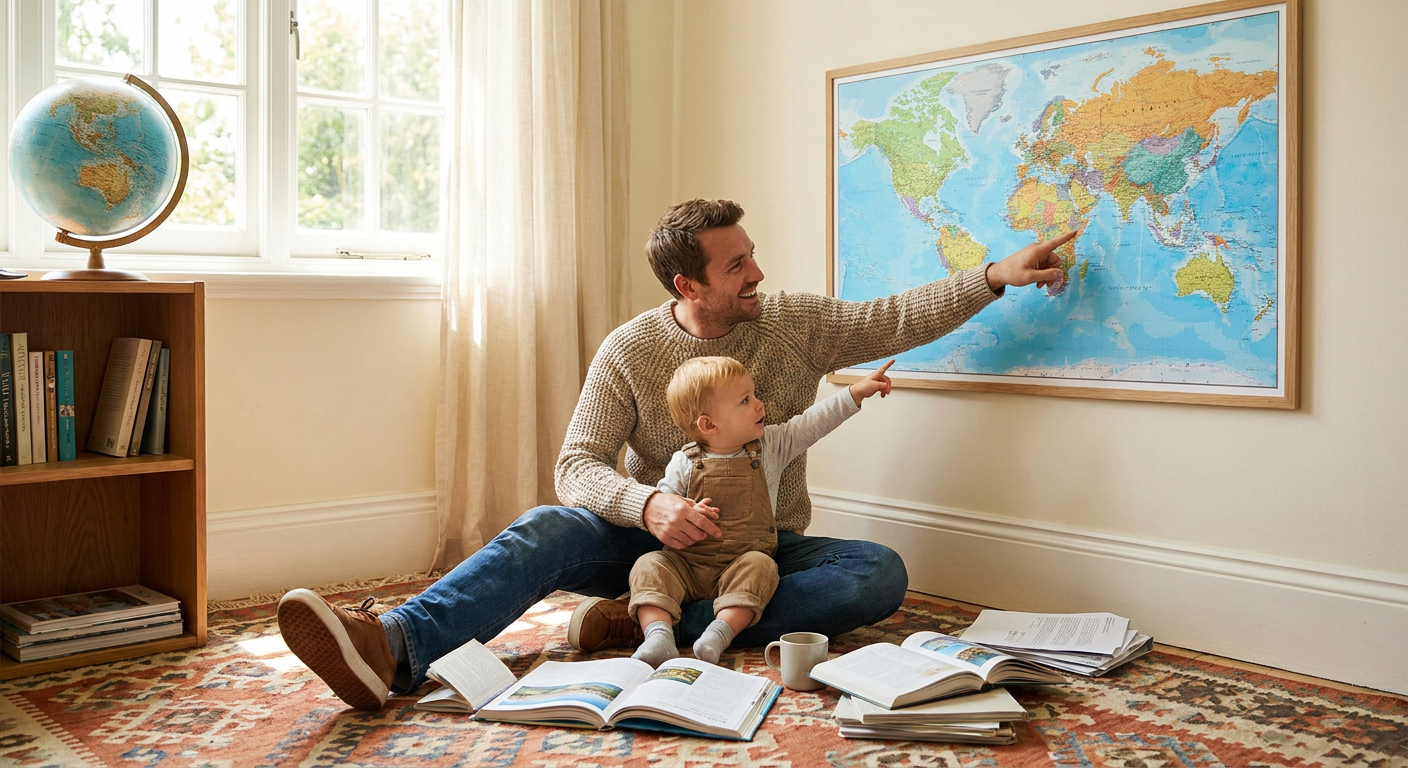
Thinking about swapping alphabet blocks for ancient ruins and playgrounds for Portuguese beaches? You're not alone. The dream of exploring the world with your little one is captivating, but the idea of doing it with a toddler can feel daunting. This comprehensive worldschooling with toddlers guide is here to show you that not only is it possible, but it can be one of the most joyful and enriching experiences for your family’s growth and your child’s early development.
Quick Answer
Worldschooling with toddlers is a style of education that uses travel and cultural immersion as the primary classroom. It focuses on gentle, play-based learning that follows a child's natural curiosity rather than a formal curriculum. The key to a successful journey is creating a flexible routine, prioritizing social interactions through local playgroups and communities, packing light with multi-purpose gear, and choosing safe, child-friendly destinations for slow travel.
TL;DR
- It's All About Play: Worldschooling for toddlers isn't about formal lessons. It thrives on sensory-rich, play-based learning where a trip to a market or a walk on the beach becomes a powerful educational experience. Discover a play-based worldschooling curriculum.
- Routine is Your Anchor: While your location may change, a consistent daily rhythm for naps, meals, and quiet time provides the stability toddlers need to thrive amidst new experiences. See how to build a routine on the road.
- Socialization is Intentional: Worried about your toddler making friends? It’s easier than you think. You can foster strong social skills by actively seeking out playgrounds, local classes, and worldschooling communities. Learn how to find your toddler's travel tribe.
- Pack Smart, Not Heavy: The right gear makes all the difference. Focus on lightweight, multi-functional items that support both comfort and learning, leaving behind anything that isn't essential. Get the minimalist packing list for toddlers.
- Legalities Matter: Before you go, understanding visa rules and education laws in your home country and destinations is crucial to ensure a smooth and compliant journey. Navigate the legal landscape of worldschooling.
In This Article
- What Exactly is Worldschooling with Toddlers?
- Why Worldschool with Your Youngest? Benefits for Toddler Development
- Is Worldschooling Good for Toddlers' Development? Addressing Common Concerns
- Crafting Your Worldschooling Curriculum for Toddlers: Play, Place, and Passion
- Daily Life on the Road: How to Worldschool with a 3-Year-Old (and other preschoolers)
- Beyond the Family: Socialization for Worldschooling Toddlers
- Essential Gear for Worldschooling Toddlers: Packing Smart & Light
- Where to Go? Best Worldschooling Hubs for Families with Young Children in 2026
- Budget-Friendly Adventures: Cheapest Countries for Worldschooling with Kids in 2026
- Navigating the Legal Landscape: Worldschooling Requirements by Country in 2026
- Worldschooling vs. Homeschooling for Kindergarten: Which Path is Right for You?
- Expert Insights: Our Experience Worldschooling with Little Ones
- Frequently Asked Questions
What Exactly is Worldschooling with Toddlers?
Worldschooling with toddlers is about immersing young children in diverse environments to foster natural learning through play, cultural experiences, and observation, rather than through formal academics. It rejects the idea that education must happen at a desk and instead embraces the world as the ultimate classroom. For this age group, it’s not about ticking off curriculum boxes; it’s about holistic development fueled by real-world interaction.
Worldschooling is an educational philosophy that uses travel as a means to educate children. This can range from short-term educational trips to a full-time lifestyle of learning on the road.
When applied to a preschooler (typically ages 2-5), this philosophy centers on hands-on, sensory exploration. For example, a trip to a local market in Thailand isn't just a shopping trip. It's an impromptu lesson where your toddler can:
- Learn colors: Pointing out the vibrant red of rambutan and the deep purple of mangosteen.
- Practice numbers: Counting out coins to pay a friendly vendor.
- Develop language skills: Hearing and attempting to mimic greetings like "sawasdee."
- Engage the senses: Smelling fragrant spices, touching bumpy durian, and tasting sweet pineapple.
This approach recognizes that toddlers learn best by doing, seeing, and touching. It leverages their innate curiosity, turning every new city, nature trail, and train ride into an opportunity for discovery. This is a far cry from the structured environment of a traditional preschool, but it's a powerful way to build a foundation of curiosity and a love for learning that can last a lifetime.
Key takeaway: For toddlers, worldschooling isn't "school" at all. It's a lifestyle of guided discovery that uses the richness of travel to support natural, play-based development.
Why Worldschool with Your Youngest? Benefits for Toddler Development
Worldschooling aims to offer benefits for toddlers by fostering adaptability, expanding their understanding of the world, promoting language skills through exposure, and enhancing social-emotional development through diverse interactions. The toddler years, from ages one to three, are a period of notable brain development. Exposing them to varied environments may offer many opportunities for learning.
Here are some of the core developmental benefits of worldschooling with toddlers:
- Enhanced Adaptability and Resilience: Constantly navigating new environments, from bustling airports to quiet beaches, teaches toddlers to be flexible. They learn to sleep in different beds, handle changes in routine, and become comfortable with the unfamiliar. This can help build psychological strength and adaptability.
- Enhanced Language Exposure: Even if you don't become fluent, exposing a toddler to multiple languages is incredibly beneficial. Hearing different sounds, intonations, and cadences helps attune their brains to language itself. Early exposure to diverse linguistic environments offers rich learning opportunities for language acquisition.
- Rich Sensory Development: A traditional home environment offers a predictable set of sights, sounds, and smells. Worldschooling provides an ever-changing sensory buffet. Think of the smell of a Moroccan spice market, the sound of waves on a Costa Rican shore, or the texture of ancient stones in Rome. These experiences offer varied sensory input.
- Development of Global Citizenship: A toddler who has played with children who look and speak differently from them, or who has seen firsthand that people live in many different ways, may develop a broader worldview. They learn from experience that "different" isn't scary.
In our experience, a child's problem-solving skills may develop. Individual results may vary. After navigating different subway systems, our child showed increased interest in train lines on maps, recognizing patterns and symbols as her environment encouraged playful, engaging exploration. Individual results may vary.
Is Worldschooling Good for Toddlers' Development? Addressing Common Concerns
Worldschooling can offer rich sensory experiences and deep cultural exposure. However, success may depend on parents proactively maintaining consistent routines, facilitating social interactions, and providing a secure emotional base amidst the changes of travel. Many parents worry that a nomadic lifestyle might be disruptive, but these concerns can be managed with intention.
Let's break down the three biggest worries parents have:
- Lack of Stability and Routine: Toddlers thrive on predictability. The key is to understand that routine is not the same as location. You can create stability by anchoring your day with consistent rituals.
- Consistent Wake-Up/Bedtimes: Stick to the same sleep schedule as much as possible, including a familiar bedtime story or song.
- Predictable Mealtimes: Even if the food is different, eating at roughly the same time each day provides structure.
- "Quiet Time" Rituals: Dedicate a part of each afternoon to quiet activities, like reading or drawing, no matter where you are.
- Socialization Concerns: Will my child learn to play and share without a regular group of peers? Absolutely. Worldschooling can provide diverse social opportunities.
- Local Playgrounds: This is the universal hub for connecting with local kids and parents.
- Library Story Times & Classes: Many towns offer free activities for young children.
- Worldschooling Hubs: Intentionally travel to destinations with established communities of traveling families.
- Family Interaction: Don't underestimate the social skills learned through constant interaction with parents, siblings, and extended family you may meet. It's a different, but equally valid, form of socialization, especially when you're managing worldschooling with multiple children.
- Overstimulation and Burnout: A toddler's world can quickly become overwhelming. The solution is slow travel. Instead of rushing from one landmark to the next, stay in one place for several weeks or months. This allows your family to settle in, establish a rhythm, and explore at a toddler's pace—which often means spending an entire afternoon fascinated by a single line of ants.
By focusing on these areas, you provide a secure and loving foundation that allows your toddler to reap the incredible developmental rewards of travel without the potential downsides.
Crafting Your Worldschooling Curriculum for Toddlers: Play, Place, and Passion
A worldschooling curriculum for toddlers isn't a set of textbooks or worksheets; it's a flexible framework built on three pillars: play, place, and passion. It leverages your immediate environment for play-based and place-based learning, where your child's natural curiosity guides exploration and the world itself becomes the classroom.
Forget complicated lesson plans. At this age, learning is about connection and discovery. Here’s how you can think about your "curriculum":
- Play-Based Learning: This is the natural language of toddlers. Your role is to facilitate play that connects to your surroundings. Bring a small bag of blocks to the beach and build sandcastles modeled after a cathedral you saw. Use finger puppets to tell a story about the monkeys you saw in the jungle.
- Place-Based Learning: This means using your specific location as a learning prompt. Are you in Italy? Make pasta together (a great sensory activity!). Count the steps of a famous monument. Learn the names of fruits at the local market. This approach makes learning tangible and relevant, which is far more effective than trying to teach with flashcards. It's one of the best ways of making learning fun on the road.
- Passion-Led Exploration (Child-Led Learning): Pay close attention to what fascinates your toddler. Are they obsessed with trains? Spend a day riding the local subway, visit a train museum, and read books about trains. If they love animals, visit a local farm or nature reserve. When you follow their interests, their engagement and retention skyrocket.
A great "curriculum" can be as simple as a daily walk with no goal other than to see what you can find. It’s about asking open-ended questions like, "What do you see?" or "What does that feel like?" and letting your toddler lead the way.
Daily Life on the Road: How to Worldschool with a 3-Year-Old (and other preschoolers)
Effectively worldschooling with a 3-year-old involves establishing flexible yet consistent routines, integrating play-based learning into daily activities, and prioritizing safety and comfort in new environments. A successful day isn't measured by how many sights you see, but by the quality of your interactions and the joy in your discovery.
A typical day might look less like a tourist's itinerary and more like a relaxed day at home, just in a new, exciting location. The goal is a rhythm, not a rigid schedule.
A Sample Daily Rhythm:
- Morning (Explore): After breakfast, head out for your main activity. This could be a visit to a local market, a playground, or a gentle hike. Keep it short and focused—one or two hours is plenty for a toddler.
- Midday (Rest & Recharge): Head back for lunch and a mandatory nap or quiet time. This downtime is non-negotiable for preventing meltdowns and giving everyone a chance to reset. This is a great time for portable, quiet activities like a Melissa & Doug Water Wow! book or sticker books.
- Afternoon (Play & Connect): Keep the afternoon low-key. This could be free play at your rental, a trip to a nearby pool, or a FaceTime call with grandparents. It's a time for connection, not more stimulation.
- Evening (Wind Down): Have an early dinner and begin a familiar bedtime routine. A warm bath, a favorite book (even if it's the same one for 30 nights in a row), and a specific song can signal sleep time, no matter what country you're in.
Quick Checklist for a Smooth Day:
- Pack Snacks & Water: Always have more than you think you'll need. A hungry toddler is an unhappy traveler.
- Prioritize Outdoor Time: Aim for at least one period of active, outdoor play every day.
- Embrace the "One Thing" Rule: Plan only one major outing per day. Anything else is a bonus.
- Involve Them in Tasks: Let your toddler "help" pack the day bag or choose a snack. It gives them a sense of control.
- Carry a "Boredom Bag": A small bag with a few lightweight toys, crayons, and paper can be a lifesaver during long waits at restaurants or train stations.
Key takeaway: A key to daily life on the road with a toddler is to travel slowly, prioritize rest, and find joy in the simple, unscheduled moments of discovery. This is a foundational part of how you create a digital nomad family education plan that actually works.
Beyond the Family: Socialization for Worldschooling Toddlers
Socialization for worldschooling toddlers is successfully achieved through an intentional effort to connect with other families, participate in local activities, and utilize online communities to arrange meet-ups. The common fear that a worldschooling child will be lonely or socially awkward can be addressed; children can develop social confidence from interacting with a wide variety of people.
Unlike a traditional preschool where a child interacts with the same 20 peers daily, a worldschooling toddler’s social circle is constantly changing. This teaches them to be adaptable, to introduce themselves to new people, and to find common ground (usually a shared love for slides or sand) across language and cultural barriers.
Here’s how to proactively build a rich social life for your toddler on the road:
- Become a Playground Regular: Find the best local playground and go there at the same time each day (usually late afternoon). You'll quickly start seeing familiar faces and striking up conversations with local parents.
- Seek Out Local Classes: Look for toddler-friendly activities like music classes, gymnastics, or "mommy and me" yoga. These are fantastic for meeting both local and expat families.
- Join Online Communities: Facebook is a powerful tool for this. Search for groups like "Worldschooling Families," "Digital Nomads with Kids," or "[City Name] Expat Parents." These groups are filled with families eager to connect for playdates. Building a network through online worldschooling communities is a modern superpower.
- Stay at Family-Friendly Accommodations: Choose Airbnbs or hotels with shared pools or play areas. We’ve found that some of our kids' best friends were made during impromptu afternoon swims.
- Embrace Intergenerational Friendships: Socialization isn't just about same-age peers. Worldschooling toddlers form incredible bonds with friendly shopkeepers, elderly neighbors, and teenage tour guides. These interactions can be valuable for their social development.
Essential Gear for Worldschooling Toddlers: Packing Smart & Light
Essential worldschooling gear for toddlers prioritizes multi-functional, lightweight items that support play-based learning and comfort. Traveling minimally is key, with an emphasis on a few cherished toys for familiarity and safety. The goal is to have what you need without excessive clutter.
Think in categories: Sleep, Play, Eat, and Explore. Through our travels, we've found that prioritizing essential items is effective.
| Gear Category | Essential Items (Pack This) | Non-Essential (Leave at Home) |
|---|---|---|
| Sleep | Lightweight travel crib (e.g., Guava Lotus), portable blackout blinds, familiar lovey/blanket. | Heavy Pack 'n Play, multiple large blankets, bulky sound machine (use a phone app instead). |
| Play | A few small nesting/stacking toys, Water Wow!/sticker books, a tablet with educational apps (e.g., Khan Kids), a small ball. | Large sets of blocks, piles of stuffed animals, any toy with dozens of small pieces. |
| Eat | Reusable snack pouch (e.g., Squeasy Gear), portable travel high chair/booster (e.g., Hiccapop), foldable silicone bib. | Full set of kid's cutlery and plates, bulky booster seats, single-use snack bags. |
| Explore | Lightweight, compact stroller (e.g., GB Pockit), comfortable baby/toddler carrier (e.g., Ergobaby), a well-stocked first-aid kit. | Heavy-duty, full-size stroller, multiple carriers for different situations. |
⚠️ A Word on Toys: Resist the urge to pack a suitcase full of toys. Toddlers are masters at turning anything into a plaything—sticks, rocks, cardboard boxes. A small, curated selection of open-ended toys is more than enough. The world will provide the rest.
A high-quality toddler carrier is a very important piece of gear. It allows you to navigate crowded markets, hike trails, and board trains hands-free while keeping your little one secure and comfortable. Similarly, a tablet pre-loaded with shows and educational games is not a parenting failure; it's a strategic tool for surviving long-haul flights and long waits in peace.
Where to Go? Best Worldschooling Hubs for Families with Young Children in 2026
The best worldschooling hubs for families with young children in 2026 are destinations offering a perfect balance of safety, community, affordability, and child-friendly infrastructure. These are places where you can easily find parks, reliable healthcare, and other families on a similar journey, making for a soft landing into the worldschooling lifestyle.
Slow travel is the name of the game with toddlers, so choosing a great "hub" to stay for a few months is a popular strategy. Here are some of the top picks for 2026:
- Lisbon, Portugal: With its charming streets, beautiful parks (like Jardim da Estrela), and stunning coastline just a short train ride away, Lisbon is incredibly family-friendly. It has a large, welcoming community of expats and digital nomads, a low crime rate, and excellent healthcare. The city is walkable (though a carrier is a must for the hills!) and the food is delicious and kid-approved.
- Chiang Mai, Thailand: A long-time favorite for digital nomad families, Chiang Mai offers an unbeatable combination of low cost of living, mouth-watering food, and a warm, welcoming culture. The city is full of "kiddie cafes," indoor play gyms, and a huge community of worldschoolers, making it effortless to find playdates. The "Elephant Nature Park" provides an ethical and unforgettable animal encounter.
- Medellín, Colombia: Once known for its dangerous past, Medellín has transformed into an innovative and family-friendly city. Its year-round spring-like climate, excellent public transportation (including cable cars kids love), and abundance of lush parks (like Parque Arví) make it a joy to explore. The cost of living can be favorable, and the community is vibrant and growing.
- Valencia, Spain: Often overlooked for Barcelona or Madrid, Valencia is a gem for families. Its centerpiece is the Turia Gardens, a massive park built in a former riverbed that snakes through the city, offering endless playgrounds and bike paths. With its flat terrain, beautiful beaches, and the incredible City of Arts and Sciences, it's a toddler's paradise.
When choosing a hub, we recommend joining a Facebook group for that city's expats or digital nomads before you go. Ask questions about neighborhoods, pediatricians, and favorite parks. This insight can be invaluable for planning a family gap year or a shorter-term stay.
Budget-Friendly Adventures: Cheapest Countries for Worldschooling with Kids in 2026
Countries often considered budget-friendly for worldschooling with kids in 2026 can offer a compelling blend of lower cost of living, safety considerations, and infrastructure for families, alongside rich cultural experiences. A worldschooling lifestyle doesn't have to break the bank. Many families find that careful planning can lead to manageable monthly expenses, potentially differing from a conventional life in some parts of North America or Western Europe.
Smart destination choices are key. The following countries are popular choices for affordability, safety, and family-friendliness.
| Country (City) | Est. Monthly Budget (Family of 3) | Why It's Great for Toddlers |
|---|---|---|
| Vietnam (Da Nang) | $1,500 - $2,200 USD | Beautiful, calm beaches; friendly locals who adore children; extremely low cost of food and activities. |
| Mexico (Playa del Carmen) | $2,000 - $3,000 USD | Large expat/worldschooling community; walkable city with easy beach access; abundance of cenotes for swimming. |
| Malaysia (Penang) | $1,800 - $2,500 USD | English is widely spoken; amazing food culture; great mix of city, beach, and nature with Penang National Park. |
| Portugal (Lisbon/Porto) | $2,500 - $3,500 USD | High safety rating; excellent public parks and playgrounds; affordable and high-quality healthcare. |
Note: Budgets are estimates and can vary widely based on lifestyle, accommodation choices, and travel pace.
Navigating the Legal Landscape: Worldschooling Requirements by Country in 2026
Navigating the legal landscape of worldschooling involves understanding the homeschooling laws of your home country (or state/province) and the visa requirements of the countries you plan to visit. For toddlers, this is generally simpler as compulsory education has not yet begun, but it's crucial to establish good practices early.
1. Home Country Education Laws: Even if you're abroad, you may be subject to the education laws of your home country, state, or province, especially if you maintain residency.
- United States: Homeschooling laws vary dramatically by state. Some states (like Texas or Oklahoma) have very few requirements, while others (like New York or Pennsylvania) require detailed paperwork and reporting. For preschoolers, this is rarely an issue as compulsory education typically starts at age 6 or 7. However, it's wise to check your state's Department of Education website to confirm the age and requirements.
- Canada: Similar to the U.S., regulations vary by province. You'll need to check with your provincial ministry of education.
- United Kingdom: Education is compulsory from the age of 5. If you are taking your child out of school, you must officially de-register them. If they have never been to school, you are not required to follow a formal curriculum, but you must be able to demonstrate that you are providing a suitable education if asked.
- Australia: Laws are state-based. You generally need to register for homeschooling and may need to submit a learning plan.
2. Destination Country Visa Rules: This is the most critical piece for long-term travel. You cannot simply stay in a country indefinitely.
- Tourist Visas: Most families operate on tourist visas. This means you must adhere to the time limits (e.g., 90 days in the Schengen Area in Europe, 30-90 days in many Southeast Asian countries).
- "Visa Runs": This common practice involves leaving a country for a short period and re-entering to get a new tourist visa. Be aware that countries are cracking down on this.
- Long-Term Visas: Some countries offer long-term visas for digital nomads or individuals who can prove a certain income level. These are more complex to obtain but provide more stability.
For toddlers, the educational requirements are minimal to non-existent. The primary legal hurdle is immigration. Always check the official government immigration website for any country you plan to visit for an extended period.
Worldschooling vs. Homeschooling for Kindergarten: Which Path is Right for You?
The choice between worldschooling and traditional homeschooling for kindergarten depends on your family's priorities regarding stability, social structure, and educational philosophy. Worldschooling prioritizes experiential learning through travel, while homeschooling offers a more structured, home-based routine.
Here's a comparison to help you decide:
| Feature | Worldschooling (Kindergarten Age) | Traditional Homeschooling (Kindergarten Age) |
|---|---|---|
| Learning Environment | The world is the classroom: museums, nature, different cultures. Learning is opportunistic and place-based. | The home is the primary classroom, often with a dedicated learning space. More predictable. |
| Curriculum | Highly flexible and child-led. Focus on life skills, cultural immersion, and play. Less emphasis on formal academics. | Can be structured (boxed curriculum) or unstructured (unschooling). Parents have full control over academic focus. |
| Socialization | Diverse and ever-changing. Involves interacting with people of all ages and backgrounds in various settings. | Consistent peer groups through co-ops, local classes, and neighborhood friends. |
| Routine & Stability | Routine is flexible and anchored by daily rituals rather than a fixed location. Requires high adaptability. | Highly stable and predictable daily and weekly schedules. |
| Cost | Can be higher due to travel and accommodation, but also potentially lower depending on destination choices. | Generally lower and more predictable costs, centered on curriculum and local activities. |
Who is worldschooling best for? Families who value flexibility, adventure, and hands-on learning. It's ideal for parents who want to instill adaptability and a global perspective from a young age. This style of learning on the go is powerful for kindergarteners.
Who is traditional homeschooling best for? Families who prefer more structure, stability, and a consistent community. It can be a suitable choice for children who thrive on predictability or for parents who want to follow a more traditional academic path from the start.
Ultimately, it's not a permanent choice. Many families blend both, traveling for part of the year and homeschooling in a home base for the rest.
Expert Insights: Our Experience Worldschooling with Little Ones
After years of worldschooling with our own children, starting when they were toddlers, the biggest lesson we've learned is this: Your attitude shapes their reality. If you approach a delayed flight or a strange new food with stress and anxiety, your toddler will mirror that. If you treat it as a fun adventure or a silly surprise, they will too. They take their emotional cues directly from you.
The second lesson is to let go of expectations. You might have a grand vision of your toddler thoughtfully admiring the Mona Lisa. The reality is they'll be more interested in the pattern on the museum floor, and that's okay. The learning is happening, just not in the way you planned. The most profound educational moments are almost always the ones you didn't schedule.
Finally, document the journey. Not just for Instagram, but for them. Take videos of them trying to speak a new language, keep a simple journal of the funny things they say, and let them help you choose photos for a digital album. When they're older, this collection will be an incredible testament to the unique and wonderful foundation you gave them.
Frequently Asked Questions
How do you handle healthcare and emergencies while worldschooling with a toddler?
Handling healthcare involves a three-part strategy: comprehensive travel medical insurance, a well-stocked first-aid kit, and pre-trip research. Always purchase a robust insurance plan that covers emergencies, hospitalization, and medical evacuation. For your kit, include toddler-specific medications (pain/fever reducer), antiseptic wipes, bandages, and any personal prescriptions. Before arriving in a new hub, research the location of the nearest reputable hospital and pediatrician.
What are the legal requirements for worldschooling?
For toddlers (ages 2-5), legal requirements are minimal as this is before compulsory school age in most countries. The primary legal aspect is immigration; you must adhere to the tourist visa limitations of each country you visit. It's also wise to be aware of the homeschooling laws in your home country/state, as you may still be subject to them if you maintain residency, especially as your child approaches kindergarten age.
Is it better to start worldschooling when my child is a toddler or wait until they are older?
There are pros and cons to both. Starting with a toddler is often easier logistically as you don't have to worry about formal curriculum or de-registering from school. It's a wonderful time for language acquisition and building adaptability. Waiting until they are older (6+) means they may remember more specific details of your travels and can engage in more complex learning. The optimal time is ultimately a personal decision based on your family's goals and readiness for adventure.
Key Takeaways
Worldschooling with a toddler is less about formal education and more about creating a lifestyle of curiosity, connection, and play. By embracing slow travel, establishing flexible routines, and focusing on your child's natural interests, you can turn the entire world into the most engaging classroom imaginable.
The key is to let go of traditional expectations and find joy in the small, unplanned moments of discovery. With the right mindset and preparation, this journey may contribute to your child's development and create lasting family memories.
Ready to start planning your family's learning adventure? Explore LearnSpark's worldschooling features to see how you can seamlessly document your child's progress, capture precious memories, and build a beautiful portfolio of their global education.
See how LearnSpark can help → View pricing.