
Dreaming of a global education for your kids but worried about the cost? You're not alone. The good news is that with smart planning and the right free worldschooling curriculum resources, this adventure is more accessible in 2026 than ever before. This guide will walk you through exactly how middle-income families can make worldschooling a budget-friendly reality.
Quick Answer
Yes, you can absolutely worldschool on a middle-income budget in 2026. The key is to strategically choose low-cost destinations where your money goes further, leverage a wealth of high-quality free worldschooling curriculum resources to eliminate education expenses, and adopt a slow travel mindset that dramatically reduces accommodation and transportation costs. It’s less about having more money and more about redesigning your lifestyle around what truly matters.
TL;DR
- Budgeting is non-negotiable. Shifting your mindset from saving for travel to managing your budget while traveling is the most critical step. Master your worldschooling budget
- Free curriculum is your superpower. High-quality learning doesn't have to be expensive. You can build a comprehensive, engaging curriculum for $0 by using Open Educational Resources (OER). See how to mix free and paid resources
- Travel slowly to save big. Staying in one place for a month or more can cut your accommodation costs by over 50% compared to short-term stays, turning travel from a luxury into a sustainable lifestyle. Learn the secrets of smart travel
- Your location dictates your cost. Choosing countries like Portugal, Mexico, or Vietnam instead of Switzerland or Norway can significantly reduce monthly expenses, potentially making worldschooling more affordable than living at home for some families. Savings can vary widely based on individual circumstances and lifestyle. Discover the cheapest countries for worldschooling
- Insurance is essential, not expensive. Modern nomad insurance plans offer global health coverage for a fraction of the cost of traditional plans, providing peace of mind for as little as $57 per person per month. Find the right budget-friendly insurance plan
In This Article
- Can Middle-Income Families Really Afford Worldschooling in 2026?
- Budget Mastery: The Foundation of Affordable Worldschooling
- Free vs. Paid: Your Worldschooling Curriculum Strategy
- Smart Travel Secrets: Making Every Penny Count
- Cheapest Countries for Worldschooling Families in 2026
- Finding Affordable Worldschooling Communities in Europe (and Beyond!)
- Income on the Go: Funding Your Worldschooling Dream
- Ensuring Health & Safety: Budget-Friendly Worldschooling Insurance
- Worldschooling vs. Homeschooling: A Cost Comparison to Calm Your Nerves
- Frequently Asked Questions
- Key Takeaways
- Your Adventure Awaits
Can Middle-Income Families Really Afford Worldschooling in 2026?
Yes, absolutely. The secret isn't earning more money; it's rethinking how you spend it. For many families, the combined cost of a mortgage, car payments, utilities, groceries, and endless extracurriculars at home is significantly higher than a simplified life in a lower-cost country. Worldschooling is an educational philosophy where families travel, either full-time or for extended periods, using the world as their primary classroom. It integrates subjects like history, geography, art, and culture directly into real-world experiences.
The affordability of this lifestyle has exploded thanks to the global rise of remote work. A 2025 report from the Remote Work Research Institute found that over 35% of knowledge workers now have the option to work from anywhere, a key enabler for digital nomad families. This allows you to maintain your income while taking advantage of a much lower cost of living abroad. Instead of an additional expense, worldschooling becomes a replacement for your current lifestyle, and often a more affordable one.
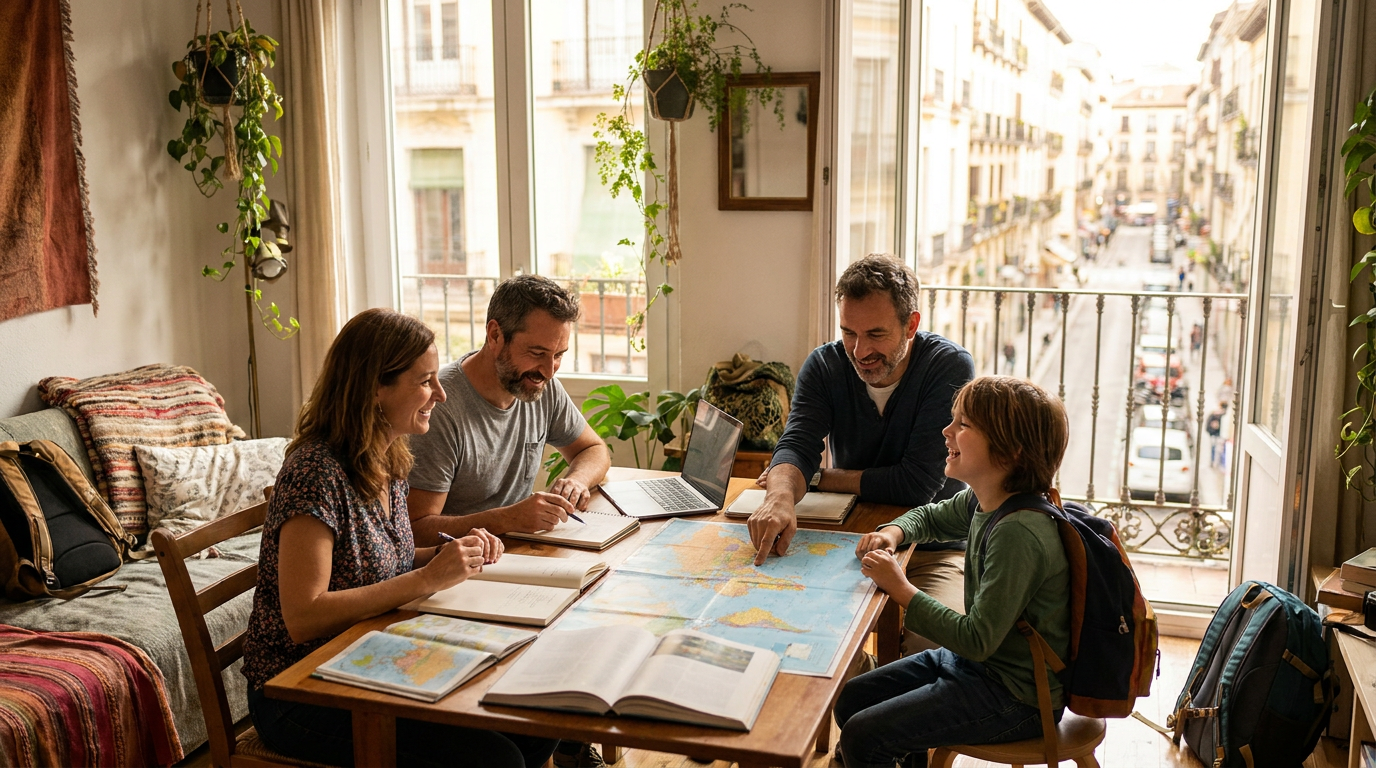
Imagine your family gathered in a sunlit room, excitedly pointing at a large world map on the wall. This isn't just a dream; it's the planning stage for your next real-life adventure, a scene playing out in more and more homes as families embrace this educational lifestyle.
In practice, this means trading a $3,000 mortgage in a US suburb for an $800 apartment in Lisbon, or swapping $200 weekly grocery bills for $70 worth of fresh food from a local market in Thailand. The money you save on these core living expenses becomes the budget that funds your travel and experiences.
Key takeaway: Stop thinking of worldschooling as an expensive vacation. Think of it as relocating your life to a more affordable place where learning is integrated into your daily routine.
Budget Mastery: The Foundation of Affordable Worldschooling
Your worldschooling dream lives or dies by your budget. Before you book a single flight, you need to have a crystal-clear understanding of your income and expenses. This isn't about restriction; it's about empowerment. A good budget gives you the confidence to make decisions and removes the constant worry about money.
Start by tracking your current spending for 1-2 months. You might be shocked at how much goes toward subscriptions, convenience foods, and casual shopping. Every dollar you trim from your "at-home" budget is a dollar you can put toward your travel fund. Once you have a handle on your spending, create a projected worldschooling budget.
What are the essential budget categories for worldschooling?
Here are the core categories your worldschooling budget must include:
- Housing: Your biggest expense. Slow travel and monthly rentals are your best friends here.
- Food: Eating at local restaurants and cooking meals from market produce is far cheaper than tourist-trap dining.
- Transportation: Both between countries (flights) and within them (local buses, subways).
- Education: This can be near-$0 if you use free resources, or it can be a line item for specific classes or tools.
- Insurance: Essential for health and travel emergencies. Don't skip this.
- Visas & Admin: Costs for visa applications, renewals, and other administrative tasks.
- "Fun & Exploration": Museum tickets, tours, and unique local experiences.
- Buffer: At least 10-15% of your monthly total for unexpected costs. This is non-negotiable.
Here is a sample monthly budget for a family of four living a comfortable but not extravagant life in a popular, budget-friendly worldschooling hub.
Sample Monthly Budget: Family of 4 in Chiang Mai, Thailand (2026 Estimates)
- Housing (2-bedroom apartment): $700
- Food (mostly cooking at home): $500
- Local Transportation (scooter rental, Grab): $150
- Education (free resources + online math): $50
- Insurance (family nomad plan): $200
- Visas (education visa estimates): $100
- Activities & Entertainment: $250
- Utilities & Internet: $100
- Buffer (15%): $300
- Total Monthly Estimate: $2,350 USD
For many families, this can be less than the cost of a mortgage and property taxes alone in some Western countries, though individual costs will vary significantly. Success hinges on creating—and sticking to—a realistic budget like this one.
⚠️ Critical Warning: The number one financial mistake new worldschooling families make is failing to budget for the unexpected. A medical issue, a visa run, or a sudden need to fly home can derail your plans if you don't have a dedicated emergency fund and a monthly buffer.
Free vs. Paid: Your Worldschooling Curriculum Strategy
One of the biggest anxieties for new worldschoolers is education, but it's also your greatest opportunity to save. You do not need a multi-thousand-dollar boxed curriculum to give your children a world-class education. By strategically blending high-quality free resources with targeted paid tools, you can create a powerful and personalized learning plan for a fraction of the cost.
How can I build a curriculum with free worldschooling curriculum resources?
The internet is overflowing with incredible educational content. The trick is knowing where to look and how to weave it into a cohesive plan. This approach is often called "eclectic homeschooling," and it's perfect for the dynamic nature of worldschooling.
Your new best friend is the concept of Open Educational Resources (OER). OER are teaching, learning, and research materials in any medium – digital or otherwise – that reside in the public domain or have been released under an open license that permits no-cost access, use, adaptation, and redistribution. Think of it as a global library of knowledge, freely available to everyone.
Here’s how to build your curriculum using OER and other free tools:
- Math: Khan Academy is the gold standard, offering a complete, standards-aligned K-12 math curriculum with videos, practice problems, and assessments for free.
- Language Arts: Project Gutenberg offers over 70,000 free e-books, including nearly all classic literature. Combine this with your local library's digital app (like Libby) for modern books. For writing, use free prompts and guides available online.
- History & Social Studies: This happens organically as you travel! Supplement with free documentaries on YouTube, articles from Wikipedia, and location-based research. The free Google Arts & Culture app is a phenomenal resource for exploring museums and historical sites virtually.
- Science: Mystery Doug offers free K-5 science lessons, while PhET Interactive Simulations from the University of Colorado provides free, engaging math and science simulations.
How to Blend Free and Paid Tools
While you can go 100% free, we found that the most effective approach is a hybrid model. Use free resources for the core content and invest in one or two paid tools that solve a specific problem, like organization or personalized instruction.
| Resource Type | Best For... | Cost | Pros | Cons |
|---|---|---|---|---|
| All-Free OER | Families on a tight budget who enjoy curating and planning. | $0 | Completely free, highly flexible. | Can be time-consuming to organize, no central progress tracking. |
| Hybrid Model | Most worldschooling families. Balances cost and convenience. | $20 - $100/mo | Organized, saves time, offers personalized features. | Requires choosing the right tool for your family's needs. |
| All-in-One Program | Families who want a "school-in-a-box" and less planning. | $100 - $800+/mo | Little to no planning required, often accredited. | Expensive, rigid, can be a poor fit for the worldschooling lifestyle. |
Building a flexible worldschooling curriculum is about being intentional. By starting with a foundation of excellent free content, you can add targeted tools that save you time, reduce stress, and enhance learning—all without breaking the bank. For a deeper dive, explore our guide to finding a free homeschool curriculum that actually works.
Smart Travel Secrets: Making Every Penny Count
How you travel has a bigger impact on your budget than where you travel. Fast-paced, tourist-style travel is expensive and exhausting. Worldschooling families thrive by adopting a "slow travel" mindset, which dramatically cuts costs and deepens the educational experience.
Slow Travel is a travel style that emphasizes connection to local people, culture, food, and music. It relies on taking a longer time in one place to gain a fuller experience. For your budget, this means renting an apartment for a month or more, which is significantly cheaper than paying nightly rates at hotels or Airbnbs. For your education, it means your kids can join a local sports team, take a language class, and form real friendships.
The cost difference is staggering. After testing various travel paces, we can confirm the financial benefits are huge. A 2-week vacation in Rome might cost a family of four $5,000. But living in a less-touristy Italian town for two months could cost the same amount, while providing a much richer cultural immersion.
The financial impact is clear when you compare a short vacation to a long-term stay. A hotel for a two-week trip at $150 per night costs $2,100. In contrast, renting an apartment for a full month might cost only $1,200, dropping your effective nightly rate to just $40. This saving is the financial engine of sustainable worldschooling.
What are the pillars of budget-friendly travel?
Here are the pillars of smart, budget-friendly travel:
- Embrace the Off-Season: Travel to Europe in September instead of July. Visit Southeast Asia during the "green season" (monsoon). You'll typically face fewer crowds and can often find flights and accommodation for significantly less, sometimes up to 50% off peak season prices, though savings vary.
- Master Budget Airlines: Use carriers like Ryanair in Europe or AirAsia in Southeast Asia for short-haul flights. Pack light to avoid baggage fees, which is the business model these airlines rely on.
- Use Public Transportation: Taxis and Ubers add up quickly. Make it a lesson in itself to learn the local bus or subway system with your kids. It’s cheaper and a more authentic experience.
- Book Accommodation Directly: Platforms like Airbnb are convenient but often have high service fees. For monthly stays, find local rental websites or Facebook groups to connect directly with landlords.
By slowing down, you transform travel from a recurring expense into a sustainable part of your everyday life.
Cheapest Countries for Worldschooling Families in 2026
Your choice of destination is the single biggest lever you can pull to control your budget. Living in Zurich on a modest income is nearly impossible, but that same income can afford you a fantastic quality of life in Lisbon or Playa del Carmen. In our experience, the sweet spot for worldschooling is a country that combines a low cost of living with reliable infrastructure (especially internet) and a welcoming environment for families. This list represents some of the best budget worldschooling hubs for 2026, but remember to research current worldschooling hub prices before you commit.
Based on our analysis of cost of living data, safety, and community feedback, here are some of the top budget worldschooling hubs for 2026.
| Country | Avg. Monthly Cost (Family of 4) | Why It's Great for Families | Internet Reliability |
|---|---|---|---|
| Portugal | $2,800 - $4,000 USD | Safe, excellent healthcare, beautiful beaches, established expat and worldschooling communities, easy access to the rest of Europe. | Excellent (fiber optic widely available) |
| Mexico | $2,200 - $3,500 USD | Rich culture, amazing food, diverse geography from beaches to mountains, large and welcoming communities in hubs like Playa del Carmen and San Miguel de Allende. | Good to Excellent (varies by region) |
| Vietnam | $1,800 - $2,800 USD | Incredibly low cost of living, friendly locals, delicious and healthy food, stunning landscapes. Hubs like Da Nang are modern and family-friendly. | Good (improving rapidly) |
| Colombia | $2,000 - $3,200 USD | "Eternal spring" climate in cities like Medellín, vibrant culture, friendly people, modern infrastructure, and a growing worldschooling scene. | Excellent (in major cities) |
| Romania | $2,300 - $3,500 USD | A hidden gem in Europe with fairytale castles, fast internet, and a very low cost of living compared to its Western European neighbors. | Excellent (some of the fastest in the world) |
These destinations prove that you don't need to sacrifice quality of life to live affordably. Many families find their lifestyle improves in these locations, with more time spent together and less financial stress. These hubs are also fantastic when you are worldschooling with multiple children, as costs for activities and food scale gently.
Picture your family strolling through a vibrant street market in Oaxaca, Mexico. The air is filled with new smells, and your children are wide-eyed, pointing at exotic fruits they've never seen before. This is learning in its most natural form—an immersive, sensory experience that a textbook could never replicate.
Finding Affordable Worldschooling Communities in Europe (and Beyond!)
While Southeast Asia and Latin America are famous for being budget-friendly, don't rule out Europe! You just have to know where to look. While a summer in Paris or London will drain your bank account, you can find thriving, affordable communities all over the continent, especially in Central and Eastern Europe. Finding low cost worldschooling communities Europe is easier than you think.
Regions like the Algarve in Portugal or Andalusia in Spain offer a lower cost of living than the major cities, with the added benefit of beautiful coastlines. But the real bargains are further east. Countries like Bulgaria, Romania, and Albania offer a fascinating blend of history, culture, and nature at a fraction of Western European prices. You can find modern apartments in lively cities like Sofia or Bucharest for under $600 a month.
How do you find these low-cost worldschooling hubs?
- Facebook Groups: This is the #1 tool. Search for groups like "Worldschoolers," "Digital Nomad Families," and location-specific groups like "Digital Nomads in Bansko, Bulgaria" or "Families in Valencia, Spain." These are goldmines of real-time information.
- Nomad List: This website crowdsources data on thousands of cities worldwide, ranking them on cost, internet speed, safety, and more. It's a great starting point for research.
- Worldschooling Hubs: Some organizations host temporary or permanent "pop-up" communities in different locations. These provide a ready-made social circle but can be more expensive than finding your own way.
The key is to do your research and connect with people on the ground before you commit. Ask questions in the forums about grocery costs, school options, and kid-friendly activities. You'll find that the worldschooling community is incredibly generous with information and support.
Income on the Go: Funding Your Worldschooling Dream
The "how to afford it" puzzle has two main pieces: reducing your expenses and maintaining your income. For most worldschooling families, this means some form of remote work. Not everyone is a software developer or graphic designer, but the range of location-independent jobs has grown dramatically.
Experts recommend building your remote income stream before you leave home. This gives you time to establish a client base and work out any kinks in your process. Even earning an extra $1,000-$1,500 per month remotely can be enough to fund a sustainable lifestyle in many of the countries listed above.
What are some common remote-friendly jobs for worldschooling parents?
- Freelance Writing or Editing: Every company needs content. Platforms like Upwork and Contently connect writers with clients.
- Virtual Assistant (VA): Help entrepreneurs and small businesses with administrative, technical, or creative tasks.
- Online Tutoring: Teach English or a specific subject to students around the world. Your travel provides a fascinating backdrop.
- Digital Marketing: Manage social media, run ad campaigns, or handle SEO for clients.
- Customer Support: Many companies hire remote agents to handle customer inquiries via email or chat.
Creating a solid digital nomad family education plan is about more than just curriculum; it's about building a sustainable lifestyle that supports learning, which includes a stable income. For more ideas specific to parents, explore these flexible income streams for homeschooling parents.
Ensuring Health & Safety: Budget-Friendly Worldschooling Insurance
One area where you absolutely cannot cut corners is insurance. A medical emergency abroad without coverage can be financially devastating and end your trip immediately. Thankfully, a new generation of insurance products has emerged specifically for people living a nomadic lifestyle.
Nomad insurance is a type of global health and travel insurance plan designed for people who are living and working outside their home country. It typically combines travel insurance benefits (like trip interruption and lost luggage) with medical coverage for accidents and illnesses. These plans are far more flexible and affordable than traditional expat health insurance. Finding the right budget worldschooling insurance is a critical step in your planning.
Based on our analysis of plans popular with worldschoolers, here are a few top options to consider:
- SafetyWing: Highly popular with digital nomad families. It operates on a monthly subscription model, making it very flexible. It provides coverage in your home country for short visits and includes children under 10 for free with a paying adult. As of 2026, plans start around $57 per person per month.
- World Nomads: A long-standing, reputable choice. It offers more comprehensive coverage for adventure activities, which can be a plus for active families. You can buy a policy even after you've already started your trip.
- Genki: A newer German-based provider gaining traction in Europe. It offers simple, transparent monthly health coverage plans with a focus on flexibility for nomads.
When choosing a plan, read the fine print carefully. Pay close attention to what's excluded, the deductible, and the maximum coverage limits.
⚠️ Critical Warning: Do not rely on your credit card's travel insurance. These policies are designed for short vacations, not long-term living abroad. They often have strict limits on trip duration and may not cover medical expenses beyond initial emergency care.
Worldschooling vs. Homeschooling: A Cost Comparison to Calm Your Nerves
A common assumption is that worldschooling must be drastically more expensive than homeschooling in one place. But when you break down the numbers, the reality is often surprising. Strategic worldschooling can be significantly cheaper than a standard middle-class life in North America or Western Europe.
The main difference is where your money goes. At home, a huge chunk of your budget is consumed by fixed, immovable costs—namely housing. When you worldschool, you trade that large, fixed cost for smaller, more flexible expenses in a lower-cost location. The worldschooling vs homeschooling cost comparison almost always favors worldschooling when you choose an affordable destination.
Here’s a simplified cost comparison between a typical US-based homeschooling family and a worldschooling family in Portugal.
| Expense Category | Homeschooling in USA (suburb) | Worldschooling in Portugal | The Difference |
|---|---|---|---|
| Housing (Mortgage/Rent + Utilities) | $3,000 | $1,200 | Potential Savings: Up to $1,800 |
| Food & Groceries | $1,000 | $700 | Potential Savings: Up to $300 |
| Transportation (Car payments, gas) | $800 | $200 (public transport/scooter) | Potential Savings: Up to $600 |
| Education (Curriculum, co-ops) | $300 | $50 (free resources + one tool) | Potential Savings: Up to $250 |
| Extracurriculars (Sports, music) | $400 | $150 (local clubs, experiences) | Potential Savings: Up to $250 |
| Healthcare (Insurance premiums) | $1,200 | $250 (nomad insurance) | Potential Savings: Up to $950 |
| TOTAL ESTIMATED MONTHLY COST | $6,700 | $2,550 | TOTAL ESTIMATED MONTHLY COST (The savings for worldschooling can be substantial, as illustrated in this example. Real savings will vary based on individual choices and lifestyle.) |
Key takeaway: While this is a simplified example, it illustrates a powerful truth. By relocating to a lower-cost country, the Potential Savings: Up to $4,150 saved per month becomes the family's budget for flights, visas, and travel experiences. The "expensive" part of worldschooling is funded entirely by the savings from their old life.
Frequently Asked Questions
How do you afford worldschooling with kids?
Affording worldschooling with kids is a matter of strategic lifestyle design, not necessarily a higher income. The primary method is geo-arbitrage: earning an income in a strong currency while living in a country with a low cost of living. By swapping high fixed costs at home (like a mortgage and car payments) for lower costs abroad, you free up funds for travel. Additionally, leveraging free worldschooling curriculum resources and adopting a slow travel mindset to reduce accommodation costs are key components.
How do you worldschool while working full time?
It's a balancing act that requires structure and flexibility. Many families who worldschool while working full time adopt a non-traditional schedule. This might look like:
- Asynchronous Work: One parent works early mornings while the other handles breakfast and morning lessons, then they switch.
- Focused Learning Blocks: Dedicating 2-3 hours of focused academic time in the morning, leaving afternoons free for exploration and work.
- Hiring Local Help: In many affordable countries, hiring a part-time tutor or babysitter for a few hours a day is very affordable, freeing up work time for parents.
- Weekend Deep Dives: Using weekends for bigger field trips and cultural immersion, while weekdays are for core academics and work.
What about socialization for worldschooling kids?
This is a common concern, but worldschooling offers unique socialization opportunities. Instead of interacting only with same-age peers in a classroom, children meet a diverse range of people of all ages and backgrounds. They learn to communicate across cultures and languages. Families can find social circles through:
- Worldschooling Hubs: Connecting with other traveling families in places like Portugal, Mexico, or Thailand.
- Local Activities: Enrolling kids in local sports teams, art classes, or music lessons.
- Online Communities: Participating in online clubs and classes with other homeschooled or world-schooled children.
What are the legal requirements for worldschooling?
The legal requirements depend on your home country, state, or province's homeschooling laws. For U.S. families, you must comply with the regulations of your "home base" state where you maintain legal residency. Some states have strict reporting requirements, while others are very relaxed. It's crucial to research your specific state's laws. Many families establish residency in a homeschool-friendly state like Texas or Oklahoma before they begin traveling. Always consult with a legal expert or an organization like the Home School Legal Defense Association (HSLDA) for personalized advice.
Key Takeaways
Worldschooling on a budget is an achievable dream for many families in 2026. Here's a summary of how to make it happen:
- Master Your Budget: The foundation of affordable worldschooling is a detailed budget. Track your spending, cut costs at home, and create a realistic travel budget with a 15% buffer for emergencies.
- Embrace Free Education: You can provide a rich education for almost no cost by using high-quality free worldschooling curriculum resources like Khan Academy and OER. Supplement with a few paid tools for convenience.
- Travel Slowly: Slow travel is the secret to affordability. Monthly rentals are drastically cheaper than nightly hotel rates, and staying in one place allows for deeper cultural immersion.
- Choose Your Destination Wisely: Your location is your biggest cost control. Opt for the best budget worldschooling hubs in countries like Portugal, Mexico, or Vietnam to make your money go further.
- Secure Remote Income: Build a location-independent income stream before you leave. Even a modest remote income can fully fund your travels in a low-cost country.
- Don't Skip Insurance: Budget-friendly worldschooling insurance from providers like SafetyWing is non-negotiable for protecting your family's health and finances.
Your Adventure Awaits
Worldschooling on a budget isn't a myth; it's a practical, achievable lifestyle for families willing to think outside the box. By strategically managing your budget, leveraging free educational resources, traveling slowly, and maintaining a remote income, you can trade the high cost of a conventional life for a world of learning and adventure. The journey of a thousand miles begins with a single step—or in this case, a single budget spreadsheet. Your family's global classroom is waiting.