
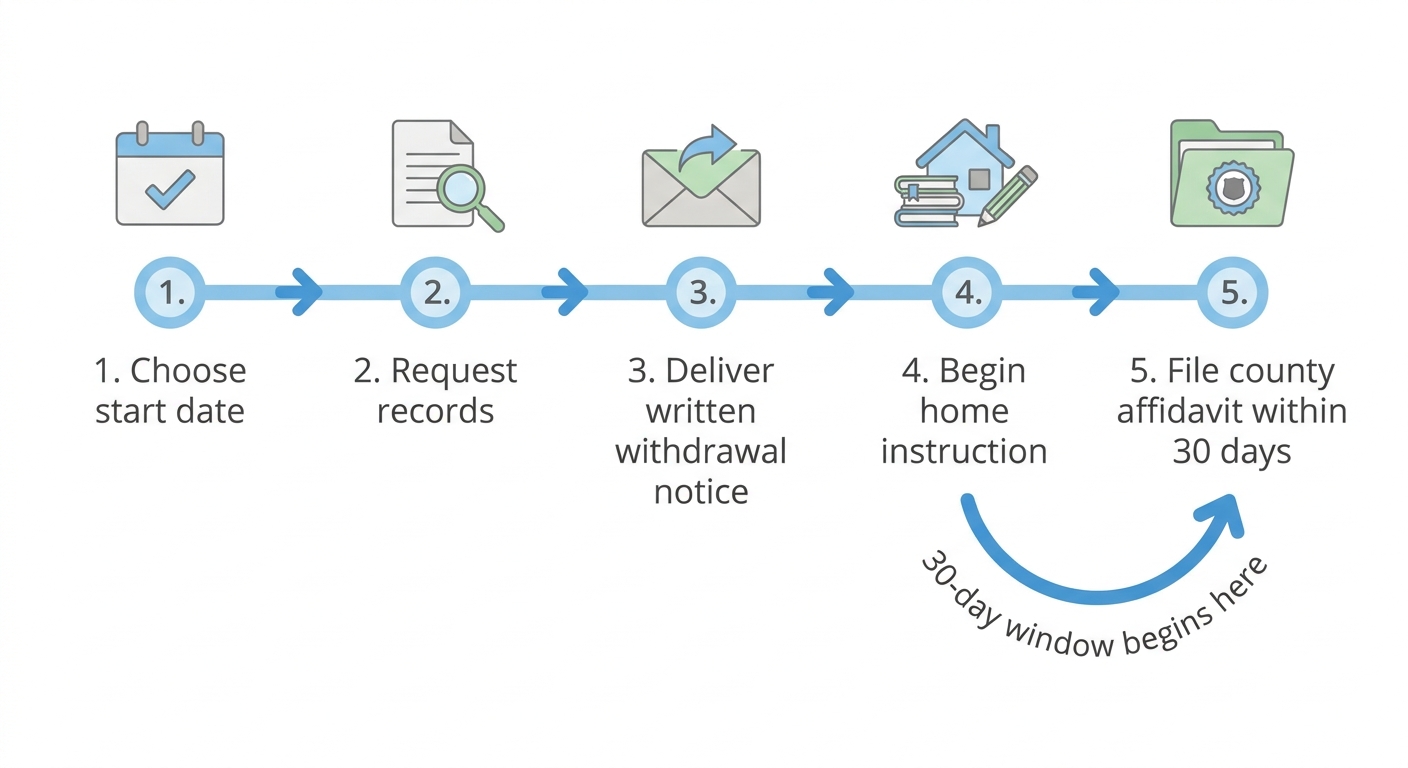
Pulling a child out of school in Arizona is one of the simpler withdrawals in the country, but the order of the steps matters more than most parents expect. This guide walks through how to homeschool in Arizona after leaving a public or private school: the written withdrawal notice, the 30-day affidavit, where your county actually accepts it, and how a scholarship account changes the picture.
Quick Answer
To withdraw a child from an Arizona public or private school for home instruction, send the school a short written notice stating the child is being withdrawn to home instruction, then file an affidavit of intent to homeschool with your county school superintendent within 30 days of the date home instruction begins. Arizona Revised Statutes §15-802 sets this requirement. You do not need district permission, curriculum approval, or standardized testing. Children under 8 may be exempt from filing, and the affidavit is filed once — not every year.
TL;DR
- Write the school first, file with the county second. The withdrawal notice goes to the school; the affidavit goes to your county superintendent. See the correct order of operations
- The 30-day clock starts when teaching starts, not when you unenroll, and Arizona does not require annual renewal. See how the 30-day affidavit window works
- County practice varies. Submission method and notary expectations differ between metro and rural offices, so call before you mail. Check the county filing table
- A scholarship account is a separate legal path. The ESA program is administered by the Arizona Department of Education and is not the same as filing the homeschool affidavit. See how ESA affects withdrawal
- Request records before you leave. Cumulative file, immunizations and transcripts are easier to get while your child is still on the rolls. See the records checklist
In This Article
- What Order Do the Steps Go In?
- What Should the Withdrawal Letter Actually Say?
- How Does the 30-Day Affidavit Window Work?
- Where Do You File It in Your County?
- How Does Withdrawal Affect an ESA Application?
- What Records Should You Request Before Unenrolling?
- What Do the First 30 Days of Home Instruction Look Like?
- Frequently Asked Questions
What Order Do the Steps Go In?
Withdraw in writing, begin home instruction, then file the affidavit within 30 days. The affidavit clock is tied to the day teaching begins — not the day the school removes your child from its rolls. Those two dates are often different, and that difference is where parents get confused.
Affidavit of intent to homeschool is a sworn one-page statement filed with your county school superintendent declaring that you are providing home instruction to a child of compulsory school age. It is a notification, not an application. No one approves or rejects it.
How to Homeschool in Arizona: The Five-Step Sequence
- Pick a start date for home instruction. Write it down. Every other date follows from it.
- Request school records in writing while your child is still enrolled.
- Deliver the written withdrawal notice to the school office, dated and signed.
- Begin home instruction on your chosen date.
- File the affidavit with your county school superintendent within 30 days, along with proof of the child's age.
Keeping the sequence tight protects you from the one genuine risk in this process: a gap where the school has marked your child absent but no affidavit is on file yet. Schools track attendance for funding and truancy purposes, so a clear, dated withdrawal notice closes that loop on their end.
If this is your first time leaving a school system entirely, it helps to read a general how to start homeschooling step by step walkthrough alongside the Arizona-specific paperwork. The legal steps are quick. The practical ones — choosing materials, setting a rhythm — take longer.
What Should the Withdrawal Letter Actually Say?
Arizona statute does not prescribe a format for the withdrawal letter, so keep it short, dated and factual. Five fields do the job:
- Your name and relationship to the child
- Child's full name, date of birth and current grade
- Effective date of withdrawal
- A single sentence stating the child will receive home instruction under A.R.S. §15-802
- A records request and your signature
Here is a copy-ready version:
To the Office of [School Name]:
I am the parent/guardian of [Child's Full Name], date of birth [DOB], currently enrolled in grade [X]. Effective [date], [Child's Name] is withdrawn from [School Name] and will receive home instruction in accordance with A.R.S. §15-802.
Please provide copies of the complete cumulative file, immunization records, the current-year report card or transcript, and any assessment results. Please confirm this withdrawal in writing.
Sincerely, [Signature, printed name, date, phone, email]
⚠️ Do not volunteer extra information. You are not required to explain your reasons, name a curriculum, or disclose scholarship status to get a withdrawal processed. Many schools offer their own exit form — completing it is usually the fastest route, but a district form is an administrative convenience, not a legal precondition.
Some Arizona county offices publish combined paperwork. The pupil withdrawal and change form hosted on the Yuma County ESA website, accessed November 2026, bundles withdrawal notification, address change and scholarship status onto a single page, and references A.R.S. §15-802 directly. Graham County publishes a private school withdrawal form of its own. Using a county form is fine — just make sure every field you complete is one you actually need to answer.
Arizona's one-time affidavit is unusually light compared to other states. If you have homeschooled elsewhere, it is worth comparing how a notice of intent works in other states so you do not accidentally import another state's annual-filing habits.
How Does the 30-Day Affidavit Window Work?
The affidavit must be filed within 30 days of the date home instruction begins, and then it is done. Arizona does not require annual renewal. The Graham County private school withdrawal form, accessed November 2026, states the rule plainly: an affidavit of intent is filed within thirty days from the time the child begins to attend a private school or home school and "is not required thereafter."
What the affidavit typically asks for:
- Child's full name and date of birth
- Child's residential address
- Name and signature of the parent or guardian filing
- A statement that home instruction is being provided
- Proof of the child's age — commonly a certified copy of the birth certificate, with alternative affidavits of age accepted in some circumstances
Two timing details catch people out. First, Arizona's compulsory attendance range runs from age 6 to 16, so the obligation only applies inside that window. Second, when home instruction ends — because the child enrols somewhere, moves out of state, or ages out — a written notice of termination goes back to the county superintendent.
For a closer walkthrough of each line on the form, see our Arizona affidavit field-by-field detail guide.
Key takeaway: File once, within 30 days of your first day of teaching, and keep a stamped or scanned copy. The only follow-up filing Arizona asks for is the notice when home instruction ends.
Arizona sets no required hours, no approved curriculum list and no state testing for homeschoolers. That is genuinely unusual, and it means the affidavit is the whole of your compliance obligation. Everything else — record keeping, assessments, transcripts — is something you choose to do for your own purposes, not something the state collects.
Where Do You File It in Your County?
Affidavits go to the county school superintendent's office where the child resides — not the school district, and not the Arizona Department of Education. Arizona has 15 counties, each with its own office, and each office sets its own intake practice.
Larger metro offices are more likely to offer email or online intake. Smaller rural offices more often handle filings by mail or in person. Call before you send anything, because a form sitting in the wrong inbox still counts as unfiled.
| County | County seat (superintendent's office base) | What to confirm when you call |
|---|---|---|
| Apache | St. Johns | Mail vs in-person; notary expectation |
| Cochise | Bisbee | Accepted submission methods |
| Coconino | Flagstaff | Email/online intake availability |
| Gila | Globe | Mail vs in-person; age proof accepted |
| Graham | Safford | Whether their published form is required |
| Greenlee | Clifton | Office hours and drop-off process |
| La Paz | Parker | Mail vs in-person |
| Maricopa | Phoenix | Online or email filing availability |
| Mohave | Kingman | Submission method; receipt confirmation |
| Navajo | Holbrook | Mail vs in-person |
| Pima | Tucson | Online or email filing availability |
| Pinal | Florence | Submission method; notary expectation |
| Santa Cruz | Nogales | Office hours and drop-off process |
| Yavapai | Prescott | Accepted submission methods |
| Yuma | Yuma | Whether their combined form applies to you |
Three things to ask on that call, whichever county you are in:
- Do you accept email, online submission, or only mail and in person?
- Does the signature need to be notarized?
- Will you send written confirmation of receipt?
That last question matters most. A dated confirmation email or a stamped copy is your proof of compliance, and it costs nothing to ask for. If you are weighing Arizona's rules against another state's before a move, our Arizona homeschool requirements overview covers the broader picture.
Key takeaway: The county superintendent's office is the only correct destination for the affidavit, and a five-minute phone call prevents the most common filing mistake.
How Does Withdrawal Affect an ESA Application?
An Empowerment Scholarship Account is a separate legal path, administered separately, with its own paperwork. It is not an add-on to the homeschool affidavit.
Arizona's Empowerment Scholarship Account (ESA) is a state program, administered by the Arizona Department of Education, through which eligible families sign an agreement with the Department and direct state education funds toward approved education expenses outside the public system. Because participants sign a contract with the Department, their legal status differs from a parent providing home instruction under §15-802.
The sequencing question comes up constantly in Arizona parent groups — including threads asking what the next steps are after unenrolling from public school and how to handle withdrawal after signing an ESA contract. The answers in those threads vary, which is exactly why you should not treat community advice as your source of record.
What to verify directly with the Arizona Department of Education before you act:
- Whether you withdraw first or apply first, for your specific situation
- Whether you should also file the §15-802 affidavit while receiving ESA funds
- How funding periods and quarterly disbursements align with your withdrawal date
- What enrollment restrictions apply while participating
Read the ADE ESA Parent Handbook and A.R.S. §15-2402, and get the Department's answer in writing. This article is general information, not legal or financial advice.
⚠️ Getting the order wrong between withdrawal and scholarship enrollment can affect funding timing. Confirm with the administering agency before you sign or submit anything.
For context on how account-based programs work across the country, see state homeschool funding and ESAs explained.
What Records Should You Request Before Unenrolling?
Request records in writing before the withdrawal takes effect. Access gets slower once a student is off the rolls, and some requests get routed to a district records department instead of the school office.
Cumulative file is the student's permanent record folder held by the school, typically covering grades, attendance history, assessment results and health data.
Your request checklist:
- Complete cumulative file — the full folder, not a summary
- Immunization record — needed for camps, sports leagues and any future enrollment
- Current-year transcript or report card, including partial-semester grades
- IEP, 504 plan or evaluation reports, if your child has them
- Standardized test results from prior years
- Written confirmation that the withdrawal has been processed
For high schoolers, the partial-credit transcript is the one to chase hardest. Arizona homeschool families issue parent-written diplomas, but a district or community college may want to see credits already earned if your teen later returns, transfers, or dual-enrolls. Credits already banked are much easier to document now than to reconstruct in three years.
Once you are teaching at home, you become the record keeper. Arizona does not require you to log hours or keep a portfolio, but a simple running log makes transcripts and course descriptions far easier later. Our guide to homeschool record keeping and transcripts covers what is worth tracking when the state is not asking for it.
What Do the First 30 Days of Home Instruction Look Like?
Arizona expects instruction in reading, grammar, mathematics, social studies and science, but sets no hours, no schedule and no approved curriculum list. So the first month is about building a rhythm, not recreating a school day at your kitchen table.
Three things that help in week one:
- Allow a decompression period. Many families report that children leaving a classroom need a few weeks before structured work lands well.
- Start from skill level, not grade label. A child can be two years ahead in reading and mid-level in fractions. Placing by grade guarantees one of those is wrong.
- Keep a light log anyway. A few lines a day — what you covered, what clicked, what didn't — gives you something to build a transcript from later.
Finding that real starting point is the part most new homeschoolers underestimate, and our guide to gap analysis for homeschoolers walks through how to do it without turning the first week into a testing session.
The honest difficulty of month one is not the paperwork — it is the second-guessing. You have just left a system that told you, however crudely, whether your child was "on track," and nothing has replaced that signal yet. This is the specific burden a home education companion like LearnSpark is built around: its learning algorithm is designed to track each subject against educational standards and help build the next lesson plan around where the child currently is, so the mastery picture is maintained for you instead of assembled from worry. What that gives back is the mental bandwidth you would otherwise spend wondering, redirected to the child sitting in front of you.
Key takeaway: Arizona asks for five subjects and nothing else. Spend the first 30 days finding each child's real starting point rather than matching a grade-level pace you no longer have to follow.
Frequently Asked Questions
Can an Arizona school refuse to let me withdraw my child?
No. A public school cannot block a parent from withdrawing a child to home instruction, though it may ask you to complete its internal exit form. That form is administrative preference, not a legal precondition. If a school raises truancy, respond in writing with the date of your withdrawal notice and the date your affidavit was filed. Keeping both documents dated and copied resolves almost every version of this dispute without escalation.
Do I have to file the affidavit again every year?
No. Arizona requires a single affidavit at the start of home instruction, plus a written notice of termination when home instruction ends. This differs from states like Pennsylvania and Ohio, where families file annually and submit evaluations or portfolios each year. If you have homeschooled in one of those states, the instinct to re-file every August is understandable — but in Arizona it is unnecessary.
What if my child is under 8 years old?
Arizona's compulsory attendance obligation begins at age 6, and children under 8 who are not enrolled in school may be exempt from the affidavit requirement under A.R.S. §15-802. Many parents file anyway. The practical reason is simple: it creates a dated paper trail showing when home instruction began, which is useful if attendance questions come up later. Filing early costs nothing and closes a gap.
Do I need to notarize the affidavit?
It depends on your county. Because the statute calls the document an affidavit, several county offices ask for a notarized signature or an in-person signing. Practice is not uniform across all 15 counties, so call your county school superintendent's office before you prepare the document. Many banks and public libraries offer notary services free or at low cost to account holders and members.
Can I withdraw mid-year, or do I have to wait for a semester break?
You can withdraw on any day of the year. The practical considerations are credits, equipment and eligibility. High schoolers mid-semester may receive partial or no credit for in-progress courses, so request a transcript showing what has been earned. Return district laptops, textbooks and instruments before you leave to avoid fees. If your child plays school sports, ask the athletic office how withdrawal affects participation.
Summary
Learning how to homeschool in Arizona after a school withdrawal comes down to three dated documents: a written withdrawal notice to the school, an affidavit of intent filed with your county school superintendent within 30 days of your first teaching day, and — eventually — a termination notice when home instruction ends. Request your child's records before you unenroll, confirm your county's filing method by phone, and treat any scholarship account application as a separate process with its own rules. After that, Arizona largely steps back, and the real work becomes finding where your child actually stands in each subject and building from there.
Information about third-party platforms reflects publicly available details at the time of writing and may have changed. Please verify directly with the provider. See our Terms of Use for more.