
Tennessee gives homeschooling families three separate legal routes, and the one you choose changes your paperwork, your testing duties, and who signs your child's diploma. This guide explains the tennessee homeschool laws 2026 families actually have to follow — in plain English, not legislative shorthand. You'll get a side-by-side comparison of all three options, a withdrawal walkthrough, the testing grades, and a records checklist you can start using this week.
Quick Answer
Tennessee recognizes three legal homeschool paths: an independent home school registered with your local director of schools under Tennessee Code Annotated § 49-6-3050, enrollment in a church-related umbrella school, or enrollment in an accredited online or correspondence program. Independent home schools carry the core duties most people mean by tennessee homeschool laws 2026 — written notice of intent, 180 instructional days averaging four hours, attendance records, and standardized testing in grades 5, 7 and 9. Umbrella and accredited routes shift most reporting to the school.
⚠️ Verify before you file. This is a plain-language overview, not legal advice. Statutes and district procedures change. Confirm current requirements with your local director of schools and the Tennessee Department of Education before you withdraw a child or submit anything.
TL;DR
- Tennessee has three legal homeschool routes, and they differ on notice, testing, and diplomas. Compare all three options side by side
- The independent route requires 180 days averaging four hours of instruction per day, logged by you. See what a four-hour day actually looks like
- Standardized testing applies to independent home schoolers in grades 5, 7 and 9; umbrella and accredited students follow their school's policy. Check the grade-by-grade testing table
- Your notice of intent goes to the local director of schools before instruction starts — many districts ask for it by August 1. Walk through the registration and school withdrawal steps
- Diplomas differ by route: independent families issue a parent transcript and diploma; umbrella schools issue their own. See how high school credits work
In This Article
- What Are Tennessee's Three Legal Homeschool Options?
- How Do You Register and Withdraw a Child From School in Tennessee?
- What Does the 180-Day, Four-Hour Rule Actually Require?
- Tennessee Homeschool Laws 2026: Who Has to Take Standardized Tests?
- What Records Should Tennessee Homeschool Families Keep?
- How Do High School Credits and Diplomas Work in Tennessee?
- What About Sports, Special Education and Part-Time Enrollment?
- Can Tennessee Families Get Funding or Tax Help?
- How Do You Build a Year That Meets These Rules Without Burning Out?
- Frequently Asked Questions
What Are Tennessee's Three Legal Homeschool Options?
Tennessee recognizes three ways to educate a child at home legally: independent home school, church-related umbrella school, or an accredited online/correspondence program. Each is a complete, lawful path. The differences are administrative, not academic.
An independent home school is a parent-run program registered directly with the local director of schools under Tennessee Code Annotated § 49-6-3050. You handle the notice, the attendance log, and the required testing yourself.
A church-related umbrella school is a school operated by or affiliated with a church organization that enrolls your child as its student. Your child is technically enrolled in that school, so the school carries the reporting duty to the state and sets its own attendance and assessment rules.
An accredited online or correspondence program is a distance-learning school your child enrolls in full time. The program keeps the records, issues the report cards, and typically grants the diploma.
Why do the top search results look like legislature pages?
Because they are. Pages such as the Tennessee General Assembly's bill information system are legislative tracking records — sponsors, amendments, vote histories, fiscal notes. They are authoritative for what a bill says and where it is in the process. They were never written to tell a parent what to send, to whom, by when. That gap is why so many Tennessee homeschool families start out confused.
| Independent home school | Church-related umbrella school | Accredited online/correspondence | |
|---|---|---|---|
| Who you notify | Local director of schools | The umbrella school (it reports) | The program (it enrolls your child) |
| Parent qualification | High school diploma or GED | Set by the school | Set by the program |
| Days & hours | 180 days, averaging 4 hours/day | School's policy (often mirrors state) | Program's academic calendar |
| Standardized testing | Grades 5, 7 and 9 | School's policy | Program's assessments |
| Immunization records | Required, with religious exemption affidavit available | Required by the school | Varies by program |
| Diploma source | Parent-issued | Umbrella school | Accredited program |
| Typical cost | Testing and curriculum costs only | Annual enrollment fee set by the school | Tuition set by the provider |
Tennessee's requirements sit in the middle of the national range — more structured than states with no notice requirement, far lighter than states requiring annual portfolio review. If you're comparing a possible move, our overview of homeschool laws in other states shows where Tennessee falls.
Key takeaway: Choose independent if you want full control and minimal cost, an umbrella school if you'd rather trade a fee for simpler paperwork and a school-issued diploma, and an accredited program if you want the whole year handed to you.
How Do You Register and Withdraw a Child From School in Tennessee?
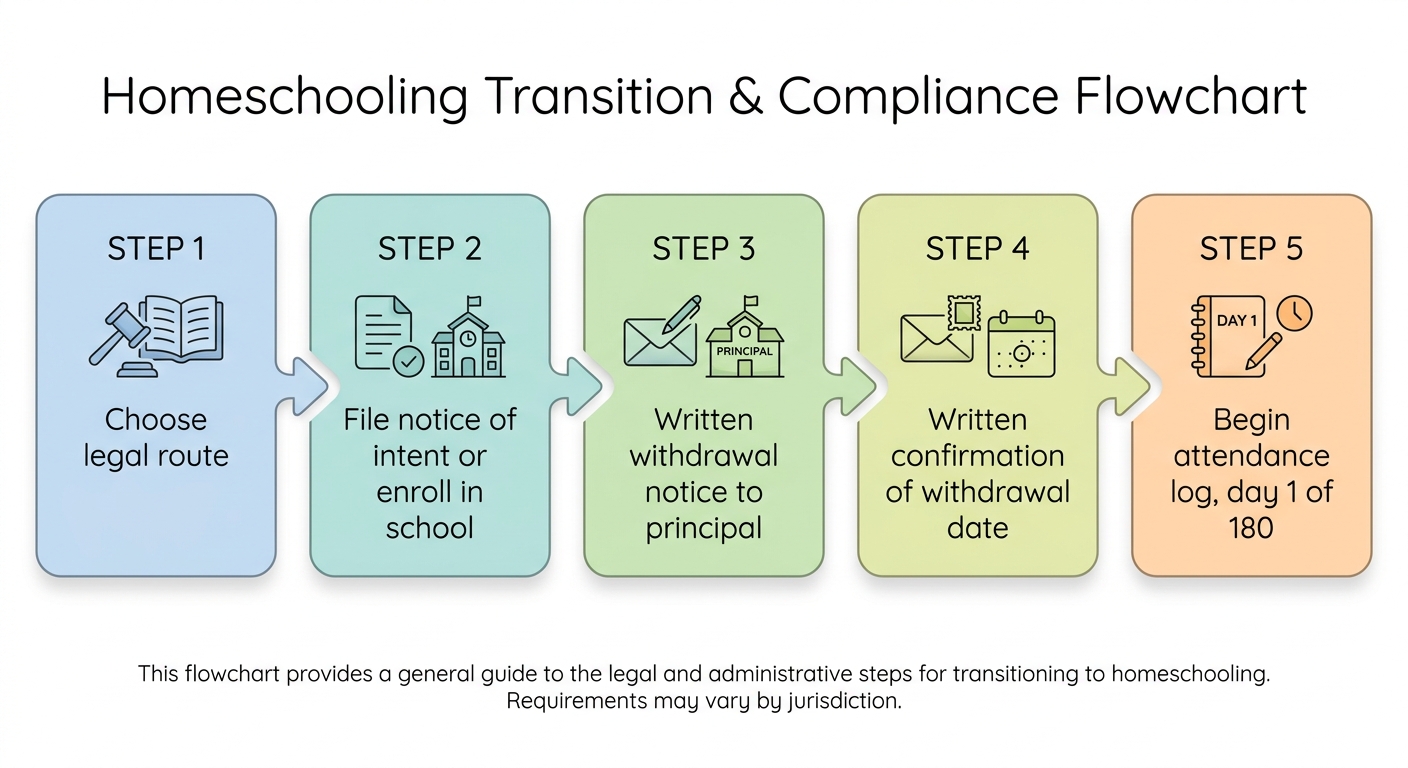
Send written notice of intent to your local director of schools before instruction begins, then formally withdraw your child from their current school. The order matters: notice first, school withdrawal second. Reversing it is the single most common mistake new families make.
Here is the sequence:
- Choose your route. Independent, umbrella, or accredited program. Everything downstream depends on this.
- File the notice (or enroll). Independent families submit the notice of intent to the director of schools. Umbrella families enroll instead — the umbrella school notifies the district on your behalf.
- Notify the current school in writing. Email or letter to the principal stating the child's name, grade, last day of attendance, and that the child will be educated under Tennessee's home school law.
- Confirm the withdrawal date in writing. Ask the school office to reply confirming the effective date and to release records. Save that reply.
- Start your attendance log on day one. Day 1 of your 180 begins the first day you instruct, not the day the paperwork clears.
What goes in the notice of intent?
Keep it short and factual. Most districts accept a one-page letter or their own form containing:
- Parent's name, address, and contact details
- Each child's full name, date of birth, and grade level
- The school year the notice covers
- A statement that the parent holds a high school diploma or GED
- Proof of immunization or the state's religious exemption affidavit
- Parent signature and date
⚠️ Do not pull your child out before the notice is on file. A gap between the last day of attendance and the date your home school is registered can be recorded as unexcused absence, and Tennessee districts may be required to report students who withdraw without a confirmed destination, a requirement addressed in pending and recent state legislation such as TN SB1968, and reporting practices can vary by district. Keep both the dated notice and the school's written confirmation.
What if you start mid-year?
Mid-year starts are allowed. File the notice at the time of withdrawal rather than waiting for August, and prorate your instructional days for the remainder of the year — count the days you actually teach from your start date forward, and note the start date clearly at the top of your log.
If this is your first time through the whole process, our step-by-step checklist for new homeschoolers covers the non-legal pieces too: curriculum choice, routines, and the first four weeks.
What Does the 180-Day, Four-Hour Rule Actually Require?
Independent home schools must provide instruction for 180 days per year, averaging four hours per instructional day. Tennessee does not dictate subjects or curriculum for the independent route — the hours are the requirement, not a prescribed syllabus.
"Four hours" is broader than most parents assume. Instructional time includes read-alouds, hands-on science, museum and historic-site visits, co-op classes, music practice tied to a learning goal, and independent reading you assign. It is an average across the year, not a daily minimum you must hit on every single day.
What does a four-hour day look like for a third grader?
A realistic weekday might run:
- 45 minutes — math lesson and practice
- 40 minutes — reading, partly read-aloud, partly independent
- 30 minutes — writing or copywork
- 45 minutes — science and history on a rotating schedule
- 60 minutes — project work, co-op, or a field trip
That totals four hours without a single worksheet marathon. On a field-trip day, the trip itself may carry most of the block.
What should you log each day?
Keep it to a few seconds per entry:
- Date — and whether it counts as an instructional day
- Approximate hours — rounded to the quarter hour is fine
- Subjects touched — three or four words each
- Anything notable — a milestone, a struggle, a finished project
Umbrella schools may set stricter day, hour, or reporting rules than the state minimum, so read your enrollment agreement rather than assuming the 180/4 standard applies. If daily logging is where your system usually collapses, our guide on how to track homeschool hours walks through methods that survive a busy week.
Key takeaway: The rule asks for 180 days averaging four hours — not 180 identical desk days. Log honestly, log briefly, and count the learning that happens away from the table.
Tennessee Homeschool Laws 2026: Who Has to Take Standardized Tests?
Independent home school students are tested in grades 5, 7 and 9 using the state's test or an approved equivalent, arranged through the local district or an approved testing provider. Students enrolled in a church-related umbrella school or an accredited program follow that school's assessment policy instead of the state schedule.
| Independent home school | Church-related umbrella school | Accredited online/correspondence | |
|---|---|---|---|
| Tested grades | 5, 7 and 9 | Set by the school | Set by the program |
| Who administers | District or approved provider | The umbrella school | The program |
| Where results go | Parent and district | The umbrella school's records | Program transcript |
| Who schedules it | The parent | Usually the school | Built into the calendar |
| Cost | Fee may apply | Often bundled in enrollment | Included in tuition |
What happens if a child scores low?
A low score is not an automatic end to your Tennessee homeschool. The statute's framework points toward consultation and a remediation plan with the district rather than immediate closure — the aim is to identify a gap and address it. Results are not a pass/fail gate for continuing to educate at home.
Practically, that means two things. First, book the test early; district testing windows fill up and you want time to reschedule. Second, treat the result as diagnostic data for your own planning, not as a verdict on your family.
Which test counts as "approved"?
Tennessee's statute allows the state test or an approved equivalent administered by a qualified party. Because approved-provider lists and district procedures change from year to year, ask your director of schools two questions in writing: which tests the district currently accepts, and whether you test at a district site or through an outside provider. Put the answer in your records file.
⚠️ Testing arrangements are one of the most district-variable parts of Tennessee school laws for home educators. Ask early, get it in writing, and don't rely on what another family did in a different county last year.
What Records Should Tennessee Homeschool Families Keep?
Keep six things: an attendance register showing your 180 days, dated samples of work, test results, immunization records or the religious exemption affidavit, a subject and grade log, and copies of every piece of correspondence with the district.
A portfolio is a dated collection of work samples, logs and assessments that evidences instruction actually happened. Tennessee's independent route does not require annual portfolio review, but a portfolio is what makes everything else — transcripts, re-enrollment, a move to another state — straightforward instead of frantic.
The six-document checklist
- Attendance register — dates, hours, and a running day count toward 180
- Work samples — a few dated pieces per subject per term, not everything
- Test results — grades 5, 7 and 9 reports, filed permanently
- Immunization records — or the state's religious exemption affidavit
- Subject and grade log — what was covered, and how the child did
- District correspondence — your notice, the withdrawal confirmation, any replies
A simple folder structure works: one folder per subject, subdivided by term, with a single front-of-binder sheet holding attendance and correspondence. Scan as you go so a lost box never costs you a year. If paper has already beaten you, compare options in our rundown of homeschool record keeping software.
How Do High School Credits and Diplomas Work in Tennessee?
Independent home schoolers issue a parent-generated diploma and transcript. Umbrella-school students typically receive a diploma from the umbrella school, which some employers, military recruiters and scholarship offices find easier to process because it comes from an institution rather than a parent.
Neither is a shortcut. Both require a credible transcript behind them.
How do you count a high school credit?
Most homeschool families follow the long-standing convention of treating a full-year, substantive course as one credit and a semester course as half a credit, with hours logged to back it up. For a Tennessee-specific record, your transcript should show:
- Course title, year taken, credit value, and grade
- A brief course description for anything non-standard
- Cumulative GPA, if you're assigning grades
- Standardized test scores and dual enrollment coursework
What about dual enrollment and scholarships?
Dual enrollment at a Tennessee community college is one of the cleanest ways to give a homeschooled teen externally verified credit. College transcripts carry their own weight, which takes pressure off the parent-issued document.
Scholarship pathways deserve early attention, not senior-year attention. Eligibility rules for state programs typically specify documentation and test-score routes for home-educated applicants, and those details drive decisions you make years earlier. Our breakdown of Tennessee Promise eligibility for homeschool graduates covers what the program's published criteria ask of non-traditional students — verify current-year rules directly with the administering agency before you rely on them.
Key takeaway: Pick your route in ninth grade based on where your teen is heading. If the plan involves scholarships, the military, or selective admissions, the extra structure of an umbrella school or accredited program can be worth the fee.
What About Sports, Special Education and Part-Time Enrollment?
Tennessee law provides for home-educated students to access certain public school extracurricular activities, and athletic participation runs through the rules of the school district and the state athletic association. Separately, districts retain child-find obligations under federal special education law, which means a district must still evaluate a child suspected of having a disability even if that child is home educated.
What should you ask your district?
Get these four answers in writing before you plan around them:
- Eligibility terms — what the district and the athletic association require of a non-traditional student for the current season
- Enrollment thresholds — whether part-time enrollment in any classes is required for participation
- Evaluation process — how to request a special education evaluation as a home-educating parent, and the timeline
- Part-time classes — whether the district permits home-educated students to take individual courses, which is generally at district discretion
Where do co-ops fit in?
Co-ops and learning pods fill the gap when district access is limited. They cover the lab sciences, group discussion, and team projects that are genuinely harder to do with one child at a kitchen table — and they produce dated, verifiable work samples for your file.
⚠️ Athletic and part-time enrollment policies vary sharply between Tennessee districts and can change between seasons. A verbal yes from one coach is not a policy. Ask the athletic director and the district office, in writing, and keep the reply with your homeschool records.
Can Tennessee Families Get Funding or Tax Help?
Tennessee does not pay parents to homeschool independently, and there is no state homeschool tax credit. The state's education savings and scholarship programs carry their own eligibility rules, and those rules generally attach to students enrolled in participating schools rather than to independent home schools.
That distinction trips up a lot of families. A program that funds a child at a private or participating school does not automatically fund a child you educate yourself under § 49-6-3050.
⚠️ Never assume an education savings account or scholarship transfers to an independent home school. Eligibility, participating-school lists, and application windows change year to year — confirm with the Tennessee Department of Education and the program administrator before you build a budget around it.
What you can plan on is the ordinary cost control available to anyone: used curriculum, library resources, free public-domain texts, and co-op cost sharing. For the current picture on state programs and where homeschool families do and don't qualify, see our dedicated guide to Tennessee homeschool funding and grants.
How Do You Build a Year That Meets These Rules Without Burning Out?
Work backwards from the calendar. Map the 180 days first, then block the four hours, then let curriculum fill the blocks. Families who choose curriculum first almost always end up reverse-engineering the legal requirements in April.
A workable Tennessee pacing frame looks like this:
- 36 teaching weeks × 5 days = 180 days — the legal baseline, exactly
- Add 4 flex weeks — illness, travel, burnout, and the week nothing works
- Four daily blocks — core math, literacy, a rotating content subject, and project time
- One catch-up day per month — unused days become field trips, not guilt
Where the burnout actually comes from
Rarely the teaching. Usually the two jobs stacked around it: building tomorrow's lesson on a Sunday night, and reconstructing three months of attendance and subject notes the week before you need a record. Both are administrative, and both are separable from the part of homeschooling you actually chose.
That separation is the design idea behind LearnSpark: it builds the daily lesson plan around where each child currently is, and keeps the mastery and progress notes updated as you teach — so the 180-day log and the end-of-term documentation accumulate from the teaching itself rather than from a second evening shift. What you get back is the Sunday night, and the attention that was going into record reconstruction.
For the planning side on its own, our guide to simple homeschool planning walks through building a year you can actually keep.
Frequently Asked Questions
Do you need a high school diploma to homeschool in Tennessee?
For the independent route, Tennessee Code Annotated § 49-6-3050 has required the parent to hold a high school diploma or GED; confirm the current text of the statute with your director of schools before relying on it. Church-related umbrella schools set their own parent qualifications, which may differ, so ask the school directly. If a parent's credential is the obstacle, the umbrella route is usually the practical answer. Confirm the current statutory language with your director of schools before filing.
When is the notice of intent due in Tennessee?
The notice goes to your local director of schools before instruction begins, and many districts ask for it by August 1 for the coming school year. Mid-year starts are permitted — file the notice at the time of withdrawal rather than waiting for the next August. Call your district office and confirm their specific date and preferred form.
Is a church-related umbrella school more work or less?
Usually less district paperwork and no separate state testing schedule, but more school-level reporting and an annual fee. Expect the school to ask for enrollment forms, periodic attendance or grade submissions each term, and sometimes a statement of faith. Fees vary widely depending on how much the school provides, so request the current fee schedule and the full reporting calendar in writing before you enroll.
Can you homeschool in Tennessee while traveling or living part of the year out of state?
If Tennessee remains your legal residence, you continue meeting Tennessee requirements wherever you happen to be that month. If you establish residency in another state, that state's law applies instead. Log travel-based learning as instructional days the same way you'd log a local field trip — date, hours, subjects covered, and a photo or work sample for the file.
What happens if you miss a requirement?
Most issues are correctable rather than catastrophic — a late notice, a thin log, a missed testing window. Contact the district promptly, document what you're doing to fix it, and keep the correspondence. The risk rises when a child is out of school with no registered home school on file, which is why the notice-before-withdrawal order matters so much.
Summary: What Should You Do This Week?
Three moves, in order. First, pick your route — independent, umbrella, or accredited program — based on how much paperwork you want to own and what your child's post-secondary plan looks like. Second, draft the notice of intent and call your district office to confirm their deadline and format. Third, open an attendance log today, even if instruction starts in two months, so the habit is built before day one of 180.
Tennessee homeschool laws 2026 reward families who front-load the admin and then forget about it. The notice takes an afternoon. The log takes thirty seconds a day. Everything after that is just teaching your kids — which is the part you signed up for.
Keep one folder for the legal paperwork, one for each subject, and one calendar with 180 days marked. That's the whole compliance system for a Tennessee homeschool, and it fits on a shelf.
Information about third-party platforms reflects publicly available details at the time of writing and may have changed. Please verify directly with the provider. See our Terms of Use for more.