
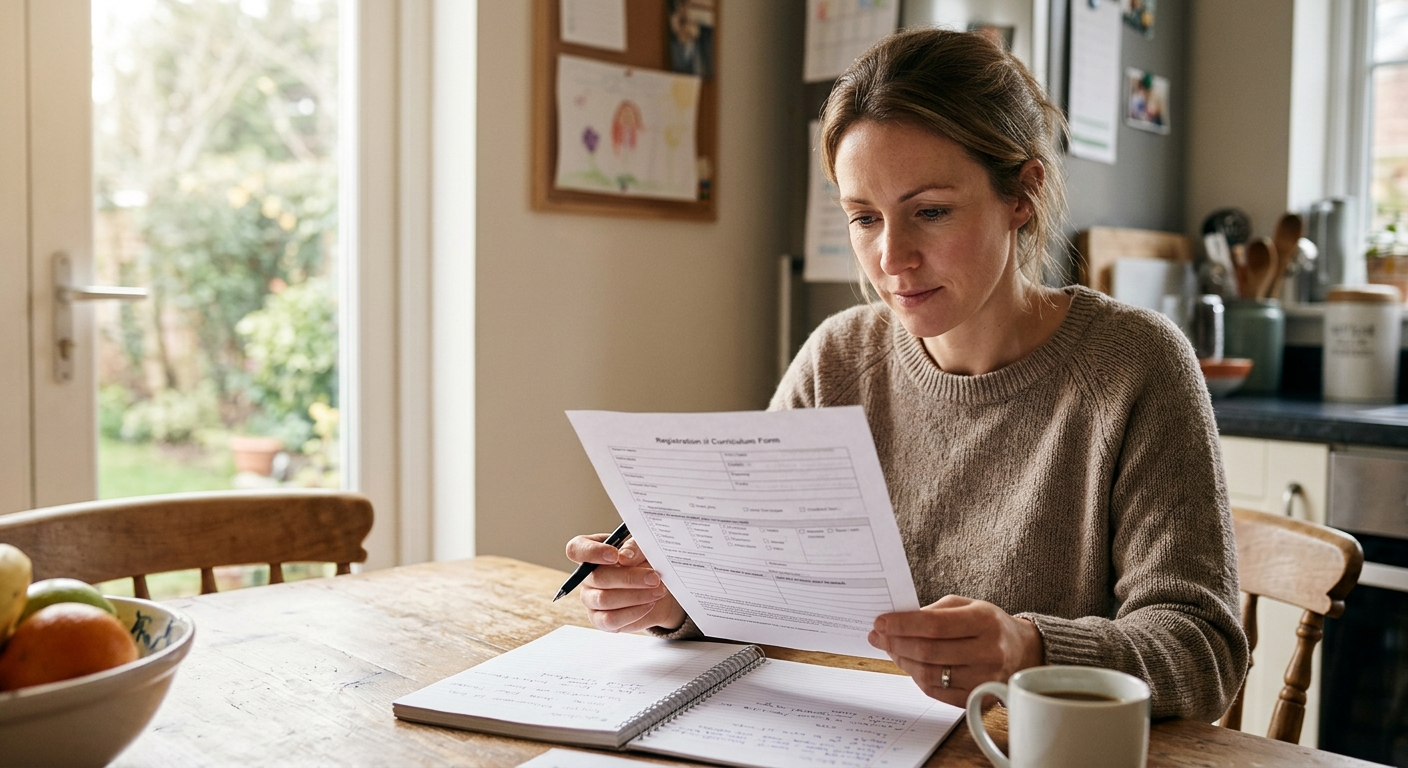
Pennsylvania has one of the more paperwork-heavy home education statutes in the country, and most of the stress families feel comes from deadlines rather than from teaching. This guide walks through what Pennsylvania homeschool law — Act 169 of 1988, codified at 24 P.S. §13-1327.1 — actually asks of you, then maps it to a month-by-month calendar you can run your year against. It is a plain-English explainer, not legal advice.
Quick Answer
Pennsylvania home education is governed by Act 169 of 1988, codified at 24 P.S. §13-1327.1 and amended in 2014. It requires a notarized affidavit filed with your local school district superintendent before instruction begins and annually by August 1, a list of educational objectives by subject, 180 days or 900 hours of instruction at the elementary level (990 hours at secondary), a portfolio of materials and work samples, standardized testing in grades 3, 5 and 8, and a written evaluator certification submitted by June 30.
TL;DR
- The statute has a name and a number. Pennsylvania's home education program lives in Act 169 of 1988 at 24 P.S. §13-1327.1 — not in district policy. See what the statute actually says
- Two dates run your year. The notarized affidavit is due by August 1, and the evaluator's written certification is due by June 30. See the full compliance calendar
- Days or hours — your choice. 180 days of instruction, or 900 hours (elementary) / 990 hours (secondary), whichever fits your family's rhythm. Compare the days-versus-hours maths
- Not just anyone can evaluate. The statute limits evaluators to specific credentialed professionals, chosen and paid by you. Check the evaluator qualifications
- Districts work from the statute, not a wish list. Objectives are filed, not approved. See the mistakes that cost families time
In This Article
- What Is Act 169 and What Does It Actually Say?
- Who Can Supervise a Home Education Program in PA?
- The Act 169 Compliance Calendar: What's Due and When?
- What Goes in the Affidavit and Objectives?
- Which Subjects Does Pennsylvania Require by Grade Level?
- How Do the 180 Days and 900/990 Hours Work?
- What Does the Portfolio Need to Contain?
- Who Can Be Your Evaluator, and What Do They Certify?
- What Changes in High School?
- What Trips PA Families Up Under Pennsylvania Homeschool Law?
What Is Act 169 and What Does It Actually Say?
Act 169 of 1988 created Pennsylvania's home education program and sits in the Public School Code at 24 P.S. §13-1327.1. Before it passed, families educating children at home operated in legal grey territory. The statute gave that arrangement a defined shape: who may run a program, what must be taught, how much instruction counts, and what has to be documented and filed each year.
A home education program is a program of instruction conducted by a parent, guardian, or person having legal custody for their own children, operating under the supervision of that adult rather than a school. That matters because Pennsylvania also recognises other arrangements — private tutoring and enrollment in a day school — that sit under different sections of the code with different rules.
The law was amended in 2014. Two changes mattered most to families: the supervisor gained the ability to issue a high school diploma directly once statutory secondary requirements are met, and the annual evaluation process shifted so that the superintendent receives the evaluator's certification rather than approving the program itself.
Where should a brand-new family start?
If you have never homeschooled before, read the statute text and your district's posted home education page first, then work backwards from the August 1 deadline. The Pennsylvania Department of Education publishes guidance on home education and private tutoring that summarises the statute and links to a model affidavit — district pages often mirror it.
For the non-legal side of getting going — picking an approach, setting up a space, choosing materials — the full first-year homeschool start checklist covers ground this article deliberately does not.
⚠️ Statutes change. Dates, subject lists and thresholds described here reflect the law as commonly summarised at the time of writing. Confirm the current statutory text and your district's filing instructions before you file, and consult a qualified attorney or a Pennsylvania homeschool organisation for legal advice.
Who Can Supervise a Home Education Program in PA?
The supervisor must be the parent, guardian, or person having legal custody of the child, must hold at least a high school diploma or its equivalent, and must attest that they have not been convicted of the criminal offenses listed in the Public School Code's background-check provision within the preceding five years.
Supervisor is the statutory term Act 169 uses for the adult legally responsible for the home education program. It is not a job title you apply for — it is a role you assume by filing the affidavit. You can hire tutors, join a co-op, or outsource a subject entirely, and you remain the supervisor.
Act 169 is one legal path among several in Pennsylvania. Families sometimes assume home education is the only option, or confuse it with a cyber charter.
| Home education (Act 169) | Private tutor (§13-1327) | Cyber charter school | |
|---|---|---|---|
| Who teaches | Parent/guardian as supervisor | PA-certified teacher, not the parent | District-employed or charter teachers |
| Filing | Notarized affidavit + objectives, annually | Tutor's credentials and criminal history filed with district | Standard public school enrollment |
| Curriculum control | Family chooses | Tutor delivers required subjects | Set by the school |
| Portfolio & evaluation | Required annually | Not required under the home education provisions | Not applicable — school keeps records |
| Standardized testing | Grades 3, 5 and 8 | Not required under §13-1327.1 | State testing as a public school student |
| Cost to family | Family pays for materials, testing, evaluator | Family pays tutor | Publicly funded |
The private tutor route requires the tutor to be certified in Pennsylvania and to provide instruction a minimum number of days per week; it is used most often by families who want a credentialed instructor without district enrollment. A cyber charter is a public school — the flexibility is in location, not curriculum.
Key takeaway: Choosing Act 169 means accepting an annual paperwork cycle in exchange for near-total control over what and how you teach.
The Act 169 Compliance Calendar: What's Due and When?
There are four fixed moments in a Pennsylvania home education year. Everything else is teaching. Build your calendar around these and the rest of the statute becomes routine.
| Timing | What's due | Goes to |
|---|---|---|
| Before instruction begins, and by August 1 each year | Notarized affidavit + educational objectives by subject | District superintendent |
| Within 30 days of moving | A new affidavit filed in your new district | New district superintendent |
| September – May (ongoing) | Log of days or hours; portfolio of work samples and reading materials | Kept by you |
| Spring of grades 3, 5 and 8 | An approved nationally normed standardized test, administered and scored | Results go into the portfolio |
| By June 30 | Evaluator's written certification that appropriate education is occurring | District superintendent |
Why is Pennsylvania's filing heavier than other states?
Two features make it heavier: the affidavit must be notarized, and an independent evaluator must certify the year. Many states ask only for a simple signed letter of intent with no annual sign-off, which is why families moving into Pennsylvania are often surprised. If you are comparing states or relocating, how homeschool notification works in other states sets Pennsylvania's requirements against lighter-touch alternatives.
A few practical scheduling notes:
- Book the notary early. Banks, libraries and shipping stores commonly offer notary services, but late July is busy.
- File even if nothing changed. The affidavit is annual, not one-time.
- Mid-year starts are allowed. If you withdraw a child from school in November, you file before instruction begins — you do not wait for the following August.
- A move resets the clock. New district, new affidavit, within the statutory window.
Key takeaway: August 1 and June 30 are the two dates that matter; everything in between is documentation you can collect as you go rather than reconstruct later.
What Goes in the Affidavit and Objectives?
The affidavit is a sworn, notarized statement. Pennsylvania's Department of Education publishes a model form, and most districts post their own version of it on their website — use your district's if one exists.
Typical affidavit fields include:
- Supervisor's name and address — the adult legally responsible for the program.
- Names and ages of the children in the program.
- A statement that required subjects will be taught in English.
- Evidence of immunization and required health and medical services, or documentation of an exemption.
- Attestation of a high school diploma or equivalent held by the supervisor.
- Criminal-offense attestation covering the preceding five years.
- Educational objectives by subject area, attached to the affidavit.
How specific do educational objectives need to be?
Specific enough to describe what the child will work toward, general enough that you are not boxed in by October. A workable objective names a subject, an action, and a rough standard. For example: By June, the student will read and summarise five grade-level nonfiction texts. Or: The student will solve multi-step word problems involving fractions with increasing independence.
You are writing a plan, not a contract. A page or two covering each required subject is common.
⚠️ Objectives are filed, not approved. Act 169 requires you to submit them; it does not give the superintendent authority to accept, reject or rewrite them. If a district asks you to revise objectives before it will "accept" your affidavit, that request goes beyond the statute — a Pennsylvania homeschool organisation can advise on how to respond.
Which Subjects Does Pennsylvania Require by Grade Level?
Act 169 lists required subjects separately for elementary and secondary levels. The list is broad, which is reassuring once you realise how much ordinary family life already covers.
| Level | Required subjects under Act 169 |
|---|---|
| Elementary (grades 1–6) | English — including spelling, reading, writing, literature and language; arithmetic; science; geography; history of the United States and Pennsylvania; civics; safety education including fire prevention; health and physiology; physical education; music; art |
| Secondary (grades 7–12) | English — language, literature, speech and composition; science; geography; social studies including civics, world history, and US and Pennsylvania history; mathematics including algebra and geometry; art; music; physical education; health; safety education including fire prevention |
A planned course is a sequence of instruction in a subject that is documented well enough to be recorded as a credit — the building block of a high school transcript. At the secondary level, graduation also requires a set number of credits across English, mathematics, science, social studies, and arts or humanities.
How do you turn a statutory list into actual lessons?
Work subject by subject, write one or two objectives for each, then attach the resources you already use. Safety education does not need a textbook — a fire-escape plan, a kitchen-safety session and a bike-helmet discussion are instruction. Civics can run through a local election or a township meeting.
Where families get stuck is knowing whether the level is right for the grade. Mapping lessons to grade-level standards explains how to use published standards as a reference point without letting them dictate your whole year.
How Do the 180 Days and 900/990 Hours Work?
Act 169 requires either 180 days of instruction or 900 hours at the elementary level and 990 hours at the secondary level. The "or" is the flexible part, because the statute does not define how long a day has to be.
The arithmetic is worth doing once:
- 900 hours ÷ 180 days = 5 hours per day — the conventional school-shaped year.
- 4.5 hours over 200 days reaches the same elementary total with shorter days.
- 6 hours over 150 days also reaches it, with a longer summer.
Families who travel, work shifts, or have a child who concentrates better in short bursts generally find the hours option easier to satisfy honestly.
What actually counts as instruction?
Pennsylvania counts instruction broadly when it serves a required subject. Reasonable inclusions are:
- Field trips and museum visits tied to history, science or art.
- Co-op classes and outside tutoring in a listed subject.
- Documentaries, audiobooks and independent reading that support literature, science or social studies.
- Project work and practical skills that map to health, safety or physical education.
Year-round schooling is permitted — summer hours count the same as November hours. The practical risk is not undercounting but forgetting to record at all, which is why a daily habit beats a May reconstruction. If your current system is a spreadsheet you keep abandoning, it is worth learning to track homeschool hours without a spreadsheet headache.
What Does the Portfolio Need to Contain?
The portfolio provision of Act 169 asks for four things, and families routinely over-build it.
- A log of reading materials used during the year.
- Samples of writings, worksheets, workbooks or creative materials used or developed by the student.
- Standardized test results for grades 3, 5 and 8.
- Evidence of sustained progress across the required subject areas, which the evaluator reviews.
Just as importantly, here is what the statute does not require: daily lesson plans, letter grades for every assignment, receipts for curriculum, or a scrapbook. A binder of every worksheet your child completed is not more compliant than a representative sample — it is just heavier.
What does a reasonable monthly sample set look like?
Something like this, collected as you teach:
- Two pieces of writing, rough drafts included.
- One maths assessment or a photographed page of worked problems.
- A page from the reading log with titles and dates.
- Two or three photos of a project, experiment or field trip.
Twelve months of that is a complete portfolio without a single late-spring panic. For a field-by-field build-out, including how to organise it before the evaluation meeting, see the Pennsylvania portfolio and evaluation checklist.
Key takeaway: The four statutory portfolio elements are a reading log, work samples, test results in grades 3, 5 and 8, and evidence of progress in required subjects — nothing more.
Who Can Be Your Evaluator, and What Do They Certify?
The evaluator must fall into one of the categories the statute names: a licensed clinical or school psychologist, a Pennsylvania-certified teacher, or a non-public school teacher or administrator with at least two years of teaching experience in Pennsylvania or another state within the last ten years. You choose the evaluator and you pay the fee — the district does not assign or fund one. Fees vary by evaluator and region, so ask when you book.
The evaluation itself has three parts: an interview with the student, a review of the portfolio, and a written certification stating whether an appropriate education is occurring and whether sustained progress has been demonstrated in the required subjects.
Can a relative serve as the evaluator?
No, not by default. The statute excludes the child's parent or spouse, and bars relatives from serving unless the superintendent approves. In practice, most families find an evaluator through a Pennsylvania homeschool association, a local support group, or word of mouth within a co-op.
Two scheduling notes that save stress:
- Book in late winter or early spring. Experienced evaluators fill their June calendars.
- Ask what format they prefer. Some evaluate in person, some remotely, and most will tell you exactly how they like a portfolio organised.
What Changes in High School: Diplomas, Credits and Dual Enrollment?
Since the 2014 amendment, the supervisor may issue the high school diploma directly once the student completes the statutory secondary course requirements. No district sign-off is needed, and the diploma is recognised under Pennsylvania law. Families who prefer an outside credential can instead pursue a diploma through an established Pennsylvania homeschool diploma program.
A workable credit tally for the secondary requirements looks like this:
| Area | Credits |
|---|---|
| English | 4 |
| Mathematics | 3 |
| Science | 3 |
| Social studies | 3 |
| Arts and humanities | 2 |
Act 169 also includes an access provision allowing home-educated students to participate in district extracurricular activities and sports, subject to the district's eligibility rules. Dual enrollment at a community college is a common route for advanced coursework, and college admissions offices generally ask for a transcript, a course description list, and test scores where required.
⚠️ Start the transcript in ninth grade. Reconstructing four years of course titles, hours and grades during senior year is the single most avoidable crisis in homeschool high school. Building a homeschool transcript from 9th grade onward walks through the format colleges expect.
What Trips PA Families Up Under Pennsylvania Homeschool Law?
Almost all compliance stress in Pennsylvania comes from timing and documentation, not from teaching. The recurring problems are predictable enough to list:
- Missing August 1 after a summer move. New district means a new affidavit, and relocation chaos swallows the deadline.
- Waiting for objectives to be "approved." They are filed, not approved — waiting for a response that is not coming burns weeks.
- Assembling the portfolio in May. A year of undocumented learning cannot be reconstructed accurately from memory.
- Booking the evaluator in June. Qualified evaluators are busiest in exactly the month the certification is due.
- Forgetting the grade 3, 5 and 8 test window. Test administration needs planning and often a qualified administrator.
How do you stop June from becoming a recovery project?
By making the record a by-product of teaching rather than a separate task. The portfolio Act 169 asks for — a reading log, work samples, evidence of progress across required subjects — is mostly a record of things you were going to do anyway. The gap is capture, not effort.
That capture is one of the things a home education companion like LearnSpark handles in the background: it logs instruction as you teach, keeps work samples and progress notes attached to each child, and maps lessons to grade-level standards using its proprietary learning algorithm. The practical effect for a Pennsylvania family is that the evaluator meeting becomes a review of something that already exists, and the hours you would have spent rebuilding May paperwork stay where they belong — with the kids, or with your evening.
Key takeaway: Every Pennsylvania compliance problem is easier to prevent in September than to solve in June.
Summary: Running Your Year on Act 169
Pennsylvania homeschool law asks more of families on paper than most states, but the requirements are finite and knowable. File a notarized affidavit with educational objectives by August 1. Teach the listed subjects for 180 days or the required hours. Collect reading logs, work samples and — in grades 3, 5 and 8 — test results as you go. Have a qualified evaluator certify the year and submit that certification by June 30.
Everything else is your choice: the curriculum, the schedule, the pace, the philosophy. Treat the statute as a calendar rather than a verdict on your teaching, and Pennsylvania becomes a straightforward place to homeschool.
Frequently Asked Questions
Short answers to the questions Pennsylvania families ask most often when setting up or renewing a home education program.
Do I have to file an affidavit if my child has never attended school?
A: Yes. The affidavit is required for any child of compulsory school age in a home education program, regardless of whether the child was ever enrolled in a district school. Compulsory attendance in Pennsylvania begins at age six, so a child who has only ever learned at home still needs an affidavit on file once they reach that age. File before instruction begins, then annually by August 1.
Can a Pennsylvania school district reject my educational objectives?
A: No. Act 169 requires you to file objectives with the affidavit, but it does not give the superintendent authority to approve, reject or rewrite them. The statute describes limited circumstances in which a superintendent may request a portfolio review if there is reason to believe appropriate education is not occurring — that is a separate process from objectives, and it is not a routine approval step.
What happens if I miss the June 30 evaluation deadline?
A: The statute allows the superintendent to notify the supervisor that the program appears to be out of compliance and to begin a process that can include submitting the portfolio for review, a hearing before an impartial hearing examiner, and an appeal path. None of that starts instantly or automatically.
⚠️ If you know you will miss June 30 — the evaluator is ill, a family emergency intervened — contact the district in writing before the deadline rather than after. Documented proactive communication is far easier to resolve than silence.
Which standardized tests are approved for grades 3, 5 and 8?
A: Pennsylvania's guidance lists a set of nationally normed achievement tests. Commonly used options include the Iowa Test of Basic Skills, the Stanford Achievement Test, TerraNova, the California Achievement Test, the Metropolitan Achievement Test, the Peabody Individual Achievement Test and the Woodcock-Johnson. Confirm the current approved list before ordering, since it is periodically updated. A parent generally may not administer the test unless they hold the qualification the test publisher requires, and participation in the state PSSA is optional.
Does Pennsylvania offer funding or tax credits for homeschoolers?
A: Pennsylvania does not provide direct state funding or a state income tax credit to home education families. The state's tax-credit scholarship programs are directed toward tuition at participating private schools rather than home education programs. Families generally fund curriculum, testing and evaluator fees themselves, though local libraries, co-ops and free curriculum resources reduce the cost considerably. Verify current programs with the Department of Revenue before assuming eligibility.
Information about third-party platforms reflects publicly available details at the time of writing and may have changed. Please verify directly with the provider. See our Terms of Use for more.