
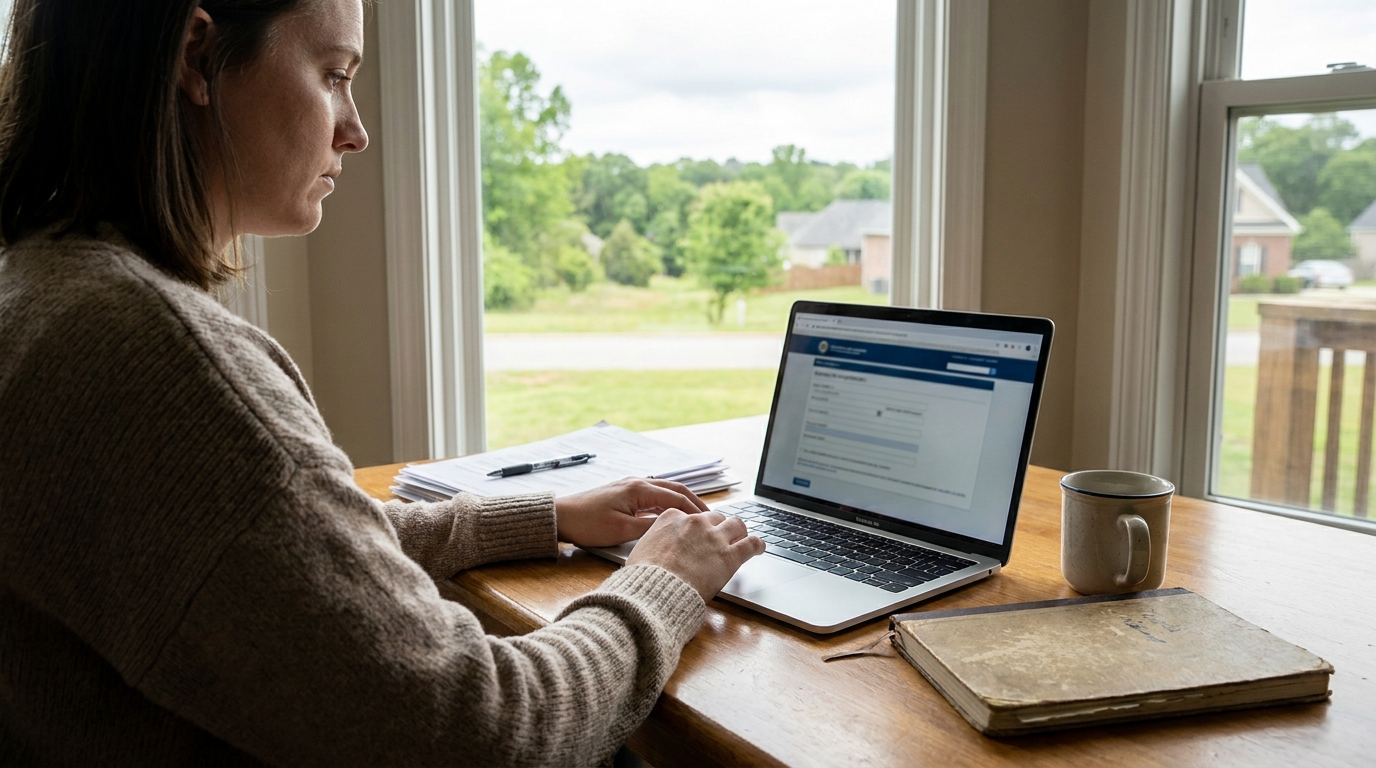
Starting a home school in North Carolina begins with one short online form — and most parents are surprised by how little the state actually asks for. Filing a notice of intent with the NC Division of Non-Public Education (DNPE) is free, takes a single sitting, and does not require anyone to approve your curriculum. This walkthrough covers what the form asks, who has to file, when, and what your ongoing duties look like once the confirmation lands in your inbox.
Quick Answer
A notice of intent in North Carolina is a free online filing to the NC Division of Non-Public Education that officially opens your home school. You name the school, designate a chief administrator who holds at least a high school diploma, and file once your youngest enrolled child has reached age 7. DNPE sends back a confirmation. No curriculum is reviewed, and no one grants or denies permission.
TL;DR
- A notice of intent is a notification, not an application — you are telling the state you plan to educate at home, not asking it to agree. See what the term actually means
- North Carolina's NOI filing happens online through DNPE and costs nothing. Walk through the DNPE form step by step
- Compulsory attendance starts at age 7, so there's nothing to file for a younger child. Check the eligibility rules first
- The real work is ongoing: a nine-month schedule, attendance and immunization records, and an annual nationally standardized achievement test. Review your duties after filing
- NC sits mid-spectrum for paperwork compared with its neighbors. Compare state filing requirements side by side
In This Article
- What Is a Notice of Intent, Exactly?
- Who Has to File a Notice of Intent in North Carolina?
- How Do You File With DNPE, Step by Step?
- What Happens After You File?
- North Carolina vs. Neighboring States: How Does the Paperwork Compare?
- What Mistakes Trip Families Up Most?
- How Do You Keep the Required Records Without Drowning in Paperwork?
- Frequently Asked Questions
What Is a Notice of Intent, Exactly?
A notice of intent is a formal written declaration telling a governing body that you plan to begin a regulated activity. In education, it tells your state that you intend to teach your child outside the public school system.
The key word is notice. You are informing, not requesting. Once filed correctly, your home school exists — nobody reviews your lesson plans or votes on your qualifications.
The phrase shows up outside education too. Construction contractors file notices of intent to preserve lien rights, and attorneys file them ahead of litigation. If you searched the bare term and landed here, the education version is the one that involves a state education department and a school-age child.
Terminology varies sharply from state to state:
- Georgia — files Georgia's Declaration of Intent with the state Department of Education, annually.
- Ohio and Pennsylvania — use notarized affidavits submitted to a local district.
- North Carolina — uses a single online filing with DNPE, submitted once.
- Virginia — sends a notice of intent to the local division superintendent.
⚠️ Careful: A form downloaded from a neighboring state's website will not be accepted in North Carolina, and the requirements attached to it are different. Always start from your own state's education agency.
Because North Carolina's filing is state-level rather than district-level, you don't negotiate with your local school board at all. That surprises families moving from states where the district is the gatekeeper.
Key takeaway: A notice of intent notifies the state that home education is beginning — it is never a request for approval, and the exact name and destination of the form changes at every state line.
Who Has to File a Notice of Intent in North Carolina?
Any family operating a home school for a child age 7 or older must file with DNPE before instruction begins. Children younger than that are below compulsory attendance age, so no filing is required yet.
North Carolina's home school law lives in the state's General Statutes, Article 39, Part 3 (G.S. 115C-563 through 115C-565), and DNPE administers it. Those sections define what a home school is and what it must do.
Run this checklist before you open the form:
- Age trigger — Your child has reached, or will reach during the school year, the compulsory attendance age of 7.
- Chief administrator named — One parent, legal guardian, or member of the household is designated, and that person holds at least a high school diploma or its equivalent.
- Two-family limit — The home school serves children from no more than two families or households. Beyond that, you are running a different kind of non-public school with different rules.
- Residence in North Carolina — The school operates at your home address in the state.
- No curriculum submission needed — You do not send in a scope and sequence, book list, or schedule.
The chief administrator requirement is the one that causes the most hesitation. The statute sets a diploma or equivalent as the bar — not a teaching license, not a college degree. One parent carries the designation for the whole school; both parents do not need separate credentials.
The two-family limit matters more than people expect. Teaching your own children plus your sister's children is generally within scope. Opening your table to four or five families turns the arrangement into something the statute treats differently, which brings a separate set of obligations.
Key takeaway: If your child is 7 or older, one adult in the household holds a high school diploma, and you're serving no more than two families, you meet North Carolina's basic conditions to file.
Because these rules come directly from statute and DNPE's own guidance, verify the current wording on the DNPE site before you submit — statutes get amended, and the agency publishes the authoritative version.
How Do You File With DNPE, Step by Step?
Filing is a single free online form on the DNPE website. Most parents finish it in one sitting, and there's no fee, no notary, and no curriculum attached.
Here's the sequence:
- Decide and set your start date. Your notice should be filed before the home school begins operating.
- Choose your school's name. This becomes the official name on every record you produce afterward — transcripts, work samples, test reports. Pick something you'd be comfortable writing on a high school transcript years from now, and avoid a name already in use.
- Designate the chief administrator. Enter the name of the parent or guardian who will hold that role, and confirm the diploma information the form requests.
- Enter address and contact details. Your home address is the school's address.
- Select religious or non-religious designation. North Carolina law provides for both categories. The ongoing requirements are identical either way — this is a classification, not a privilege tier.
- Submit and wait for confirmation. DNPE returns a confirmation notice. Save it. It is the single document that proves your school legally exists.
If your child is currently enrolled in a public school, there's a parallel task the state filing does not handle for you: formally withdrawing from that school. The district needs its own written notification, or your child can be recorded as absent while you believe everything is settled. Handle the withdrawal and the NOI filing in the same week so neither slips.
A few practical notes on the form itself:
- One filing covers all your children. You are opening a school, not registering each student separately.
- Nothing is approved or denied. Confirmation means your filing was received and recorded.
- Keep your details current. If you move, change the chief administrator, or close the school, DNPE's record needs updating.
Once the confirmation arrives, the paperwork phase is genuinely over and the teaching phase begins. If you're mapping out what comes next — curriculum, routine, and the first full term — the broader step-by-step checklist for new homeschoolers covers the ground this article deliberately doesn't.
What Happens After You File?
DNPE sends confirmation, and from that moment your obligations become ongoing rather than one-time. North Carolina asks for comparatively little paperwork up front and somewhat more over the long run.
Chief administrator is the person designated in your filing who is legally responsible for the home school's operation, including maintaining its records and arranging annual testing.
Four duties follow your filing:
- Operate on a regular schedule for at least nine calendar months of the year, excluding reasonable holidays and vacations.
- Keep attendance records for each enrolled child. There's no state-mandated format, but the records must exist and be available.
- Keep immunization records for each child, matching what any school-age child in the state is expected to have on file.
- Administer a nationally standardized achievement test annually, covering English grammar, reading, spelling, and mathematics. Results must be retained for at least one year.
DNPE may request to review those records, with notice. That review is routine administration rather than an inspection of your teaching philosophy — the agency is checking that attendance, immunization, and test documentation exist.
Key takeaway: Your four ongoing North Carolina duties are a nine-month schedule, attendance records, immunization records, and an annual standardized achievement test with results kept for a year.
The nine-month requirement trips people up because it sounds like a seat-time rule. It isn't a daily hour count — it's a requirement that your school operates on a regular schedule across most of the calendar year. Still, a simple log makes the requirement easy to demonstrate. If you want a system rather than a shoebox, here's a practical guide to track homeschool attendance hours without turning it into a second job.
On testing: the statute specifies a nationally standardized test or nationally normed equivalent. Plenty of options are available to home educators by mail or online, and families generally schedule theirs in spring. Build it into your calendar the same week you file, so the first year doesn't end with a scramble.
North Carolina vs. Neighboring States: How Does the Paperwork Compare?
North Carolina sits in the middle of the regulation spectrum. There's more structure than states with option-based systems, and far less than states requiring quarterly reports and portfolio reviews.
| State | What the filing is called | Where it goes | Annual testing required? | Records to keep |
|---|---|---|---|---|
| North Carolina | Notice of intent | NC Division of Non-Public Education (state) | Yes — nationally standardized, annually | Attendance, immunization, test results (1 year) |
| South Carolina | Varies by which of three statutory options you choose | District board or an approved association | Depends on the option selected | Varies by option; typically attendance and work samples |
| Georgia | Declaration of Intent | Georgia Department of Education, annually | Standardized testing on a periodic schedule | Attendance records and annual progress assessments |
| Virginia | Notice of intent | Local division superintendent | Annual evidence of progress required | Notice, curriculum description, year-end evidence |
| Tennessee | Independent home school registration, or enrollment via an umbrella/church-related school | Local district or umbrella school | Depends on the path chosen | Attendance and records per path |
Three structural differences stand out:
- Who receives the filing. North Carolina files to a state agency. Virginia and parts of South Carolina and Tennessee file locally, which means your experience can vary by district.
- How often you file. North Carolina's notice of intent stays active until you close the school. Georgia requires a fresh declaration each year.
- What flexibility exists in the model. Some states offer multiple legal routes to home educate. North Carolina offers one home school route, with religious and non-religious designations carrying identical duties.
⚠️ Verify before you file. State education agencies update guidance and legislatures amend statutes. Treat this table as orientation, then confirm the current requirement on the relevant state department of education or non-public education office website before submitting anything.
If you're relocating mid-year, the practical consequence is that your North Carolina confirmation does not transfer. You close here and file there, under whatever that state calls its form.
What Mistakes Trip Families Up Most?
Three stumbles account for most of the trouble: filing too early, forgetting the school withdrawal, and skipping the annual test.
- Filing before age 7 and assuming it carries forward. If you file for a 5-year-old, the filing may not sit correctly against the compulsory attendance trigger. Wait until the right year, then file.
- Not formally withdrawing from the public school. The state filing and the district withdrawal are separate actions. Skip the second and your child may be marked absent.
- Skipping the annual standardized test. It is the easiest duty to postpone and the hardest to retroactively fix. Calendar it.
- Letting the chief administrator designation go stale. If the designated parent changes — through a move, separation, or simply a shift in who's teaching — update the record rather than leaving it inaccurate.
- Choosing a school name already in use. Have a second and third choice ready.
- Not saving the DNPE confirmation. Co-ops, sports leagues, music programs, and some employers' dependent paperwork ask to see it. Store a digital copy somewhere you'll find it in three years, alongside the rest of your records — a good reason to build an online homeschool portfolio from day one rather than year four.
⚠️ The quiet one: Families who move within North Carolina often forget to update their address with DNPE. The record should reflect where the school actually operates.
How Do You Keep the Required Records Without Drowning in Paperwork?
Pick one system for attendance, one for test results, and one for work samples — then update them weekly instead of reconstructing a year in April.
Options you can set up this afternoon:
- Attendance — A shared spreadsheet with a row per month and a checkbox per instructional day. Nine months of regular operation becomes visible at a glance.
- Immunization — A single scanned PDF per child, stored with the DNPE confirmation.
- Test results — One dated folder per child per year. Drop the score report in the moment it arrives.
- Work samples — Three or four pieces per subject per term is plenty for most purposes. Photograph physical work rather than storing it.
- The confirmation letter — Pinned at the top of your folder structure, because it's the item you'll be asked for most often.
The weakest link in almost every system is the weekly update. Logs that depend on someone remembering to fill them in on a Friday afternoon tend to develop gaps around holidays, illness, and busy seasons — exactly the periods you'd most want documented.
That's where the record and the teaching can overlap instead of competing. A planning system like LearnSpark builds each day's lesson from where your child actually is, and logs attendance and mastery as those lessons are completed — so the nine-month record and the progress notes accumulate from the teaching you were already doing. The admin hour that used to sit at the end of the week goes back to you.
For the wider picture of what's worth tracking beyond the legal minimum — and how to read progress without constant testing — this guide to building a homeschool progress tracking system is a good next read.
Key takeaway: Three folders, one weekly habit, and a saved confirmation letter cover everything North Carolina asks you to retain.
Frequently Asked Questions
Do I need to file a notice of intent in North Carolina for a 5-year-old?
A: No. Compulsory attendance in North Carolina begins at age 7, so filing isn't required until the school year in which your child reaches that age. You are free to teach at home before then without any state filing. Many families use those early years informally and file when the age trigger arrives.
Is there a fee to file with DNPE?
A: No. The North Carolina notice of intent is free and submitted online through the DNPE website. Be cautious of third-party sites offering to "process" or "expedite" the filing for a fee — the form is one you complete yourself in a single sitting, directly with the state.
What happens if I miss filing before I start teaching?
A: File as soon as you realize. North Carolina expects the notice before the home school begins operating, and the practical remedy for a late filing is usually prompt filing rather than a penalty. If your situation is unusual — a mid-year move, or a child already recorded as absent — contact DNPE directly and ask.
Do I have to file a new notice of intent every year?
A: No. Unlike Georgia's annual declaration, a North Carolina notice of intent stays active until you close the school. You do need to keep the record current, though — update DNPE if your address changes, if the chief administrator changes, or when you close the home school.
Can I homeschool other people's children under my notice of intent?
A: Only children from no more than two families or households may be taught in a single North Carolina home school. Teaching beyond that limit means you're operating a different category of non-public school, with its own separate requirements. Co-op arrangements usually work around this by having each family file their own notice.
Summary
Filing a North Carolina notice of intent is one of the simpler pieces of starting home education: a free online form to DNPE, submitted once your child reaches age 7, naming your school and a chief administrator with a high school diploma. Nobody approves your curriculum, and the confirmation you receive is the document that proves your school exists.
The work that follows is lighter than it sounds, but it is continuous — a nine-month schedule, attendance and immunization records, and one annual standardized test. Set up your record system in the same week you file, keep it current weekly, and the compliance side of homeschooling in North Carolina stays quietly in the background where it belongs.
Information about third-party platforms reflects publicly available details at the time of writing and may have changed. Please verify directly with the provider. See our Terms of Use for more.