
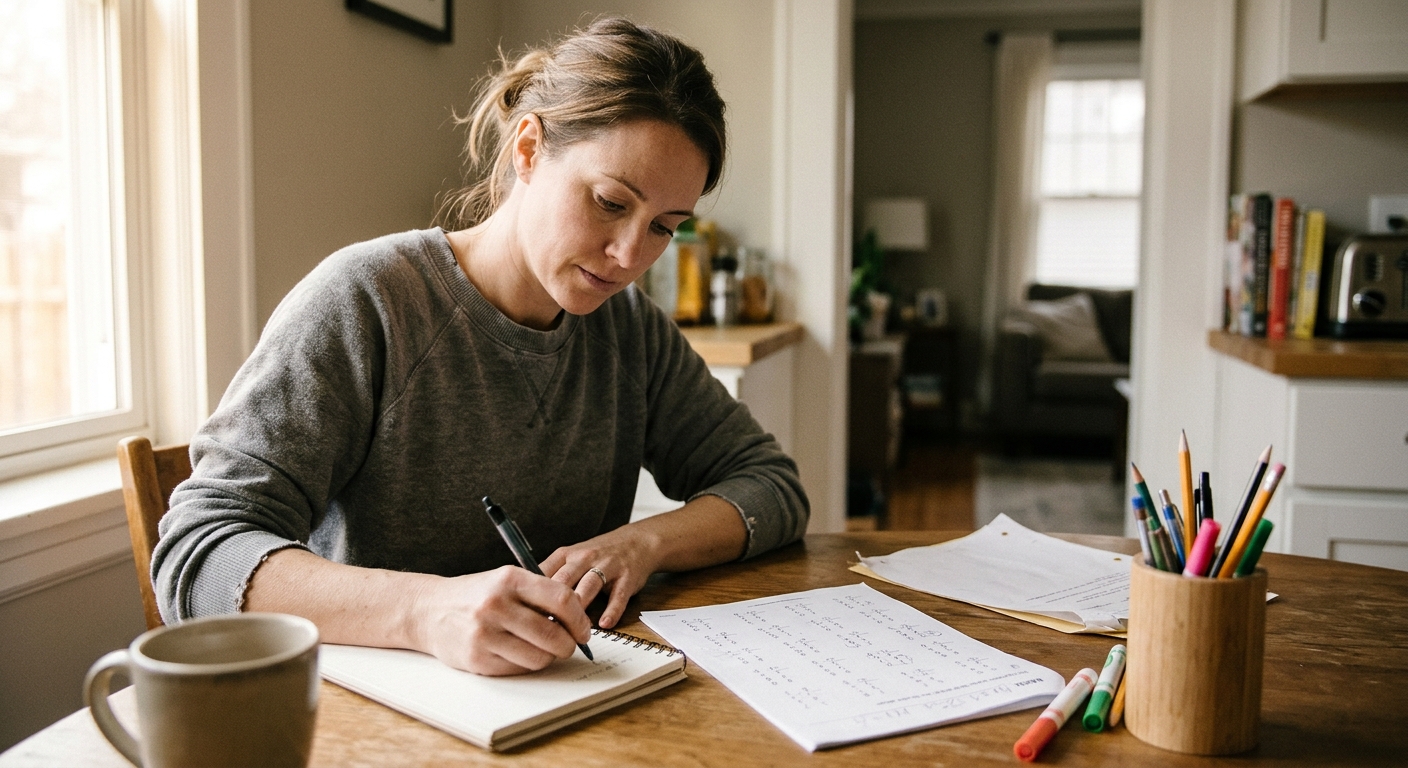
Missouri homeschool requirements for record keeping are shorter than most families expect: three documents, one annual hour total, and nobody to mail anything to. The catch is that the hour rules have a split inside them that trips people up. Here's exactly what to log, a fill-in daily template you can copy today, and how those records turn into a diploma later.
Quick Answer
Missouri law (RSMo 167.031) requires a home school to keep three things: a plan book, diary, or daily log showing subjects taught and activities, a portfolio of samples of the child's academic work, and a record of evaluations of the child's progress. Students must receive 1,000 hours of instruction per year, with at least 600 hours in reading, language arts, math, social studies, and science — and at least 400 of those 600 hours at the regular home school location. You file none of it with anyone unless a court requests it.
TL;DR
- Missouri names exactly three required records in statute — a log, a portfolio, and progress evaluations. See what each record has to contain
- The hour math is 1,000 total, 600 core, 400 of the core at home. Most families miss the last number. Walk through the hour breakdown
- A one-line-per-session log satisfies the statute. Perfect systems get abandoned by October. Copy the fill-in daily log template
- Missouri requires no standardized testing, but it does require recorded evaluations — parent-written narratives count. See sample evaluation wording
- Missouri parents issue their own diploma and transcript. Your hour log is what makes that transcript credible. Turn logged hours into credits
In This Article
- What Records Does Missouri Actually Require?
- How Do the 1,000, 600 and 400 Hour Rules Fit Together?
- A Fill-In Daily Hour Log Template You Can Copy
- What Belongs in the Work-Sample Portfolio?
- How Do You Record Evaluations Without Standardized Testing?
- How Long Should You Keep Missouri Homeschool Records?
- Turning Records Into a Transcript and Diploma
- Paper Binder, Spreadsheet or Software: Which Suits Missouri?
What Records Does Missouri Actually Require?
Three things, named directly in the Missouri Revised Statutes at section 167.031. Nothing else is required, and nothing is submitted to a school district or the state.
A Missouri home school record is a plan book, diary, or daily log showing the subjects taught and the activities engaged in, kept alongside a portfolio of the child's academic work samples and a record of evaluations of the child's academic progress. That three-part set is the whole legal obligation for documentation.
Here is what each one means in practice:
- The log — dated entries showing what you taught, for how long, and where. This is also your hour count.
- The portfolio — dated samples of your child's actual work, showing progress across the year.
- The evaluations — some written record of how the child is doing, term by term or year by year.
If you are still at the withdrawal stage and haven't sent your letter yet, start with the practical sequence for how to start homeschooling in Missouri and come back here once you're teaching.
⚠️ Missouri has no notice of intent, no annual report, and no district approval step for home schools. Statute 210.167 is the enforcement side: records can be requested by a court or prosecuting attorney in a truancy proceeding. That is the one scenario your records exist for.
Key takeaway: Keep a log, keep work samples, keep evaluations — and keep them where you can find them. There is no form to file.
How Do the 1,000, 600 and 400 Hour Rules Fit Together?
Think of it as one total with two nested minimums inside it. You need 1,000 hours of instruction in the school year. At least 600 of those must be in the five core subjects. At least 400 of those 600 core hours must happen at your regular home school location.
| Requirement | Hours | What Counts | Common Mistake |
|---|---|---|---|
| Total instruction | 1,000 | All subjects, including electives, art, music, PE, field trips | Counting only "desk time" and undershooting badly |
| Core subjects | 600 minimum | Reading, language arts, math, social studies, science | Forgetting that reading and language arts are separate lines |
| Core hours at home location | 400 of the 600 | Core instruction delivered at your stated home school site | Logging co-op and museum core hours toward this number |
| Flexible remainder | Up to 400 | Electives, enrichment, life skills, travel-based learning | Treating these as optional — they count toward the 1,000 |
The arithmetic catches people out. Four hours a day, five days a week, for 36 weeks gives 720 hours. That is well short of 1,000. Most Missouri families close the gap one of three ways: longer days, a longer year that runs into summer, or more honest counting of the learning that already happens.
That last one matters. Read-aloud time, a documentary followed by discussion, cooking that turns into fraction work — all of it is instruction when you record the subject and the activity. The log is where it becomes countable.
Missouri law also provides for the hour requirement to be modified for a child with a diagnosed disability. If that applies to your family, confirm the specifics with a Missouri-focused legal resource before you set your yearly target.
If you teach across state lines or expect to move, keep a copy of the free state requirements reference alongside your log, because hour rules vary sharply from one state to the next.
Key takeaway: 1,000 total, 600 core, 400 of the core at home. Track the location column from day one — you cannot reconstruct it in May.
A Fill-In Daily Hour Log Template You Can Copy
The simplest compliant log is six columns. Copy this structure into a notebook, a spreadsheet, or whatever you already use.
| Date | Subject | Core or Non-Core | Location | Hours | Activity & Materials |
|---|---|---|---|---|---|
| Oct 12 | Math | Core | Home | 1.0 | Fractions — halving a pizza, workbook pp. 42–44 |
| Oct 12 | Science | Core | Away (co-op) | 1.5 | Density lab, salt water vs. fresh, group write-up |
| Oct 13 | Language Arts | Core | Home | 0.75 | Paragraph on the lab, edited for topic sentences |
| Oct 13 | Art | Non-Core | Home | 0.5 | Watercolor leaf study, fall colors |
Add two rollup rows and your year takes care of itself:
| Period | Total Hours | Core Hours | Core at Home |
|---|---|---|---|
| Week of Oct 12 | 18.5 | 12.0 | 9.5 |
| October total | 76.0 | 49.5 | 38.0 |
Five things to write down the same day you teach them:
- The date — not "week of," the actual day.
- The subject label you will use on a transcript later.
- Core or non-core, decided once per subject and kept consistent.
- Home or away, every single time.
- One line on the activity, specific enough to jog your memory in June.
Logging at the end of the session takes under a minute. Logging at the end of the month takes an hour and produces guesses. For general techniques that work in any state, see the companion guide on how to track homeschool hours.
What Belongs in the Work-Sample Portfolio?
Samples that show progress over time — not your child's best work. An evaluator or a receiving school learns far more from a September writing sample sitting next to a May one than from a folder of A papers.
A portfolio is a dated collection of academic work samples that demonstrates what was taught and how the child progressed across the year. Date every piece. Undated work proves nothing.
A workable collection per child looks like:
- Writing — one sample early in the year, one mid-year, one at the end.
- Math — a test or quiz per quarter, including one with corrections visible.
- Science — a lab sheet, a diagram, or a project write-up.
- Reading — a running book list with dates finished.
- Field work — a photo from a Missouri State Capitol tour or a science center visit, with a one-line caption tying it to a subject and the hours you logged.
The practical rule: two or three samples per core subject per quarter is plenty. If storing paper is the friction point, you can build your portfolio online by photographing work as you go.
⚠️ The most common portfolio mistake is keeping everything. A box of 400 worksheets is not a record — it is a sorting problem you have handed to your future self. Choose, date, file, recycle the rest.
How Do You Record Evaluations Without Standardized Testing?
Missouri does not require standardized testing, state assessment, or an outside evaluator. The statute at 167.031 does require "a record of evaluations of the child's academic progress," which means the judgment is yours to make and yours to write down.
A progress evaluation is a dated written assessment of what a child has learned in a subject and what they are working on next. Three approaches satisfy this:
- Parent-written narrative — a short paragraph per subject, each term.
- Graded work — scores on tests or assignments, summarized into a term grade.
- Optional norm-referenced testing — a nationally normed test taken privately, if you want an outside data point. Nothing in Missouri law requires it.
Wording you can adapt for a narrative evaluation:
Quarter 2, Mathematics, Grade 4. Multiplication facts through 12 are now fluent. Long division with two-digit divisors is emerging — accurate with a reference chart, inconsistent without one. Fractions equivalence was introduced in November with strong results. Next quarter: division fluency and adding unlike denominators.
That is enough. It names the subject, the period, what is mastered, what is shaky, and what comes next. Three or four of those per child per term builds a defensible evaluation record and makes grading simple later. Requirements differ elsewhere, so check the free state requirements reference before assuming Missouri's flexibility travels with you.
How Long Should You Keep Missouri Homeschool Records?
Keep them for the whole time you homeschool, plus a few years past graduation. Only three audiences ever ask, and each wants something different.
- A court or prosecuting attorney, in a truancy inquiry — wants the three statutory records for the years in question.
- A public school district, when a student enrolls or re-enrolls — wants hours, subjects, and recent work samples for placement.
- A college or military recruiter — wants a transcript and proof of graduation, not your daily log.
⚠️ Store both a digital backup and a physical folder. Cloud storage survives a basement flood; paper survives a dead laptop and a forgotten password. Scan work samples at the end of each quarter rather than all at once in May.
Families who move mid-year carry a second problem: the receiving state may want documentation Missouri never asked for. Check the homeschool requirements by state before you pack, and keep the Missouri hour log intact rather than restarting it.
Turning Records Into a Transcript and Diploma
In Missouri, the parent-administrator issues the diploma and the transcript. There is no state-issued homeschool diploma, and none is needed. Your records are what give those documents substance.
A homeschool transcript is a one-page summary of courses completed, credits earned, grades, and graduation date, signed by the parent who administered the program. Hours convert to credits using a widely used convention: roughly 120 to 180 hours of instruction in a single subject equals one high school credit.
| Logged hours in a subject | Typical credit assigned | Example |
|---|---|---|
| 60–90 | 0.5 credit | Semester of health or personal finance |
| 120–180 | 1.0 credit | Full-year Algebra I or Biology |
| 240–360 | 2.0 credits | Two years of the same world language |
Your transcript needs: course title, year completed, credits, grade, cumulative GPA, graduation date, and your signature. Some Missouri scholarship and dual-enrollment programs ask homeschool applicants for specific documentation, so confirm current rules directly with the program rather than assuming.
The hard part is almost never the format. It is reconstructing four years of courses from memory because the log stopped in November of sophomore year. Systems that generate progress notes and mastery reports from lessons you have already taught — LearnSpark is one — mean the transcript is assembled from records that built themselves as you went, instead of a weekend of archaeology. The practical gain is the end-of-year scramble disappearing, so your attention stays on teaching. The same discipline described in how to track homeschool hours is what makes the transcript trustworthy years later.
Key takeaway: The diploma is yours to issue. The log is what makes it mean something.
Paper Binder, Spreadsheet or Software: Which Suits Missouri?
All three satisfy the statute. The right choice depends on how many children you teach and whether you log daily or catch up weekly.
| Method | Setup Time | Hour Totals | Portfolio Storage | Best For |
|---|---|---|---|---|
| Three-ring binder | Minutes | Manual addition | Physical, in the same binder | One or two children, daily loggers who like paper |
| Google Sheets log | An hour | Automatic with formulas | Separate — folder or photos | Families who want running core/at-home totals |
| Homeschool planner app | A session or two | Built in | Built in, usually digital | Three or more children, multiple subject lines |
| Hybrid (sheet + paper folder) | An hour | Automatic | Physical samples, digital hours | Most families, honestly |
A plain composition notebook is legal. So is a spreadsheet with four tabs. The failure mode is never the tool — it is a system elaborate enough that you stop updating it in week six.
If you are leaning digital, compare homeschool record keeping software on the two features Missouri actually stresses: a location field on every entry, and separate core versus non-core totals.
Summary: Missouri Homeschool Requirements, in One Place
The missouri homeschool requirements for documentation come down to a log, a portfolio, and evaluations — kept by you, shown to nobody unless a court asks. Hit 1,000 hours, with 600 in the core five, and 400 of those core hours at home. Date everything. Record the location every time. Those habits take a minute a day and produce a transcript, a diploma, and a clean answer to any question a district or court could raise.
Frequently Asked Questions
Do I have to send my homeschool records to anyone in Missouri?
No. Missouri has no notice of intent, no annual report, and no district filing requirement for home schools. You keep the records yourself and produce them only if a court or prosecuting attorney requests them under RSMo 167.031. That is also why the records matter — they are your documented answer in the one situation where someone has standing to ask.
Do field trips and co-op classes count toward the 1,000 hours?
Yes. Instruction at a co-op, museum, or field site counts toward your 1,000-hour total, and core-subject instruction there counts toward the 600. It does not count toward the 400-hour at-home core minimum, because that requirement is tied to the regular home school location. A co-op chemistry lab or a Kansas City museum day is core instruction — just log the location as "away."
What happens if I fall short of 1,000 hours?
The hour requirement functions as your legal footing against a truancy claim, so a shortfall matters most if a district or court ever inquires. The practical fix is simple: in Missouri the parent defines the school year, so extend teaching into the summer and keep logging. Check your running total each month rather than discovering a 200-hour gap in May.
Can I start homeschooling mid-year in Missouri?
Yes. Families who withdraw mid-year commonly prorate the 1,000 hours across the remaining months, keeping the same 600 core and 400 at-home proportions, and note the start date at the top of the log. For the withdrawal letter and the order to do things in, follow the step-by-step guide on how to start homeschooling in Missouri.
This article explains general requirements and is not legal advice. Verify current statutory language and any program-specific rules directly with the relevant authority. See our Terms of Use for more.