
Michigan Homeschool Laws: Two Legal Paths Compared
Michigan homeschool laws give families more freedom than almost any other state — and that freedom is exactly what makes them confusing. There is no form to file, no annual test and no state office waiting to approve your plan, which leaves many new parents wondering whether they have skipped a step. This guide walks through the two legal paths Michigan offers, the subjects you must cover, the records worth keeping anyway, and how diplomas, special education and dual enrollment actually work.
Quick Answer
Michigan homeschool laws let you home educate one of two ways. Most families use the home school option under the compulsory attendance statute (MCL 380.1561), which requires no notice to the state, no testing, no teacher certification and no submitted records — only instruction in nine named subjects. The alternative is operating as a non-public school, which involves annual reporting to the Michigan Department of Education and certified-teacher instruction, unless a religious exemption applies.
TL;DR
- Two legal paths exist, and they are not equally popular. The home school option carries almost no paperwork; the non-public school option carries reporting duties. Compare the two options side by side
- Michigan requires no notice of intent. If your child has never enrolled, you simply begin; if they are enrolled, you send a withdrawal letter. Walk through the step-by-step start
- Nine subjects are named in the statute, but no hours are. There is no required day count or clock-hour total for home-educated students. See the full required subject list
- Students with disabilities can still seek district support. Evaluation and some services may be available through your resident district. Read how special education requests work
- The parent issues the diploma. Michigan has no state homeschool diploma and no exit exam, so your transcript does the heavy lifting. See what a credible transcript contains
In This Article
- What Are Michigan's Two Legal Homeschool Options Under Michigan Homeschool Laws?
- How to Homeschool in Michigan: Where Do You Start, Step by Step?
- What Subjects Does Michigan Require You to Teach?
- What Records Should Michigan Homeschoolers Keep Anyway?
- How Does Michigan Handle Homeschooling a Child With Special Needs?
- Do Michigan Homeschoolers Get a Real Diploma?
- Can Michigan Homeschoolers Take Public School Classes, Sports or Dual Enrollment?
- How Do You Choose Curriculum That Fits Michigan's Freedom?
- Frequently Asked Questions
What Are Michigan's Two Legal Homeschool Options Under Michigan Homeschool Laws?
Michigan's compulsory attendance law, MCL 380.1561, lists several exemptions from public school attendance. Two of them matter to home educators, and families choose one or the other — not both.
The home school option is parent-directed instruction delivered at home in an organized educational program covering the subjects the statute names. It carries no notification requirement, no testing mandate, no teacher certification requirement and no obligation to submit records to anyone.
The non-public school option is operating your home as a private school under the same statute. Non-public schools in Michigan report enrollment and staff information annually to the Michigan Department of Education and are generally expected to use certified teachers. A religious exemption to the certification expectation has existed since the Michigan Supreme Court's 1993 decision in People v. DeJonge, which involved parents teaching their own children for sincerely held religious reasons.
Here is how the two compare in practice:
| Home school option | Non-public school option | |
|---|---|---|
| Notice to the state | None required | Annual report of enrollment and staff to the Michigan Department of Education |
| Teacher qualifications | None specified | Certified teacher expectation, with a religious exemption recognised in case law |
| Required subjects | The nine subjects named in the statute | Comparable instruction to public school subject areas |
| Testing | None | None mandated for the student |
| Records submitted | None | Enrollment and staff data |
| Who it tends to suit | Families wanting minimal administration | Families wanting formal private-school status, often for structural or affiliation reasons |
Most Michigan families use the home school option precisely because it asks the least of them administratively. The non-public school route is usually chosen by families who want formal school status for a specific reason — joining an umbrella structure, for example, or running something closer to a small private school.
It helps to see Michigan in context. Some states require a notice of intent, periodic standardised testing, portfolio evaluation by a certified reviewer, or all three. Michigan asks for none of that. If you are weighing a move, or comparing what friends in other states describe, it is worth understanding how homeschool laws vary state to state before assuming your neighbour's paperwork applies to you.
Key takeaway: Most Michigan families homeschool under the home school exemption because it requires no notice, no testing and no submitted records — the non-public school route exists mainly for families who want formal private-school status.
This article is general information about Michigan's legal framework, not legal advice. Statutes and administrative rules change, so confirm current requirements with the Michigan Department of Education or a Michigan education attorney before relying on any detail here.
How to Homeschool in Michigan: Where Do You Start, Step by Step?
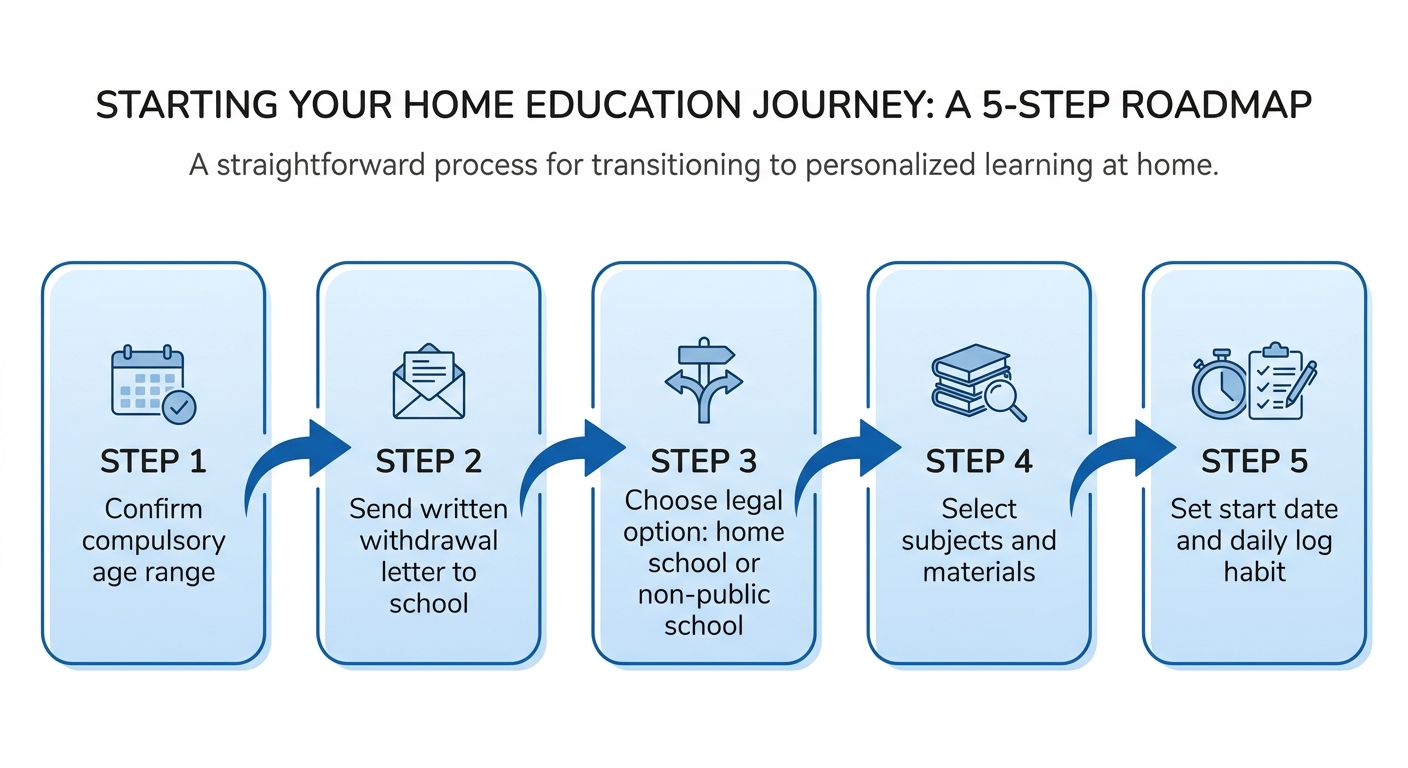
If your child is already enrolled in a public school, you start by sending a written withdrawal letter. If your child has never enrolled, there is nothing to send — you simply begin teaching.
Michigan's compulsory attendance window generally runs from age 6 to age 18, so a child under 6 is not yet covered by the law at all. Confirm the current age range before you make decisions based on it.
Here is the sequence most families follow:
- Confirm your child falls inside the compulsory age range. Under-6 learners need no legal action.
- Write and send the withdrawal letter to the school principal or district office if your child is currently enrolled.
- Choose your legal option — home school exemption or non-public school.
- Decide what you will teach across the nine required subject areas.
- Set a start date and a simple daily habit for noting what got done.
What goes in a Michigan withdrawal letter?
Keep it short and factual. A usable letter contains:
- Your child's full name and date of birth — so the district can match the record
- Current school, grade and student ID if you have one
- The effective date you are withdrawing
- A plain statement that you are educating your child at home under MCL 380.1561
- A request that the district update its records and confirm receipt in writing
- Your signature and the date
You do not need to explain your reasons, outline your curriculum or ask permission. Send it in a way that creates a record — certified mail or email with a read receipt — and keep a copy.
Consider a family in Grand Rapids pulling a fourth grader mid-semester. They email the principal on a Friday with the details above, print a copy for their file, and begin at home the following Monday. There is no waiting period written into the home school exemption, and no approval step to clear.
The first weeks tend to be about rhythm rather than curriculum. Many families report that their initial schedule was far too ambitious and settled into something shorter within a month. If you are building that rhythm from scratch, the full step-by-step checklist for new homeschoolers covers the practical setup — space, materials, routine — that Michigan law deliberately leaves to you.
Key takeaway: Learning how to homeschool in Michigan is mostly logistics, not legal work — withdraw in writing if your child is enrolled, pick your legal option, and start.
What Subjects Does Michigan Require You to Teach?
Michigan's statute requires an organized educational program in nine named areas. That list is the whole academic mandate.
An organized educational program is instruction that is planned and sequential rather than incidental. The law does not define a method, a textbook list or a pacing schedule — it expects the teaching to be deliberate, not accidental.
The nine subjects are:
- Reading
- Spelling
- Mathematics
- Science
- History
- Civics
- Literature
- Writing
- English grammar
Notice what is absent. There is no required hours-per-day figure, no minimum days-per-year count, no specified grade-level benchmark and no approved curriculum list. Several neighbouring states attach explicit instructional hour or day totals to home education; Michigan does not apply such a count to families under the home school exemption.
That freedom cuts both ways. Nobody tells you what "enough" looks like, which is liberating in year one and unsettling in year three. A common approach is to use published learning standards as a private yardstick — not because Michigan requires alignment, but because it gives you something external to check against when you wonder whether your eighth grader is where they should be. If that appeals, read about curriculum guides by subject to see how families structure coverage without surrendering flexibility.
What Records Should Michigan Homeschoolers Keep Anyway?
Michigan requires no records to be submitted under the home school option — but keeping them is still one of the smartest things you can do. Records are useful for the moments you cannot predict.
Four situations tend to prompt a request for documentation:
- A truancy inquiry from a district that has not updated its enrollment file
- College applications, where admissions offices expect a transcript with course detail
- Athletic or part-time enrollment eligibility, where a district may ask what the student has studied
- Moving to a higher-regulation state, where portfolios or evaluations become mandatory
What should a Michigan homeschool file contain?
A practical file is small and consistent rather than exhaustive:
- An attendance log — a calendar with days marked is sufficient
- A subject-by-subject note of what was covered each term
- Work samples filed by term, roughly six to eight pieces per child per semester
- A reading list with titles and dates
- Assessment notes — quiz scores, narrative observations or anything showing progress
- Copies of correspondence with the district, including your withdrawal letter
A folder per child per semester, with those six to eight samples inside, is enough to reconstruct a school year later. The hard part is not the format. It is doing it weekly for nine months while also teaching.
That is the quiet burden of Michigan's light regulation: no deadline forces the paperwork, so it accumulates until a college application or a district letter makes it urgent. This is one of the few teaching tasks that can genuinely be handed off. LearnSpark is a home education companion whose proprietary learning algorithm tracks each child's progress against educational standards and turns that tracking into progress notes and mastery reports as you teach — so the record builds while the lesson happens, and the evening stays yours. For a broader look at the category, see record keeping software that handles portfolios and transcripts.
Key takeaway: Michigan never asks for your records, which is exactly why they are easy to neglect — build a simple weekly habit now so the file exists when a college, a district or a move demands it.
How Does Michigan Handle Homeschooling a Child With Special Needs?
Homeschooled students in Michigan with suspected or identified disabilities may be able to access evaluation and certain special education services through their resident public school district. The path starts with a written request, and what follows depends on both state rules and federal law.
Two frameworks interact here:
- Michigan Administrative Rules for Special Education (MARSE) — the state rules governing identification, evaluation and service delivery.
- IDEA Part B provisions for parentally placed students (federal regulations at 34 CFR 300.130–300.144) — which direct districts to spend a proportionate share of federal funds on students whose parents have placed them outside the public system, typically through a services plan rather than a full Individualized Education Program.
How do you request an evaluation?
Put it in writing and keep a copy. A useful request includes:
- Your child's name, date of birth and your address within the district
- A statement that your child is home educated and that you are requesting a special education evaluation
- Specific concerns — what you observe in reading, speech, attention, motor skills or behaviour
- Any outside documentation you already hold, such as a paediatrician's or therapist's notes
- A request for written response including timelines
Districts vary considerably in what they offer home-educated students. Evaluation, speech and language support, and occupational therapy are commonly discussed; the scope and scheduling of services is a district-level decision and is not guaranteed. Ask what is available, ask in writing, and ask for the answer in writing too.
Services from a district, where offered, usually amount to a few hours a week at most. The daily teaching still belongs to you — and that is where most of the real work sits. Families supporting a child with dyslexia, ADHD or autism often find the planning is harder than the teaching, because every lesson needs adjusting for pace, sensory load and attention span. If that is your situation, see the practical approach to planning lessons for a neurodivergent learner alongside whatever your district provides.
⚠️ Michigan's designation of home education within the non-public school framework affects how federal proportionate-share rules are applied. Before assuming a particular service is available, confirm the current position with your district's special education office or the Michigan Department of Education's Office of Special Education.
Who should you contact first about homeschool special needs in Michigan?
Start with your resident district's special education office, not the building principal. That office handles evaluation requests and knows what the district currently offers parentally placed students.
Three habits make the conversation go better:
- Write everything down. Email creates a timeline; a phone call does not.
- Ask three specific questions. Will you evaluate? What services, if any, follow? On what schedule?
- Keep every reply in the same file as your other homeschool records.
Do Michigan Homeschoolers Get a Real Diploma?
Yes. In Michigan the parent or home school issues the diploma, and there is no state-issued homeschool diploma, no state registration of graduates and no required exit examination.
That surprises people, so it is worth being precise: the diploma itself is a document you create. What gives it weight is the transcript behind it.
What should a Michigan homeschool transcript contain?
- Course titles for each year, named the way a school would name them
- Credits awarded per course, with your credit definition noted
- Grades and a grade-point average, with your grading scale explained
- Graduation date and the school name you use for your home school
- A parent signature attesting to accuracy
- Supporting detail such as standardised test scores, dual enrollment transcripts or course descriptions
What are the Michigan homeschool graduation requirements?
There are no state-mandated Michigan homeschool graduation requirements for families under the home school exemption. No credit minimum, no exit exam and no state sign-off — you set the standard and record it on the transcript.
The Michigan Merit Curriculum sets graduation requirements for public school students. For families under the home school exemption it functions as an optional benchmark rather than a mandate — some parents mirror it deliberately so a transcript looks familiar to admissions readers, others design their own course sequence.
| Parent-issued diploma | GED | Accredited umbrella or online school diploma | |
|---|---|---|---|
| Who issues it | You, as the home school | The state testing authority | The enrolling school or program |
| Typical cost | Materials only | State test fees | Tuition, varies by provider |
| Effort required | Building and maintaining a transcript | Preparing for and passing the test battery | Meeting the provider's full course requirements |
| Common use case | Most Michigan homeschool graduates | Students who need a credential quickly | Families wanting third-party validation |
Michigan's public universities generally accept parent-prepared transcripts from home-educated applicants, often alongside test scores or detailed course descriptions. Requirements differ by institution and change over time, so check each admissions office's current homeschool applicant page rather than relying on what another family did three years ago.
Building the transcript in twelfth grade from memory is miserable. Building it incrementally from the records you already keep is routine — which is the practical argument for record keeping software that handles portfolios and transcripts from the start of high school rather than the end.
Can Michigan Homeschoolers Take Public School Classes, Sports or Dual Enrollment?
Yes, in several forms. Michigan's shared-time provision in the State School Aid Act (commonly referenced as Section 166b) allows home-educated and non-public school students to enroll part-time in non-essential elective courses at their local public school, with the district receiving state funding for those course hours.
Shared-time enrollment is part-time attendance at a public school for specific elective classes while the student is otherwise home educated. Think band, choir, art, a foreign language, a science lab or a shop class.
Michigan's Postsecondary Enrollment Options Act separately allows eligible secondary students to take college courses, with the resident district paying toward tuition under defined conditions. A home-educated eleventh grader might, for example, take composition and college algebra at a local community college while covering history, science and literature at home.
Athletics is the murkiest area. Eligibility for interscholastic sports is governed by Michigan High School Athletic Association rules and by individual district policy, and participation by home-educated students is not automatic. Ask the athletic director early, in writing, and well before a season begins.
⚠️ Shared-time access applies to non-essential elective courses, not to core academic subjects, and districts retain discretion over scheduling and capacity. A neighbouring district's generous arrangement does not obligate yours to match it — always confirm locally before building your year around a public school class.
Two practical points. First, shared-time participation may bring the school's attendance and grading expectations into your week, so ask what reporting the district will want. Second, dual enrollment coursework generates an official college transcript, which strengthens a parent-issued diploma considerably.
How Do You Choose Curriculum That Fits Michigan's Freedom?
Because Michigan publishes no approved curriculum list and mandates no testing, your choice is about fitting your child and your capacity — not satisfying a reviewer. That changes the decision criteria entirely.
Three factors tend to decide it:
- Coverage across the nine required subject areas over the year
- Workload for the teaching parent, which is the constraint most families underestimate
- Flexibility across ages, if you are teaching more than one child
What Is the Best Homeschool Curriculum for Michigan Families?
There is no officially best homeschool curriculum in Michigan, because the state approves none and reviews none. The best fit is the one you will still be using in March. These four approaches cover most of what Michigan families actually choose:
| Approach | What it is | Strongest fit |
|---|---|---|
| Boxed all-in-one | A single publisher supplies every subject, scheduled | Parents who want structure decided for them |
| Free open resources | Publicly available lessons, videos and practice sets, assembled by you | Tight budgets and confident planners |
| Piecemeal by subject | Best-fit material chosen separately for maths, reading, science and so on | Children working at different levels across subjects |
| Personalized planning tools | Daily plans generated around the child's current level and interests | Multi-age households and families who dislike Sunday-night prep |
The burden Michigan families describe most often is not finding materials. It is that no external structure exists, so the structure has to come from you — every week, for every child, for years. Boxed curricula solve that by removing choice. Free resources solve the cost but hand the assembly work back. Piecemeal gives the best academic fit and the heaviest planning load.
There is no correct answer, and most families change approach at least once. Starting with something structured and loosening it is usually easier than starting loose and trying to add structure mid-year.
Key takeaway: Choose a homeschool curriculum around your capacity as the teaching parent, not around compliance — Michigan is not checking.
Summary
Michigan homeschool laws ask very little of you on paper and quite a lot of you in practice. Legally, the home school exemption under MCL 380.1561 means no notice, no testing, no certification and no submitted records — just planned instruction in nine named subjects. Practically, that means you supply the structure, the records, the transcript and the judgement about whether your child is thriving.
The families who find Michigan easiest are the ones who treat the optional parts as non-optional: they keep an attendance log, file work samples each term, build the transcript as they go, and ask their district questions in writing. None of that is required. All of it makes the next decision — a college application, a sports season, a move across state lines — straightforward instead of stressful.
Frequently Asked Questions
How does a homeschooler get a work permit in Michigan?
Michigan's Youth Employment Standards Act requires work permits for most employment of minors under 18, and permits are issued through the school district the minor would otherwise attend. For a home-educated student, the homeschooling parent generally acts as the issuing officer, or the district superintendent's office handles the paperwork. Practice varies locally, so contact your resident district and ask who signs before your teen accepts a job.
Does Michigan require a notice of intent to homeschool?
No. Under the home school exemption there is no notice of intent, no registration form and no annual filing with the state or your district. The only letter most families send is the withdrawal letter to a school the child is leaving. If you later move to a state that does require notification, it helps to know what a notice of intent actually contains before the deadline arrives.
How many hours a day do you have to homeschool in Michigan?
Michigan sets no daily hour count and no minimum number of school days for home-educated students. The statute asks for an organized educational program across nine subjects, not a clock total. In practice, elementary families often finish core work in two to three focused hours, with older students taking longer as coursework deepens.
Do Michigan homeschoolers have to take standardized tests?
No. There is no state testing requirement for students under the home school exemption, and no evaluation or portfolio review by an outside reader. Some families test anyway — usually to benchmark progress or to strengthen a high school transcript for college admissions.
Do parents need a teaching certificate to homeschool in Michigan?
Not under the home school option. The statute specifies no parent qualifications, degree or certification. The non-public school option carries a certified-teacher expectation instead, with the religious exemption recognised in People v. DeJonge.
Can you withdraw a child from a Michigan public school mid-year?
Yes. There is no waiting period and no approval step in the home school exemption. Send a written withdrawal letter stating the effective date and your intent to educate at home under MCL 380.1561, keep a copy, and ask the district to confirm receipt in writing.
At what age does Michigan's compulsory attendance law apply?
Michigan's compulsory attendance window generally runs from age 6 to age 18. A child under 6 is not covered, so no legal step is needed to teach a preschooler or young kindergartener at home. Confirm the current age range with the Michigan Department of Education before relying on it for an enrollment decision.