
Pulling a child out of school in Tennessee feels like a legal maze until you see it as a short sequence of steps. Learning how to start homeschooling in Tennessee comes down to picking one of three legal paths, sending one letter, filing one form, and then teaching. This guide lays out the first 30 days week by week, so you know exactly what to do and when.
Quick Answer
To start homeschooling in Tennessee, choose one of three legal routes: an independent home school registered with your local director of schools, enrollment in a church-related umbrella school, or enrollment in an accredited online or private school. Withdraw your child in writing, file your notice of intent with the district if you're independent, then keep attendance records. Tennessee's home school statute (T.C.A. § 49-6-3050) also sets standardized testing in grades 5, 7 and 9 for independent families.
TL;DR
- Tennessee recognizes three legal homeschool routes, and the paperwork, testing and diploma source differ for each. Compare the three legal paths side by side
- Independent home schools register directly with the local director of schools before the school year starts, or immediately after a mid-year withdrawal. See the week-by-week filing sequence
- Under the independent option, the statute sets 180 days of instruction averaging four hours a day, plus standardized testing in grades 5, 7 and 9. Read what the testing rules actually involve
- Umbrella schools set their own attendance, testing and transcript policies, which is why many families choose them. Work through the decision tree
- Record keeping is the part that burns families out by November, and it's the easiest part to systematize early. Build a log that takes one minute a day
In This Article
- What Are Tennessee's Three Legal Homeschool Options?
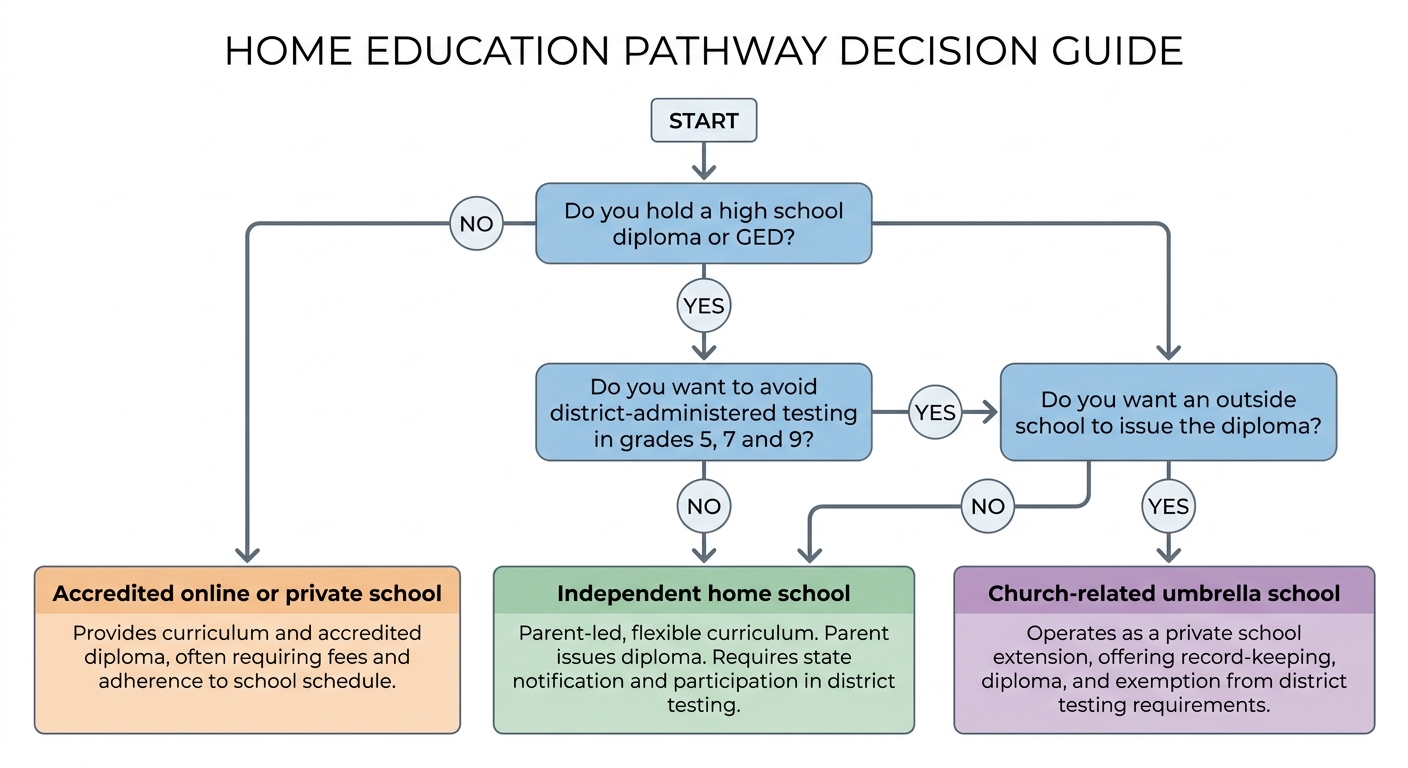
- Which Option Should You Choose?
- How to Start Homeschooling in Tennessee: Your First 30 Days
- What Are Tennessee's Homeschool Testing Requirements?
- How Do You Keep Records Without Making It a Second Job?
- What Does the First Year Actually Cost in Tennessee?
- Where Do Tennessee Families Find Groups, Sports and Field Trips?
- What Mistakes Trip Up New Tennessee Homeschoolers?
- Frequently Asked Questions
What Are Tennessee's Three Legal Homeschool Options?
Tennessee families educate at home under one of three legal structures, and your choice determines who you report to for the rest of the year.
- An independent home school is a home school registered directly with your local director of schools under T.C.A. § 49-6-3050. You report to the district.
- A church-related umbrella school is a private school organized under Tennessee's church-related school provisions that enrolls home-educated students. You report to the school, not the district.
- An accredited online or private school enrollment means your child is a student of that school, studying from home under its schedule and assessment policy.
HomeLife Academy's website describes it as a K-12 private school and ministry providing educational access and support to homeschooling families, and it is one of the umbrella providers Tennessee parents commonly encounter (HomeLife Academy, as of November 2026). For publicly funded virtual options, the Tennessee Department of Education maintains a public virtual school list on its website.
| Independent home school | Church-related umbrella | Accredited online/private school | |
|---|---|---|---|
| You report to | Local director of schools | The umbrella school | The enrolling school |
| Notice of intent | Yes, filed with the district | Umbrella handles reporting | Not applicable |
| Parent qualification | High school diploma or GED for K-12 under current law | Set by the umbrella | Not applicable |
| Attendance | You log days and hours | Umbrella's policy | School's calendar |
| Standardized testing | Grades 5, 7 and 9 per statute | Umbrella's policy | School's assessment schedule |
| Diploma issued by | Parent | The umbrella school | The school |
| Tuition | None | Annual enrollment fee | Tuition, where charged |
Statutory details change, and districts differ in how they collect paperwork. Confirm the current-year requirements with your director of schools, and read our deeper companion piece on Tennessee homeschool rules for testing, records and diplomas before you file.
Key takeaway: Your legal route decides your paperwork, your testing obligations and who signs the eventual diploma — pick it before you do anything else.
Which Option Should You Choose?
Pick independent if you want no tuition and you're comfortable dealing with the district directly. Pick an umbrella school if you'd rather have flexibility on testing and transcripts and a third party issuing the diploma. Pick an accredited online school if you want the structure, grading and calendar handled for you.
Three questions usually settle it:
- Do you hold a high school diploma or GED? The independent route requires it for K-12 instruction under the statute. If not, an umbrella or enrolled option is your path.
- Do you want to avoid district-administered testing in grades 5, 7 and 9? Umbrella families follow their school's assessment policy instead.
- Do you want someone else issuing the transcript and diploma? That points to an umbrella or accredited school.
Umbrella providers charge an annual enrollment fee per student, and fees vary by provider and year — check the provider's current fee schedule rather than relying on a figure you read anywhere, including here. If a move is on the horizon, compare Tennessee against your destination using our overview of homeschool requirements by state, since notice deadlines and testing rules differ sharply across state lines.
How to Start Homeschooling in Tennessee: Your First 30 Days
Most Tennessee families can be fully legal and teaching inside one month. The state's own pages are reference hubs, not sequences, so here is the order that actually works: decide and withdraw, file, set up records, then teach a trial week.
Week 1: Decide your path and tell the school
Choose your legal route first, then withdraw in writing. Verbal notice to a front office is not a record.
Send a dated letter by email with a read receipt, or hand-deliver and ask for a signed acknowledgement. Keep your copy. A workable skeleton:
- Date and your full name and address
- Child's full name and date of birth, current school and grade
- A statement of intent — that the child is withdrawing to be educated as an independent home school under T.C.A. § 49-6-3050, or that the child is enrolling in a named church-related school
- Effective date of withdrawal
- Parent signature
⚠️ Do not withdraw before your umbrella enrollment is confirmed in writing. A gap between leaving the district and being on another school's roll is what triggers truancy follow-up.
Week 2: File your notice of intent
Independent home schoolers register with the local director of schools before the school year begins, or immediately on withdrawal if you're starting mid-year. Umbrella and enrolled families skip this step — their school reports instead.
Districts use their own forms, but most ask for:
- Child's full name, date of birth, grade level and home address
- Parent's name and proof of a high school diploma or GED
- The school year covered
- A short description of subjects or curriculum, where the district requests it
If you've never filed one before, our explainer on what a notice of intent is and what goes in it walks through the wording line by line.
Week 3: Set up attendance and records
Tennessee's home school statute sets 180 days of instruction averaging four hours per day for the independent option. Independent families make their records available to the district on request, so build the habit now rather than reconstructing it in May.
A compliant log is simpler than most parents expect:
- Date — one row per instructional day
- Hours — total instructional time that day
- Subjects touched — three or four words is enough
- Notes — field trips, assessments, anything unusual
If weeks three and four feel unproductive, that's normal. Deschooling — the adjustment period after leaving a classroom routine — takes time for both of you.
Week 4: Pick curriculum and run a trial week
Don't buy a full year of boxed curriculum before you've taught for a week. You don't yet know your child's real pace, and that pace is the only thing that should drive the purchase.
Run a low-stakes trial week using free material:
- Your county library's free databases, e-books and reading programs
- State library and archives digital collections for Tennessee history
- Free online math practice for daily arithmetic and skills review
- One hands-on project your child chooses
Track what took 20 minutes versus two hours. Then buy. For the wider framework, see our step-by-step guide to getting started homeschooling.
What Are Tennessee's Homeschool Testing Requirements?
Independent home school students in grades 5, 7 and 9 take a standardized achievement test, under the arrangements set out in T.C.A. § 49-6-3050 and administered through the local district or an approved provider.
Standardized achievement testing under the independent option is a snapshot check, not a pass/fail gate. A low result does not end your home school; the statute's framework points toward consultation and a remedial course of action rather than automatic removal.
| Independent home school | Church-related umbrella | Accredited online/private | |
|---|---|---|---|
| Which grades | 5, 7 and 9 per statute | Umbrella's own policy | School's assessment schedule |
| Who administers | District or approved provider | The umbrella school | The school |
| Who sees results | Parent and district | Parent and umbrella | Parent and school |
| If scores are low | Consultation and remedial plan | Umbrella's policy | School's intervention process |
Three practical points for first-year families:
- Ask early. Contact your director of schools in the autumn of a testing year to confirm dates, location and whether you may use an approved outside provider.
- Don't cram. The test reports where your child currently is. That information is more useful to you than a polished score.
- File the result. Keep the report with your attendance log. It's the one document a district is most likely to ask for.
Administration logistics shift year to year, so verify current details with the Tennessee Department of Education or your district rather than with a forum post. Our companion guide to Tennessee homeschool rules for testing, records and diplomas covers what happens after the results arrive.
How Do You Keep Records Without Making It a Second Job?
You need three things on file: attendance days and hours, a record of subjects covered, and test results for the required grade years. Everything else is optional and should stay optional.
A one-line daily entry is enough: Oct 14 — 4.0 hrs — math, reading, TN history, art. A short quarterly note per child adds the narrative a district or umbrella might want: what you covered, what clicked, what you're changing next term.
The honest difficulty isn't the format. It's that after a full teaching day, writing up hours, subjects and progress is the task families skip first and then dread catching up on. By November, the half-finished log becomes a reason to quit. This is exactly the burden a home education companion can take off you: LearnSpark tracks mastery against educational standards as you teach and generates parent-facing progress notes, so the record becomes a by-product of the lesson instead of a Sunday-night job. What you get back is the evening you'd otherwise spend reconstructing the week.
Key takeaway: Decide your record format in week three, keep it to one line a day, and the compliance side of homeschooling stops being the thing that wears you down.
What Does the First Year Actually Cost in Tennessee?
Your first-year cost depends almost entirely on which legal route you chose and how much you buy new. Independent homeschooling with library and free curriculum sits at the low end; accredited online programs sit at the high end.
| Cost line | Independent | Umbrella | Accredited online |
|---|---|---|---|
| Registration or enrollment fee | None | Annual per-student fee | Tuition where charged |
| Curriculum | Your choice, free to premium | Your choice, free to premium | Usually included |
| Testing | District or provider fee may apply | Per umbrella policy | Usually included |
| Co-op dues | Optional, varies by group | Optional | Optional |
| Field trips and supplies | Varies | Varies | Varies |
Fee amounts vary by provider, district and year, so build your budget from current quotes rather than from a published range. Ask each umbrella provider for a written fee schedule, and ask your district whether a testing fee applies in your child's grade year.
One thing worth knowing before you plan: Tennessee does not run a state funding stream or tax credit aimed specifically at home schoolers. Our guide to whether does Tennessee give money to homeschoolers covers the programs that do exist and who qualifies.
Where Do Tennessee Families Find Groups, Sports and Field Trips?
Most support in Tennessee comes from regional associations and local co-ops rather than from the state.
- Regional associations. The Middle Tennessee Home Education Association publishes a support groups directory on its site, listing groups serving Middle Tennessee families (as of November 2026).
- Co-ops and enrichment classes. TheHomeschoolMom maintains a Tennessee homeschool co-ops and academic enrichment listing covering tutoring groups, classes and events across the state (as of November 2026).
- County libraries. Many branches run homeschool programs and reading groups; call your branch rather than relying on the website calendar.
- Museums, zoos and science centers. Check each venue's education page for homeschool days and group rates.
Parent groups on social platforms are useful for local intel — which co-op has openings, which district office is easy to reach — but treat legal advice found there as a starting point to verify, not an answer.
Access to public school sports and extracurriculars depends on district policy and on your legal status, so ask your director of schools directly before promising your child a season. For planning your year's outings, see our roundup of Tennessee homeschool field trips and groups.
What Mistakes Trip Up New Tennessee Homeschoolers?
Five mistakes account for most first-year trouble, and all five are avoidable in your first 30 days.
- Withdrawing before the paperwork is confirmed. Get umbrella enrollment or district registration in writing first.
- Missing the notice deadline. Independent families register before the school year begins, or immediately on a mid-year withdrawal.
- Assuming an umbrella removes all record keeping. Umbrella schools set their own attendance and reporting requirements — read them in week one.
- Buying a full boxed curriculum in July. You don't know your child's pace yet. Teach a trial week first.
- Forgetting the grade 5, 7 and 9 test window. Note the testing year on your calendar the day you register.
⚠️ Keep every dated document — withdrawal letter, acknowledgement, registration confirmation, test reports — in one folder, physical or digital. Districts rarely ask, but when they do, they ask at short notice.
Summary
Knowing how to start homeschooling in Tennessee is really about sequence, not difficulty. Choose one of the three legal routes, withdraw in writing, file your notice of intent with the local director of schools if you're independent, set up a one-line daily attendance log, and run a trial week before you spend money on curriculum. Keep the grade 5, 7 and 9 testing years marked on your calendar, confirm current details with your district rather than a forum, and lean on regional associations and co-ops for community. When you're ready to plan the teaching itself, our step-by-step guide to getting started homeschooling picks up where this timeline ends.
Frequently Asked Questions
Do you need a teaching degree to homeschool in Tennessee?
No. Under the independent option, Tennessee's home school statute requires a parent to hold a high school diploma or GED to teach K-12 at home. No teaching license is required. Church-related umbrella schools set their own parent requirements, which can differ from the statutory standard, so confirm with the provider before enrolling.
Can you start homeschooling mid-year in Tennessee?
Yes. Withdraw your child in writing, then register with your local director of schools immediately rather than waiting for the next school year. Your instructional day count is measured against the remainder of the school year, so ask the district what count they expect from your effective withdrawal date and record it.
What happens if a Tennessee homeschooler scores low on the required test?
A low score does not end your home school. Under the statute's framework, the district may require consultation and a remedial course of action, and sustained results well below grade level can prompt further steps. Specifics are handled locally, so ask your director of schools what their process involves before testing year arrives.
Does Tennessee issue homeschool diplomas?
The state does not issue them. Independent home schoolers produce a parent-issued diploma supported by a transcript of courses and credits. Umbrella and accredited online schools issue their own diplomas and transcripts. Colleges typically evaluate the transcript alongside ACT or SAT scores, so keep course records organized from ninth grade onward.
Information about third-party platforms reflects publicly available details at the time of writing and may have changed. Please verify directly with the provider. See our Terms of Use for more.