
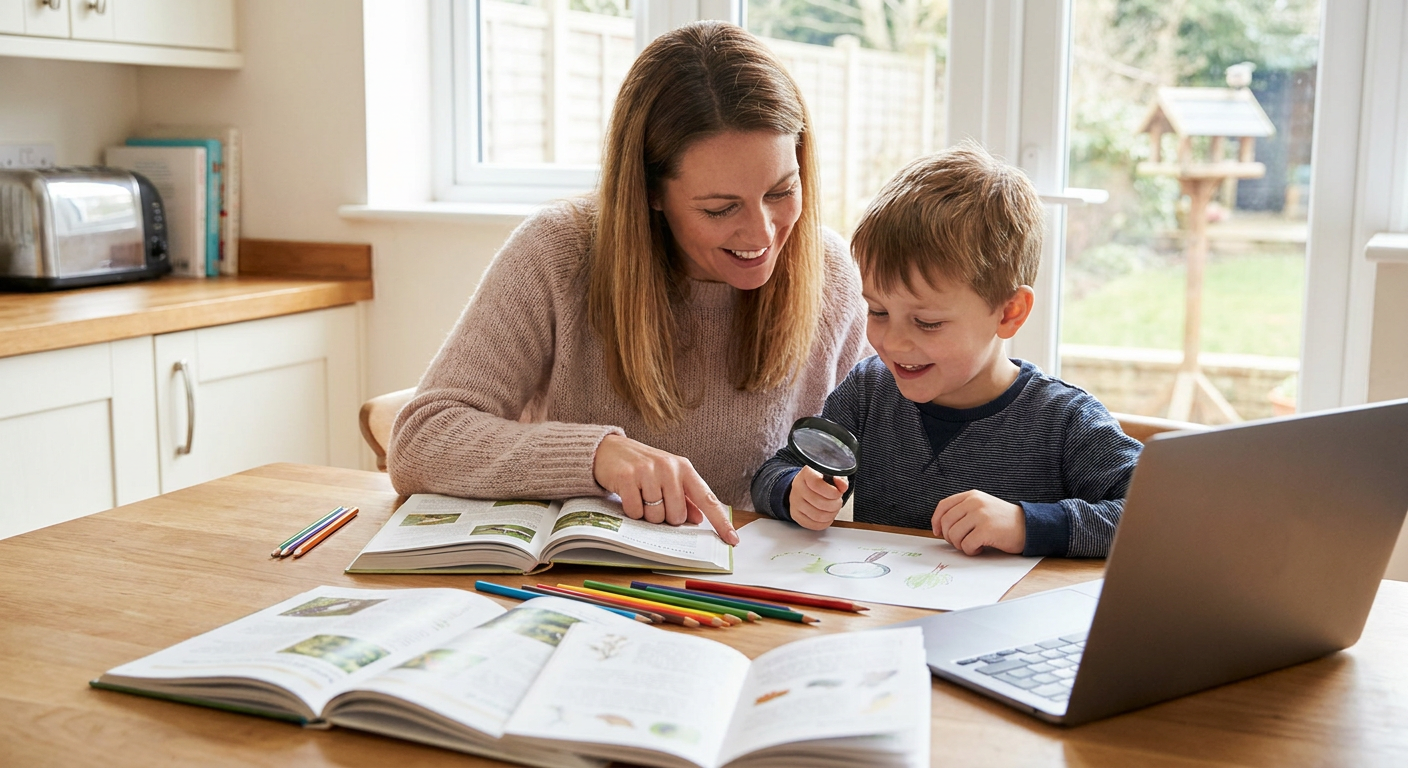
Homeschooling a child with ADHD can feel like a huge challenge, but it's also an incredible opportunity to create a learning experience that truly works for them. Instead of trying to fit a unique, vibrant mind into a rigid system, you get to build the system around your child. This guide is filled with practical strategies and resources for homeschooling a child with ADHD, helping you turn potential struggles into moments of joyful discovery and find the cheapest way to homeschool on a budget without sacrificing quality.
Quick Answer
The best way to homeschool a child with ADHD is by embracing flexibility and personalization. This means designing a learning environment that minimizes distractions, creating a schedule that integrates frequent movement, choosing a curriculum that follows their interests, and consistently using teaching strategies that break down information into manageable, engaging pieces. Success comes from customizing their education to support their unique brain wiring, rather than trying to replicate a traditional classroom at home.
TL;DR
- Flexibility is your superpower. A home learning environment allows you to adapt schedules, lessons, and spaces to your child's energy and focus levels, which is far more effective than a rigid classroom structure. Discover why homeschooling is a great fit for ADHD
- Create a brain-friendly space. Simple adjustments like reducing clutter, providing flexible seating (like a yoga ball), and having fidget tools on hand can can help improve focus and reduce frustration. Learn how to craft an ADHD-friendly learning environment
- Curriculum should follow curiosity. Interest-led and project-based learning are fantastic for ADHD learners because they tap into natural motivation. Boxed curricula can feel restrictive, so embrace a mix of resources. Compare the best curriculum styles for ADHD
- Executive function skills are essential. Beyond academics, focus on teaching your child how to plan, organize, and manage their time. These life skills are just as important as mastering math facts. Get strategies for supporting executive function
- You don't have to do it alone. Connecting with other homeschooling families, both online and in person, provides invaluable support, ideas, and encouragement for you and your child. Find out how to build your support system
In This Article
- What Makes Homeschooling a Great Fit for Kids with ADHD?
- Recognizing ADHD: What Does It Look Like in a Learning Setting?
- Crafting Your ADHD-Friendly Learning Environment in 2026
- Key Teaching Strategies for Homeschooling Kids with ADHD
- What Are the Best Curriculum Styles & Resources for ADHD Learners?
- Leveraging Technology: Tools & Apps for ADHD Support in 2026
- Beyond Academics: Supporting Executive Function & Emotional Regulation
- Building a Support System: Community & Resources for Parents
- Frequently Asked Questions About Homeschooling ADHD
- Conclusion
What Makes Homeschooling a Great Fit for Kids with ADHD?
Homeschooling provides unparalleled flexibility and one-on-one attention, which are two of the most critical ingredients for helping a child with ADHD thrive. In a traditional classroom of 20-30 students, a child who needs to move, ask frequent questions, or work on a passion project can be seen as disruptive. At home, these traits can be redirected into powerful learning opportunities.
The ability to customize is the core benefit. You can break the day into shorter learning blocks, take a "recess" whenever wiggles appear, and spend more time on subjects that fascinate your child. Many parents of children with special educational needs choose homeschooling to provide a safer environment and more tailored instruction. This control allows you to eliminate common classroom triggers for anxiety and distraction, such as overwhelming social dynamics or sensory overload from fluorescent lights and background noise.
By embracing a personalized learning approach, you can design lessons around your child's interests, which is a game-changer for focus. If they love dinosaurs, you can build an entire unit study around them, covering biology, history, math (measuring fossils!), and art. This kind of deep engagement is often difficult to achieve in a standardized school setting.
Finally, homeschooling allows you to prioritize skills that often get overlooked in school but are vital for kids with ADHD. You can take the time to explicitly teach emotional regulation, time management, and organizational skills in real-world contexts, building a foundation for lifelong success.
Key takeaway: Homeschooling works well for many kids with ADHD because it removes the "one-size-fits-all" pressure of a traditional classroom and replaces it with a flexible, supportive, and customizable learning journey.
Recognizing ADHD: What Does It Look Like in a Learning Setting?
ADHD, or Attention-Deficit/Hyperactivity Disorder, primarily impacts attention regulation, hyperactivity, and impulse control, which can create unique challenges in a learning environment. While many people picture a child who can't sit still, ADHD symptoms are much more nuanced and can look very different from one child to another. Understanding these signs is the first step toward providing effective support.
The three core features of ADHD are:
- Inattention: This isn't about laziness or defiance; it's a genuine difficulty in sustaining focus. In a learning context, it might look like your child starting a math worksheet but getting sidetracked by a bug outside the window, having trouble following multi-step instructions, or frequently losing their pencils and books.
- Hyperactivity: This is the more visible symptom. It's the need for constant movement. This can manifest as fidgeting, tapping, squirming in a chair, or getting up and running around at inappropriate times. For some, it's an internal feeling of restlessness.
- Impulsivity: This is the tendency to act on a whim without thinking through the consequences. In learning, this might look like blurting out answers before a question is finished, interrupting others, or having difficulty waiting their turn during a game.
The Three Presentations of ADHD
ADHD isn't a single diagnosis; it's a spectrum. Experts recognize three main ways it can present:
- Predominantly Inattentive Presentation: This is what used to be commonly called ADD. These children may not be disruptive. Instead, they might seem like "daydreamers" or be described as shy or forgetful. They often struggle with organization, finishing tasks, and paying attention to details.
- Predominantly Hyperactive-Impulsive Presentation: This is the classic stereotype of ADHD. These children are often in motion, fidgety, and talkative. They may act without thinking and struggle with self-control.
- Combined Presentation: This is the most common type, where an individual has significant symptoms of both inattention and hyperactivity-impulsivity.
Here's a quick checklist of common signs you might observe during a homeschool day:
- Difficulty Staying on Task: Abandons a project halfway through to start something else.
- Poor Organization: A perpetually messy workspace, lost assignments, or forgets what they need for a lesson.
- Trouble with Transitions: Becomes upset or dysregulated when asked to switch from a fun activity (like a video game) to a non-preferred one (like writing).
- "Careless" Mistakes: Rushes through work and misses details, not from a lack of knowledge but from a need to get it done quickly.
- Emotional Dysregulation: Has big, intense emotional reactions to seemingly small frustrations.
Recognizing these behaviors as symptoms of ADHD—not character flaws—is a fundamental mindset shift that empowers you to respond with compassion and effective strategies.
Crafting Your ADHD-Friendly Learning Environment in 2026
Creating a learning space that supports an ADHD brain doesn't require a total home makeover or expensive gear. It’s about being intentional with your space, routine, and sensory inputs to reduce friction and boost focus. Your goal is to build an environment where your child's brain can work with them, not against them.
Optimize the Physical Space
An overstimulating environment can be a major source of distraction. The key is to find a balance between engaging and overwhelming.
- Designate a Learning Zone: It doesn't have to be a separate room. A quiet corner of the living room or a specific spot at the kitchen table works. The consistency of going to the "school spot" helps signal to the brain that it's time to focus.
- Minimize Clutter: Keep the immediate learning area clear of unnecessary toys, papers, and visual noise. Use bins, shelves, and drawers to store supplies out of sight. A clean workspace reduces the number of things competing for attention.
- Offer Flexible Seating: Many kids with ADHD focus better when they can move. Instead of a standard chair, consider a wobble stool, a yoga ball, a standing desk, or even just allowing them to work on the floor with a lap desk. In our experience, letting a child stand or pace while reciting facts can help improve retention for some children.
- Control Auditory Inputs: For some, absolute silence is distracting, while for others, background noise is impossible to ignore. Experiment with noise-canceling headphones, a white noise machine, or soft instrumental music to find what helps your child concentrate.
Build a Predictable, Flexible Routine
Routine is a cornerstone for supporting executive function. Children with ADHD thrive on predictability, as it reduces the anxiety of not knowing what’s next. However, rigidity is the enemy of the ADHD brain.
Create a visual schedule that outlines the flow of the day (e.g., Morning Walk, Math, Snack, Reading, Park). This provides structure without being a minute-by-minute prison. This flexible routine allows you to take a "brain break" when you see focus waning or to spend an extra hour on a science experiment that has captured your child's imagination.
Incorporate Sensory Tools
Sensory input can be incredibly regulating. Think of these not as toys, but as tools for focus.
- Fidgets: Provide a quiet, non-distracting fidget tool like putty, a stress ball, or a spiky sensory ring. This gives their hands something to do so their brain can focus on listening or thinking.
- Movement Breaks: Schedule short, frequent bursts of physical activity. This could be 5 minutes of jumping jacks, a quick dance party, or running a lap around the house.
- Heavy Work: Activities like carrying a stack of books, pushing a piece of furniture, or using a weighted blanket can provide calming proprioceptive input.
Key takeaway: Your home is not a classroom; it's a learning laboratory. Experiment with different setups and routines to discover what helps your child feel calm, focused, and ready to learn.
Key Teaching Strategies for Homeschooling Kids with ADHD
Effective teaching strategies for a child with ADHD revolve around making learning engaging, breaking down tasks into achievable steps, and celebrating effort over perfection. It’s less about a specific method and more about a flexible, responsive approach that honors how their brain works.
One of the most powerful strategies is chunking. This means breaking down large assignments into small, manageable pieces. Instead of "write a book report," the task becomes:
- Read one chapter.
- Write three sentences about what happened.
- Draw a picture of the main character.
Presenting tasks this way prevents the overwhelm that often leads to shutdown and procrastination. A checklist where they can physically tick off each small step provides a powerful sense of accomplishment.
Multi-sensory instruction is another game-changer. This approach involves engaging multiple senses in the learning process. Don't just read about fractions; bake with measuring cups. Don't just write spelling words; trace them in sand, build them with magnetic letters, or spell them out while jumping rope. When learning is active and hands-on, it’s stickier for a brain that craves novelty and engagement.
Here are other essential strategies we've found to be highly effective:
- Gamify Learning: Turn drills into games. Use a timer to see how many math problems they can solve in two minutes ("beat the clock"). Use educational apps that incorporate points and rewards. Make learning a fun challenge rather than a chore.
- Provide Clear, Direct Instruction: When introducing a new concept, be explicit. State the goal of the lesson clearly at the beginning and provide step-by-step instructions. Avoid vague or overly complex language.
- Use Visual Aids: ADHD brains are often highly visual. Use whiteboards, charts, diagrams, and color-coding to organize information. A visual timer (like a Time Timer) can make the abstract concept of "five more minutes" concrete and less stressful.
- Embrace Positive Reinforcement: Catch them being "good." Acknowledge their effort, not just the outcome. Simple, immediate praise like, "I love how you focused on that hard problem!" is far more motivating than a delayed reward.
⚠️ Important distinction: Positive reinforcement is not bribery. It’s about recognizing and encouraging the behaviors you want to see more of, like persistence and focus, which builds intrinsic motivation over time.
It's a process of discovery. What works wonders one week might fall flat the next. The key is to be an observant guide, noticing what sparks their interest and what causes friction, and adjusting your approach without judgment.
What Are the Best Curriculum Styles & Resources for ADHD Learners?
The best curriculum for a child with ADHD is rarely found in an all-in-one, open-and-go box. Instead, success lies in flexible, hands-on, and interest-led approaches that can be adapted to your child's ever-shifting focus and energy levels. The goal is to piece together resources that inspire curiosity rather than demand compliance.
Three curriculum styles are particularly well-suited for ADHD learners:
- Unit Studies: This approach involves picking a topic your child is passionate about (like space, ancient Egypt, or marine biology) and building all academic subjects around it. It leverages hyperfocus, turning a child's intense interest into a vehicle for learning math, science, history, reading, and writing.
- Project-Based Learning (PBL): Similar to unit studies, PBL is driven by a central question or challenge (e.g., "How can we build a better bird feeder?"). The learning happens as the child researches, plans, creates, and presents their solution. This hands-on, goal-oriented process is highly motivating for kids who need to see the "why" behind their work.
- Unschooling Principles: While full unschooling isn't for everyone, incorporating principles of interest-led learning can be incredibly powerful. It means trusting that learning happens all the time and being ready to follow your child's questions and curiosities wherever they lead.
Here's how these styles compare to a more traditional approach:
| Feature | Traditional Curriculum | Unit Studies & PBL | Unschooling Principles |
|---|---|---|---|
| Structure | Highly structured, linear | Thematic, project-driven structure | Unstructured, follows child's lead |
| Pacing | Teacher/curriculum-paced | Flexible, student-paced | Entirely student-paced |
| Motivation | Often extrinsic (grades) | Intrinsic (interest, tangible goal) | Intrinsic (curiosity) |
| Best For | Families who want clear expectations and a pre-set path. | Kids who thrive on deep dives and hands-on creation. | Highly self-motivated kids and families comfortable with less structure. |
| ADHD Fit | Can feel rigid and boring. | Excellent. Taps into hyperfocus and project-based energy. | Excellent. Maximizes autonomy and interest-driven focus. |
Finding the Best Homeschooling Resources for a Child with ADHD
Instead of buying one complete curriculum, many families find success by curating resources.
- For Multi-Sensory Math & Reading: Programs like All About Reading and All About Spelling use a multi-sensory, mastery-based approach that is fantastic for kids who need explicit instruction. For math, Math-U-See uses manipulatives to make abstract concepts concrete.
- For Project-Based Learning: Curricula like Moving Beyond the Page offer literature-based unit studies that encourage creativity and critical thinking.
- For Gamified Practice: Platforms like Prodigy Math, DreamBox Learning, and Khan Academy Kids offer game-like environments for practicing skills.
Finding the Cheapest Way to Homeschool on a Budget with ADHD
Many of the best resources are low-cost or free. The public library is your number one asset, offering books, documentaries, and even museum passes. Online, sites like Khan Academy provide comprehensive lessons for free. Embracing interest-led learning is also inherently budget-friendly—a deep dive into a topic your child loves can be fueled by library books and internet research, which costs nothing.
Managing this eclectic mix of digital apps, library books, and hands-on projects can feel chaotic. This is where a modern planning tool becomes essential. Using an personalized platform like LearnSpark can help you pull these disparate resources into a cohesive plan, track progress, and generate new lesson ideas based on your child's interests.
Leveraging Technology: Tools & Apps for ADHD Support in 2026
When used thoughtfully, technology can be a powerful co-pilot in your homeschool journey, offering tools that support focus, organization, and engagement in ways that traditional paper and pencil cannot. The key is to choose tools that serve a specific purpose rather than just providing digital busywork.
For kids with ADHD, the right app can act as an external support for struggling executive function skills. A computer doesn't get frustrated or impatient; it just provides the structure needed to complete a task.
Here are some categories of tools we've found particularly helpful:
- Focus and Time Management: Visual timers are a must. Apps like Forest gamify focus by growing a virtual tree during a set work period—if you leave the app, the tree dies. This creates a tangible incentive to stay on task.
- Organization and Planning: Digital tools can help externalize planning. An app like Trello uses visual cards that can be moved across columns (e.g., To Do, Doing, Done), which is perfect for a visual learner who needs to see their workflow. Creating a simple "Assignment" board with your child can teach them project management skills.
- Gamified Learning: High-quality educational games can transform practice from a chore into a joy. Endless Reader helps with early literacy through fun animations, while Prodigy Math embeds math problems into an epic role-playing game. These provide the novelty and frequent rewards the ADHD brain craves.
- AI-Powered Learning Platforms: A newer category of tools uses artificial intelligence to create personalized learning paths. For instance, AI-powered learning platforms like LearnSpark can take your child's interest in volcanoes and generate a week's worth of age-appropriate lessons covering geology, history, and even art, complete with videos and activities. This can save significant time in planning and help keep the content engaging.
⚠️ A Note on Screen Time: It's crucial to set clear boundaries around technology. Use it as a targeted tool, not a default babysitter. Balance screen-based learning with plenty of hands-on activities, outdoor time, and unstructured play.
Beyond Academics: Supporting Executive Function & Emotional Regulation
For a child with ADHD, learning how to manage their time, stay organized, and handle big emotions is just as critical as learning algebra. These skills fall under the umbrella of executive functions, which are the set of cognitive skills that act as the "management system" of the brain. Homeschooling provides the perfect, low-pressure environment to build these skills through daily practice.
Executive functions are the brain-based abilities that help us plan, focus attention, remember instructions, and juggle multiple tasks successfully. Many people with ADHD have weaknesses in this area, which is why they may be incredibly bright but struggle to turn in an assignment on time.
A Practical Checklist for Building Executive Function Skills
Integrate these supports into your daily routine:
- Externalize Everything: Use checklists, visual schedules, and reminders. Instead of just telling your child the steps to get ready for an outing, create a picture chart by the door. This offloads the burden from their working memory.
- Teach Time Management: Use visual timers to make time tangible. Break assignments down into timed chunks (e.g., "Let's work on math for 15 minutes"). This teaches them how to estimate and manage their work periods.
- Model Planning: Think out loud as you plan your day or a trip to the store. ("Okay, first we need to go to the library, then the post office. I'll write that down so I don't forget.") This demonstrates the process of thinking ahead.
- Create "A Place for Everything": Designate specific homes for school supplies, backpacks, and sports gear. Consistently putting things back in their place builds organizational habits.
Co-Regulating and Teaching Emotional Skills
Emotional dysregulation is a core component of ADHD. It's the tendency to feel emotions more intensely and have a harder time returning to a calm baseline. As a homeschooling parent, you are in the unique position to be a "co-regulator" for your child.
- Be a Mirror: When your child is overwhelmed, stay calm yourself. Acknowledge their feeling without judgment: "I can see you are incredibly frustrated with this math problem. It's a tough one."
- Create a Calm-Down Space: Designate a cozy corner with soft pillows, a weighted blanket, or sensory toys. This isn't a "time-out" spot for punishment, but a safe place to go to feel better.
- Teach the "Name It to Tame It" Strategy: Help your child build an emotional vocabulary. Giving a name to a big feeling (frustration, disappointment, anxiety) makes it less scary and more manageable.
- Model Healthy Coping: Let your child see you handle your own frustrations constructively. Say things like, "I'm feeling a little stressed, so I'm going to take five deep breaths before I try again."
Building a Support System: Community & Resources for Parents
Homeschooling a child with ADHD is a marathon, not a sprint, and you don't have to run it alone. Building a strong support system is essential for both your well-being and your child's success. It provides encouragement on tough days, fresh ideas when you're in a rut, and social opportunities for your child.
How to Socialize Homeschooled Children with ADHD
The question of "how to socialize homeschooled children" is common, but for a child with ADHD, it's about finding the right kind of social interaction. Homeschooling can be a huge advantage here, allowing you to curate positive social experiences.
- Focus on Quality over Quantity: A few close friendships can be more beneficial than navigating a chaotic classroom.
- Seek Structured Activities: Many kids with ADHD do better in structured social settings like sports teams, martial arts classes, drama clubs, or robotics leagues where the rules of engagement are clear.
- Utilize Homeschool Co-ops: These groups offer classes and social time, providing a "best of both worlds" scenario. You can find local homeschool groups that fit your family's philosophy and schedule.
- Practice Social Skills: Use the low-pressure home environment to role-play social scenarios, like how to join a conversation or what to do when you disagree with a friend.
Finding Your Tribe
Connecting with other parents who "get it" is a lifeline.
- Online Communities: Facebook groups and online forums dedicated to homeschooling children with ADHD can be invaluable sources of advice and solidarity.
- Local Support: Don't underestimate the power of an in-person connection. Look for local parent support groups for children with special needs.
- Professional Help: Don't hesitate to include professionals in your support system, such as educational psychologists, therapists, or ADHD coaches.
Frequently Asked Questions About Homeschooling ADHD
How do you create a homeschooling schedule for working parents with an ADHD child?
A successful homeschooling schedule for working parents hinges on flexibility and creativity. Instead of a traditional 9-to-3 school day, consider a "block schedule" with learning happening in the mornings, evenings, and weekends. Use asynchronous tools and apps for independent practice while you work. Most importantly, communicate with your child; a flexible schedule allows you to capitalize on their moments of high focus, whenever they may occur.
What is the difference between unschooling vs homeschooling for a child with ADHD?
Homeschooling is a broad term for education that happens at home, which can follow a very structured, school-at-home approach or be more flexible. Unschooling is a specific style of homeschooling where learning is entirely directed by the child's interests and curiosity, with no set curriculum. For a child with ADHD, a hybrid approach is often ideal. It combines the freedom of unschooling to dive deep into passions with just enough structure (like a daily math practice) to ensure key skills are covered.
How can I find the cheapest way to homeschool on a budget?
Finding the cheapest way to homeschool on a budget is very achievable, especially with an ADHD learner. The best resources are often free or low-cost. Your public library is your greatest asset, providing books, audiobooks, and documentaries. Free online platforms like Khan Academy offer full curricula. Unit studies built around your child's interests are also incredibly cost-effective, as they rely on research and creativity rather than expensive boxed sets.
How do I handle socialization for my homeschooled child with ADHD?
Socialization is about learning to navigate the social world, and homeschooling can provide a safer, more tailored environment to do this. Instead of the often overwhelming and sometimes negative social environment of a large school, you can focus on structured activities like sports, clubs, and co-ops. This allows your child to connect with peers over shared interests in a setting with clear expectations, which is often a recipe for success for kids with ADHD.
Conclusion: Embrace the Journey
Homeschooling a child with ADHD is an adventure in personalized education. It's about letting go of preconceived notions of what "school" should look like and embracing what works for your unique, brilliant child. By creating a flexible environment, leveraging their interests, teaching essential life skills, and building a strong support network, you can provide an education that not only meets their academic needs but also nurtures their confidence and love of learning.
The journey will have its challenges, but the rewards—seeing your child thrive in an environment built just for them—are immeasurable. With the right strategies and tools, you are more than equipped to guide them toward a bright and successful future.