
Choosing a homeschooling philosophy in 2026 is less about picking a rigid set of rules and more about finding a compass for your family’s educational journey. With the rise of flexible digital tools, you are no longer locked into a single, pre-packaged curriculum. Instead, understanding the core principles of major methods like Charlotte Mason, Montessori, and Classical education allows you to craft a personalized approach that aligns with your child's personality, your family's lifestyle, and your long-term goals. These philosophies are not just different booklists; they represent fundamentally different views on how children learn best. According to the National Home Education Research Institute (NHERI), the homeschooling population has grown significantly, with estimates suggesting over 3.1 million students in 2021-2022, showcasing a diverse range of families seeking tailored education. Research indicates that this trend continues, with a growing emphasis on individualized learning paths.
Selecting a guiding philosophy provides a framework for your day-to-day decisions. It answers critical questions: What is the parent's role? What materials are most valuable? How do we measure progress? The debate over charlotte mason vs montessori homeschool vs classical methods is central for many families because it touches upon these core questions. By exploring these foundational models, you can move from feeling overwhelmed by infinite choices to feeling empowered to build a unique, effective, and joyful learning environment at home, one that can be seamlessly managed with modern homeschool planning software.
Quick Answer
The best homeschooling philosophy depends on your child and family goals. Charlotte Mason uses "living books" and nature for a gentle, literature-rich education. Montessori focuses on child-led, hands-on learning in a prepared environment. Classical education provides a rigorous, three-stage (Trivium) approach to cultivate logic and wisdom.
TL;DR
- Charlotte Mason: Best for families who love reading, nature, and a gentle pace. It uses engaging, narrative-rich "living books" instead of dry textbooks.
- Montessori: Ideal for independent, hands-on learners. It emphasizes a prepared environment, self-correcting materials, and long, uninterrupted work cycles.
- Classical: Suited for families seeking intellectual rigor and a structured, history-focused curriculum based on the three stages of the Trivium (Grammar, Logic, Rhetoric).
- Eclectic Homeschooling: Most families don''t stick to one method but blend elements from several to create a custom fit that works for their unique children.
In This Article
- What Are the Core Three Homeschooling Philosophies?
- At a Glance: Charlotte Mason vs. Montessori vs. Classical
- Which Other Homeschooling Methods Should I Know?
- Frequently Asked Questions (FAQ)
What Are the Core Three Homeschooling Philosophies?
Navigating the world of homeschooling begins with understanding the core philosophies that shape different educational approaches. The three most enduring and influential methods are Charlotte Mason, Montessori, and Classical education. While they share the goal of a rich and robust education, their methods and underlying principles differ significantly, making the choice between Charlotte Mason vs. Montessori homeschool vs. Classical a pivotal one for new homeschoolers. Understanding them in depth allows you to identify their elements in various curricula and make informed choices for your family's unique needs.
Charlotte Mason: The 'Living Books' and Whole-Person Approach
The Charlotte Mason method is a gentle, literature-based approach that sees children as whole persons, capable of complex thought and deep feeling from a young age. This philosophy, developed by British educator Charlotte Mason, is built on her 20 Principles, which assert that "education is an atmosphere, a discipline, a life."
- An Atmosphere: Learning happens in the natural environment of the home. The atmosphere should be one of joy, curiosity, and respect, not one of high pressure or competition. The parent-child relationship is central.
- A Discipline: This refers to the discipline of good habits. Mason believed that instilling habits like attention, obedience, and self-control was a primary function of education, creating a smooth and peaceful learning life. This isn't about punishment, but about training the will.
- A Life: The child's mind needs living ideas, not dry facts. This is achieved through a broad and generous curriculum built on high-quality, narrative-rich materials known as "living books." Living books are books written by a single author who is passionate about their subject, conveying information in an engaging, story-like format rather than a list of dry facts. Instead of textbooks, children engage directly with well-written books by passionate authors, classic literature, and primary sources.
A hallmark of this method is the use of narration, where a child tells back in their own words what they have just read or heard. This simple act cultivates focus, memory, and the ability to synthesize and organize information. Lessons are intentionally short (15-20 minutes for young children, up to 45 for older students) to honor natural attention spans and foster a love of learning without burnout.
Key takeaway: The Charlotte Mason method nurtures the whole child through a wide curriculum of "living books," nature study, and good habits, emphasizing short lessons to keep learning joyful.
The curriculum is famously a "wide feast," including not only core subjects but also:
- Nature Study: Weekly time spent outdoors observing, identifying, and journaling the natural world. Studies show that time in nature can reduce stress and improve concentration, making this a cornerstone of the method.
- Art & Music Appreciation (Picture & Composer Study): Studying one artist and one composer at a time, becoming intimately familiar with their work.
- Handicrafts: Meaningful handwork like sewing, clay modeling, or woodworking to develop skill and diligence.
- Poetry, Shakespeare, and Plutarch: Regular exposure to beautiful language and complex moral ideas.
This style is ideal for families who value a slower pace, want to instill a lifelong love of reading, and believe that learning happens best through engaging stories and direct experience. Many of the top 10 literature based homeschool curricula draw heavily from these principles.
A Day in the Life (Charlotte Mason, age 8): The morning begins with a short Bible story and a hymn, followed by 15 minutes of copywork from a classic poem. Next is a 20-minute history reading from a living book about the Vikings, after which the child narrates the story back. Math involves another 20 minutes with manipulatives. The morning ends with picture study, looking closely at a Monet painting for 10 minutes. The afternoon is reserved for "riches": an hour spent at a local creek for nature journaling, followed by time for handicrafts like knitting or clay modeling.
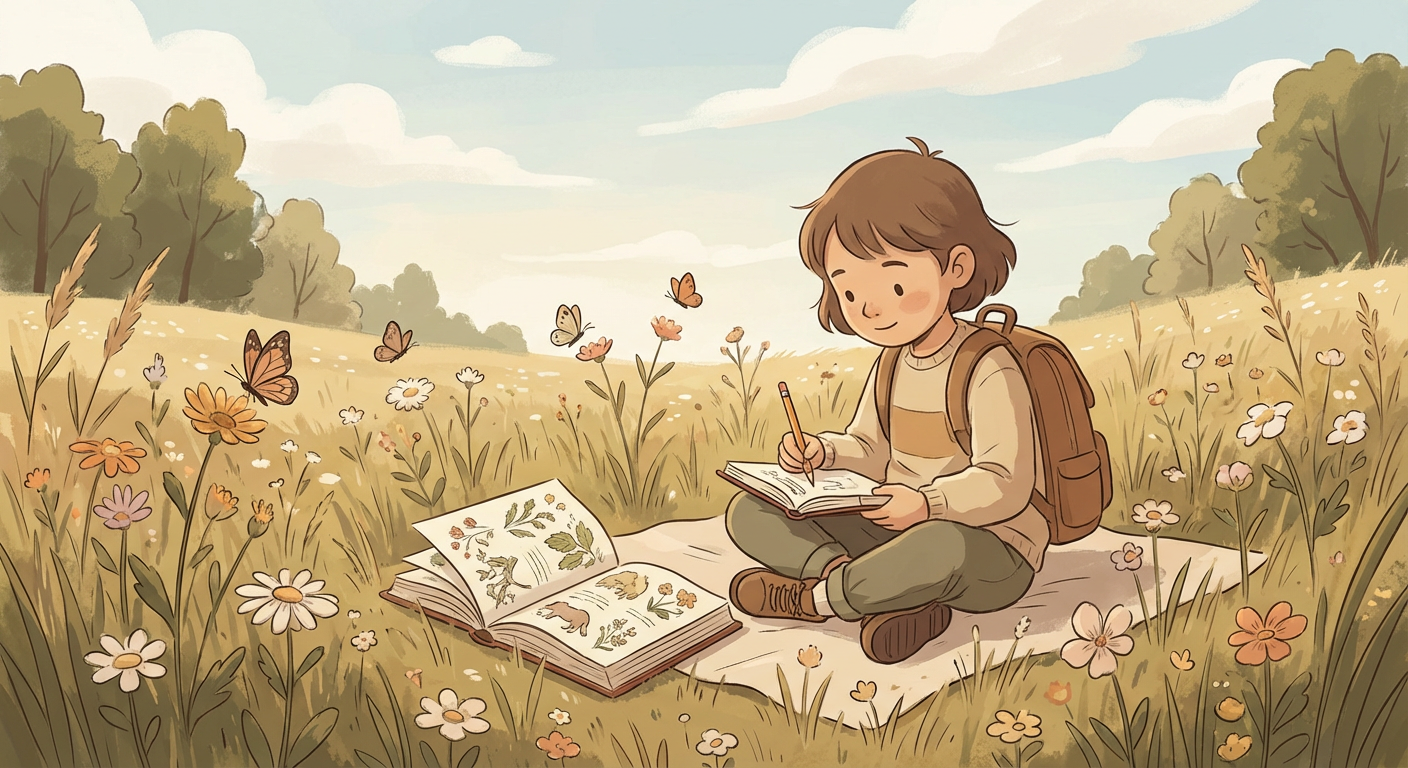
A child is deeply engrossed in their nature journal, carefully sketching a wildflower they've found in a sun-dappled meadow. Beside them lies an open, beautifully illustrated book about local flora, showcasing the connection between direct observation and literature-rich learning central to the Charlotte Mason philosophy. This scene captures the essence of the method: learning that is alive, hands-on, and connected to the real world, fostering a sense of wonder and keen observation.
Potential Challenges: This method requires significant parent involvement for read-alouds, discussions, and curating the "feast" of subjects. Finding truly "living" books for every subject, especially in modern science and diverse histories, can be time-consuming. Its gentle, trust-based approach to assessment (narration over testing) may feel unstructured or insufficient to parents accustomed to traditional schooling metrics. Furthermore, the emphasis on short lessons requires careful scheduling to cover all subjects adequately. However, tools for tracking student progress can help document learning through narration summaries and project photos.
Top Literature-Based Curricula Compared
When exploring the top 10 literature based homeschool curricula compared, you'll find many rooted in Charlotte Mason's ideas. Here are a few standouts:
- AmblesideOnline: A free, comprehensive curriculum that faithfully follows Mason's original schedules and booklists. It's rigorous and requires significant parent planning, but is considered the gold standard for a purist approach.
- A Gentle Feast: A more structured, open-and-go option that provides daily lesson plans, making it easier for busy parents to implement a CM education. It groups subjects into thematic "feasts" that cycle through history.
- Beautiful Feet Books: Offers literature packs focused on history and character development, using exceptional books to guide students through different time periods. It is less comprehensive but excellent for its specific focus.
- A Modern Charlotte Mason: This approach involves using the core principles (living books, narration, nature study) but with updated booklists that include more diverse authors and contemporary scientific topics, offering a more flexible and modern interpretation.
- Build Your Library: A popular secular option that uses the "living books" approach but with a focus on modern, diverse, and inclusive literature choices, often structured as unit studies. It's considered one of the best secular homeschool curriculum for unit studies 2026 by many families.
Montessori at Home: The Prepared Environment and Child-Led Work
The Montessori method, created by physician and educator Dr. Maria Montessori, is a child-centered scientific pedagogy that emphasizes hands-on, self-directed learning within a carefully prepared environment. The core belief is that children possess an innate drive to learn and will do so spontaneously when provided with the right tools and freedom. The parent or guide's primary role is to observe the child, identify their developmental needs and "sensitive periods," and connect them with appropriate materials, or "jobs."
At home, this translates to creating an accessible, orderly space. This includes low shelves with a curated selection of materials, child-sized furniture, and a place for everything. The materials are a key component; they are often beautifully crafted, tactile (frequently made of wood), and designed to be self-correcting. Self-correcting materials are educational tools designed so that a child can identify their own errors without needing adult correction, fostering independence and problem-solving skills. A set of knobbed cylinders, for instance, will only fit in their correct holes, allowing the child to perceive and fix their own errors without adult intervention. This fosters independence, concentration, and deep satisfaction.
The Montessori philosophy is structured around Four Planes of Development:
- Infancy (0-6): The "Absorbent Mind," focused on sensorial exploration and practical life skills.
- Childhood (6-12): The "Cosmic Education" period, where children develop a reasoning mind and are interested in the interconnectedness of everything. Learning is often done through great stories and large-scale, interdisciplinary work.
- Adolescence (12-18): A period of great social development, focused on understanding one's place in society through real-world work and collaborative projects.
- Maturity (18-24): The transition to adulthood and economic independence.
Adapting Montessori for homeschooling involves creating a rhythm around a long, uninterrupted "work cycle" (typically 2-3 hours). During this time, children choose their activities, engage deeply, and clean up after themselves. This method is exceptionally well-suited for kinesthetic learners, and many parents find it's the answer to how to choose a homeschool style for a neurodivergent child due to its emphasis on individual pace and sensory-rich materials.
Key takeaway: Montessori at home centers on a child-led approach within a "prepared environment," using specific, hands-on materials to foster independence, concentration, and a natural love of learning.
A Day in the Life (Montessori, age 8): The child enters their prepared learning space and begins their 3-hour morning work cycle. They choose to start with the checkerboard bead frame to work on long multiplication. After about 45 minutes, they put it away neatly and move to a language work, using grammar symbol stencils to analyze sentences from a book they are reading. They take a short break to water the plants (practical life) before settling in with a large timeline of life on Earth, researching a specific dinosaur and writing a short report. The parent observes quietly, only stepping in to present a new material or answer a question.
The homeschool room is a model of order and accessibility. Low, uncluttered wooden shelves display a curated selection of Montessori materials, such as colorful bead chains for math, wooden map puzzles, and a pink tower. A child-sized table and chair are positioned in the center, inviting focused, independent work. This "prepared environment" is not just about aesthetics; it is a core pedagogical tool designed to promote independence, concentration, and a love for learning by making everything the child needs accessible and engaging.
Potential Challenges: The initial cost of authentic Montessori materials can be high, though there are many DIY options available. It also requires the parent to "follow the child" and let go of traditional control over the learning sequence, which can be a difficult mindset shift. Adapting the method for the abstract thinking of middle and high school requires creativity, often shifting towards project-based learning and real-world apprenticeships, which can be challenging for a single family to facilitate. Ensuring all state-mandated subjects are covered can also require more intentional planning from the parent, as the child's interests may not naturally align with requirements. Using a digital planner to create customizable learning plans can help bridge this gap.
The Role of Project-Based Learning in Montessori Homeschooling
For older elementary and middle school students in a Montessori environment, learning naturally evolves towards project-based work. This addresses the need for more complex, integrated application of skills. Project-Based Learning (PBL) is a teaching method in which students learn by actively engaging in real-world and personally meaningful projects. The benefits of project-based learning in homeschooling are immense, as it fosters critical thinking, collaboration, and creativity. A 2021 study by Lucas Education Research found that students in PBL environments showed higher engagement and better retention of information compared to traditional learning models.
Key benefits include:
- Deeper Understanding: Students engage with topics for longer periods, leading to better retention.
- Real-World Relevance: Projects connect academic skills to real-world problems and careers.
- Development of 21st-Century Skills: PBL promotes collaboration, communication, and critical thinking.
- Increased Motivation: Students have ownership over their work, which boosts engagement and intrinsic motivation.
In a Montessori context, a project might stem from a "Great Lesson," such as the story of the universe, leading a child to build a scale model of the solar system, write a research paper on a specific planet, and calculate orbital periods.
Classical Education: The Trivium and the Pursuit of Wisdom
Classical education is a rigorous, language-focused methodology rooted in the traditions of Western civilization. Its primary goal is to cultivate wisdom and virtue by training the mind to think logically, critically, and expressively. The framework for this approach is the Trivium, a three-stage process that aligns with a child's natural cognitive development.
The three stages of the Trivium are:
- The Grammar Stage (Ages ~6-10): This stage focuses on absorbing facts and building a foundation of knowledge—the "grammar" of any subject. Children at this age excel at memorization, so this period is filled with chants, songs, and memory work covering history timelines, science facts, math tables, and Latin vocabulary. The goal is to stock the mind with rich information.
- The Logic/Dialectic Stage (Ages ~10-14): As children naturally begin to question and analyze, the focus shifts to understanding relationships between facts. Students learn formal logic and are taught to identify fallacies, construct arguments, and engage in reasoned debate. They begin to ask "Why?" and connect the dots of their knowledge through Socratic dialogue.
- The Rhetoric Stage (Ages ~14-18): In the final stage, students learn to express their well-reasoned conclusions persuasively and eloquently, both in writing and speech. The goal is to apply the knowledge and logic they've acquired to articulate their own thoughts with clarity, wisdom, and creativity through thesis defense, essays, and public speaking.
A common misconception is that Classical education is dry or overly rigid. While it is highly structured, modern adaptations emphasize rich literature (the "Great Books"), history as a narrative spine, and Socratic dialogue, encouraging deep thinking rather than mere rote learning. Families who value intellectual rigor, systematic learning, and a deep connection to history often find this model appealing. It requires consistent effort and a structured approach, making tools for weekly planning and goal setting particularly valuable.
Key takeaway: Classical education is a rigorous, language-focused method that uses the three-stage Trivium (Grammar, Logic, Rhetoric) to train a child's mind for wisdom, virtue, and eloquent expression.
A Day in the Life (Classical, age 8): The day is structured and sequential. It starts with 20 minutes of memory work: chanting the timeline of ancient Rome, Latin noun endings, and scientific classifications. This is followed by a systematic phonics and grammar lesson. History involves reading a chapter from a history encyclopedia and marking key locations on a map. Math is a traditional, mastery-based lesson. The day also includes reading from a classic like The Lion, the Witch, and the Wardrobe, with guided questions about the plot and characters.
Potential Challenges: The rigor can lead to burnout if not balanced with play and rest. The heavy emphasis on Western history and literature may require intentional supplementation to provide a more global perspective. A significant portion of classical curricula is produced from a Christian worldview, so finding high-quality secular classical curricula can be a challenge, though options are growing. The sequential nature can also be difficult to implement with multiple children at different stages of the Trivium, which is why some parents use a homeschooling styles for working moms quiz to see if a more flexible method might be a better fit for their family's logistics.
What are some Classical Conversations Alternatives for 2026?
Classical Conversations (CC) is a popular, community-based Christian classical program. However, many families seek alternatives due to its cost, religious focus, or community requirements. Here are some excellent Classical Conversations alternatives for 2026:
- Well-Trained Mind Academy: Based on the book The Well-Trained Mind, this offers both live and self-paced online classes that follow a rigorous, traditional classical model. It is more flexible than CC and offers a wider range of secular-friendly options, making it a top choice for families wanting academic rigor without a specific religious doctrine.
- Classical Academic Press: This publisher provides a full range of curricula (Latin, logic, writing, etc.) that can be used independently at home. It allows families to implement a classical education without being tied to a specific co-op structure. Their "Scholé Academy" offers live online classes for those who want community and expert instruction.
- Memoria Press: Another comprehensive curriculum provider with a strong focus on Latin and the classics. They offer online academy classes as well as materials for independent home use. While it comes from a Christian perspective, many secular families find it adaptable by supplementing with their own science and history resources.
- DIY Approach: Many families use The Well-Trained Mind as a guide to piece together their own curriculum using various resources, giving them maximum control over content and cost. This is the ultimate in customization but requires the most planning.
- Logos Press: For those who want a robust Christian classical curriculum but prefer a different structure than CC, Logos Press offers a comprehensive, book-based curriculum that is designed for home use.
At a Glance: Charlotte Mason vs. Montessori vs. Classical
To make a clear decision, it helps to see these philosophies compared on the factors that will most impact your daily life. This table breaks down the core differences in their approach to teaching, materials, scheduling, and progress evaluation, helping you navigate the charlotte mason vs montessori homeschool vs classical decision.
| Feature | Charlotte Mason | Montessori | Classical |
|---|---|---|---|
| Core Principle | Education is an atmosphere, a discipline, a life. | Follow the child. | Cultivating wisdom and virtue through the Trivium. |
| Role of Parent/Teacher | Guide & Fellow Learner ("Spreader of the Feast") | Observer & Guide ("Director/Directress") | Instructor & Mentor (Socratic Guide) |
| Primary Materials | "Living Books," Nature, Art, Music | Specific, self-correcting tactile manipulatives | Classic Literature, Primary Sources, Logic Texts, Latin |
| View of Child | A whole person, born with a desire for knowledge. | A natural learner driven by sensitive periods. | A mind to be trained and a soul to be shaped. |
| Schedule Structure | Short lessons, predictable daily rhythm. | Long, uninterrupted work cycles, highly flexible. | Structured and sequential, follows the Trivium stages. |
| Evaluation Method | Narration, Discussion, Observation | Observation of mastery, Self-correction | Tests, Papers, Debates, Socratic Dialogue |
| Parental Effort | High daily involvement (reading, discussing). | High initial effort (environment prep), then observational. | High in planning and direct instruction. |
| Typical Cost | Low to Moderate (library-focused). | Moderate to High (specialized materials). | Moderate (curriculum and book-heavy). |
| Secular Friendliness | High (easily adaptable). | High (inherently secular). | Moderate (requires careful curriculum choice). |
| Adaptability for High School | Strong, with focus on independent reading and narration. | Challenging to adapt without a community; focus on projects. | Excellent, as it culminates in the Rhetoric stage. |
| Best For Learners Who... | Are imaginative, love stories, and enjoy nature. | Are independent, kinesthetic, and self-motivated. | Are systematic, logical, and enjoy deep intellectual challenge. |
Which Other Homeschooling Methods Should I Know?
While the charlotte mason vs montessori homeschool vs classical debate is central, the homeschooling landscape in 2026 is rich with other powerful methods. Understanding these can help you find the perfect eclectic blend for your family.
The Waldorf Philosophy: Nurturing Imagination and Rhythm
Developed by Rudolf Steiner, the Waldorf philosophy is a holistic approach that seeks to educate the "head, heart, and hands." It is deeply rooted in a developmental model that mirrors the Classical Trivium but with a different focus. Early childhood (0-7) is dedicated to imaginative play and developing the will through practical work and movement. Formal academics are delayed until around age seven, when the child is deemed developmentally ready.
Key principles include:
- Emphasis on Imagination: Fairy tales, myths, and legends are central to the curriculum in the early years, believing they provide deep truths in a pictorial form.
- Rhythm and Routine: A strong daily, weekly, and seasonal rhythm provides security and connection.
- Arts-Infused Learning: All subjects are taught through artistic activities like painting, drawing, music, and modeling. Students create their own beautiful "main lesson books" instead of using textbooks.
- Eurythmy: A unique form of movement art that expresses speech and music, intended to harmonize the child's body and soul.
- Delayed Academics: The focus is on building a strong foundation of oral language, social-emotional skills, and physical coordination before introducing formal reading and math. Experts in child development note that this approach can lead to less academic anxiety and a stronger, more intrinsic motivation for learning later on.
Waldorf vs. Montessori for Elementary at Home: A Key Comparison
Families are often torn between these two child-centered methods. The distinction between Waldorf vs. Montessori for elementary at home is crucial, as they have nearly opposite views on fantasy and reality in the early years.
| Feature | Montessori | Waldorf |
|---|---|---|
| Focus in Early Years | Reality-based, practical life skills, and sensorial work. | Imagination, fantasy, fairy tales, and creative play. |
| Academic Introduction | Early introduction to letters, numbers, and reading as child shows interest. | Delayed formal academics until age 7; focus is on pre-literacy skills. |
| Learning Materials | Specific, self-correcting scientific materials. | Natural, open-ended materials (wood, silk, wool, beeswax). |
| Role of Teacher | An objective observer and guide to the prepared environment. | A warm, loving authority who leads the class through stories and art. |
| Technology/Media | Limited/mindful use, especially in early years. | Strongly discouraged, especially in early years. |
Eclectic Homeschooling: The Best of All Worlds
The truth is, most homeschooling families in 2026 are eclectic. An eclectic homeschooling method means you don't subscribe to a single philosophy but instead pick and choose the best elements from various approaches to suit your child's needs and your family's lifestyle. You might love the living books of Charlotte Mason, the hands-on math materials of Montessori, and the structured writing program from a Classical curriculum. This approach offers maximum flexibility, especially for an eclectic homeschooling method for middle school, where a student's needs for independence and deeper study may require a blend of project-based work and more structured academics. The key is to have a clear vision for your goals so your choices remain intentional and cohesive.
Unschooling and Wildschooling: Interest-Led Learning
Often misunderstood, unschooling is a philosophy where learning is directed by the child's natural interests and curiosity, rather than by a set curriculum. The parent's role is to facilitate by providing a rich environment of resources, opportunities, and experiences. It's the ultimate in "following the child." A common question is what is wildschooling vs unschooling? Wildschooling is a modern offshoot of unschooling that places a heavy emphasis on nature connection and primitive skills. While unschooling is interest-led learning in any environment, wildschooling is interest-led learning with the natural world as the primary classroom.
Frequently Asked Questions (FAQ)
How do I choose a homeschool style for a neurodivergent child?
There is no single "best" style, as neurodivergence is a broad spectrum. However, many parents find success with methods that are flexible and cater to the individual child. The Montessori method is often recommended for its hands-on, self-paced nature and appeal to kinesthetic learners. The Charlotte Mason method's short lessons and gentle pace can be excellent for children with attention challenges. The key is observation: choose a philosophy that aligns with your child's strengths and provides support for their challenges.
Can I switch homeschooling styles if one isn't working?
Absolutely! This is one of the greatest benefits of homeschooling. Don't be afraid to pivot if a method is causing friction or burnout for you or your child. Many families start with a structured approach like Classical and find they need more flexibility, moving towards an Eclectic or Charlotte Mason style. The goal is a joyful and effective education, not rigid adherence to a label.
What's the best homeschool style for working moms?
The best style for a working mom often prioritizes efficiency, independence, and flexibility. An eclectic homeschooling method that combines an open-and-go curriculum for core subjects with interest-led projects can work well. Montessori can also be a good fit, as it fosters independent work habits in children. Many parents find that taking a homeschooling styles for working moms quiz can help them identify curriculum and philosophies that align with their limited time and energy.
What is the difference between an eclectic and an unschooling approach?
While both are flexible, the key difference is structure. An eclectic homeschooler actively chooses and combines different curricula and methods to cover specific subjects—they might use a math curriculum, a literature guide, and science experiments from different sources. An unschooler does not use a curriculum at all; learning happens organically as the child pursues their own interests, with the parent acting as a facilitator rather than a teacher.
Conclusion: Find Your Family's Compass
The debate over Charlotte Mason vs. Montessori vs. Classical homeschooling isn't about finding a single winner. It's about discovering your family's educational compass. These philosophies provide a language and a framework to help you build a learning life that is authentic to your child and sustainable for you.
In 2026, you have unprecedented freedom to blend these timeless ideas with modern tools. You can use a digital planner to organize your Charlotte Mason "feast," find online communities to support your Montessori journey, or access virtual tutors for your Classical studies. Don't feel pressured to fit into a perfect box. Start with the philosophy that resonates most, be willing to observe and adapt, and trust that the best method is the one that helps your child thrive.