
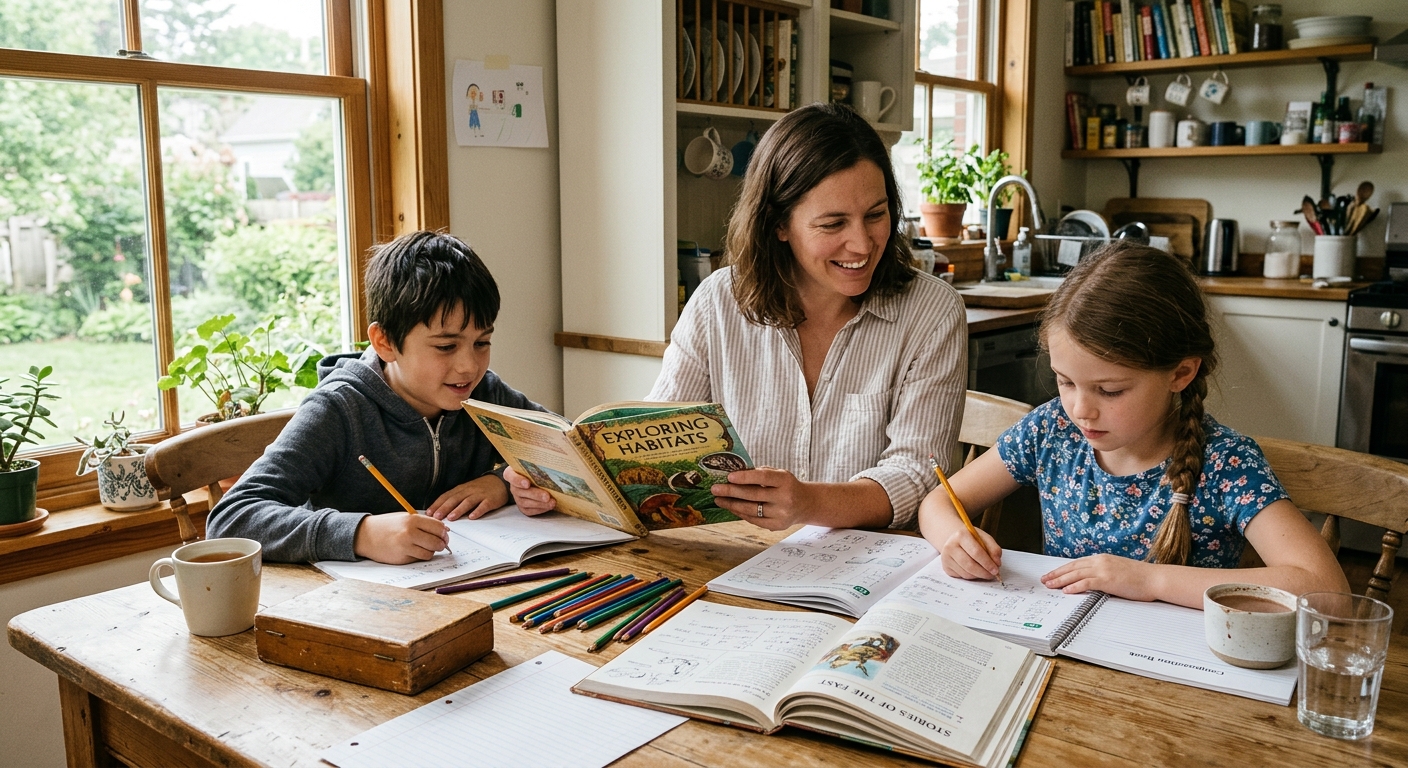
Texas is one of the least regulated states in the country for home education, and that freedom confuses people more than strict rules ever would. If you want to homeschool in Texas, the question isn't "what forms do I file?" — it's "what would I need to show if someone ever asked?" This guide explains the three legal tests Texas applies, the five subjects you must teach, and the two myths that cause the most unnecessary paperwork.
Quick Answer
Texas treats a home school as a private school. That means there is no notice of intent to homeschool in Texas, no registration, no attendance-hour log, no standardized testing, and no teacher qualification requirement. Instead, you must meet three conditions established by the Texas Supreme Court in Leeper v. Arlington ISD (1994): the instruction must be bona fide (genuine, not a sham), it must use a written, visual, or audio curriculum, and it must cover reading, spelling, grammar, mathematics, and good citizenship. The only paperwork most families ever produce is a withdrawal letter to the school their child currently attends.
TL;DR
- Texas requires no notice of intent, affidavit, or registration with any district or state agency. See why no homeschool notice is required in Texas
- The withdrawal letter is the one document that matters, and it goes to your child's school — not to the state. Read the four-step withdrawal sequence
- Five subjects are required: reading, spelling, grammar, math, and good citizenship. Check the five-subject list
- There is no 180-day or hour requirement for Texas homeschoolers, because the compulsory attendance exemption applies. Understand Texas homeschool attendance requirements
- Records are optional by law but useful in practice — especially if you re-enroll or apply to college. See which three records to keep anyway
In This Article
- What Does Texas Law Actually Require of Homeschoolers?
- Is a Notice of Intent to Homeschool Required in Texas?
- What Are the Five Required Subjects?
- How Do Texas Attendance Requirements Work for Homeschoolers?
- How Do You Withdraw a Child and Start Homeschooling in Texas?
- What Records Should You Keep Even Though Texas Doesn't Ask?
- How Do Texas Families Choose Curriculum With No State Restrictions?
- What Trips Texas Families Up Most Often?
What Does Texas Law Actually Require of Homeschoolers?
Texas requires three things, and none of them involve a government office. Under Texas Education Code §25.086, a child attending a private school is exempt from compulsory attendance. The Texas Supreme Court's decision in Leeper v. Arlington ISD, 893 S.W.2d 432 (Tex. 1994), affirmed that a home school counts as a private school for this purpose.
A Texas home school is a private school operated in the home that must satisfy three conditions: the instruction is bona fide, it follows a written, visual, or audio curriculum, and it covers the state's five required subjects.
"Bona fide" is the test most parents overthink. It simply means the education is real rather than a cover story for keeping a child out of school. A family that teaches regularly, uses actual materials, and can describe what the child is learning meets it.
The curriculum condition is equally forgiving. Written, visual, or audio covers almost everything in use today — textbooks, workbooks, printed lesson plans, video courses, and audio programs all qualify. What it rules out is instruction that exists nowhere except in a parent's head.
Two reference points matter when you want to double-check something. The Texas Education Agency (TEA) publishes a homeschool FAQ describing the private-school exemption, and the Texas Home School Coalition (THSC) is the state advocacy organization that most families turn to for practical interpretation of district disputes. Neither one approves your program; they simply explain it.
Worth saying plainly: there is no state body that inspects, licenses, or signs off on a home school in Texas. If you have already read a general overview of homeschooling in Texas, this article goes a layer deeper into what you'd actually have to demonstrate.
Key takeaway: Texas homeschool laws create a standard you must meet, not a process you must complete — there is nothing to submit and nobody to submit it to.
Is a Notice of Intent to Homeschool Required in Texas?
No. Texas requires no notice of intent to homeschool, no affidavit, no declaration, and no annual registration with your district, your county, or the TEA. A family that has never enrolled a child in public school can begin home education with zero paperwork.
The one document that does matter is a written withdrawal letter sent to the school your child is currently enrolled in. Without it, the school keeps marking your child absent, and repeated unexcused absences can trigger a truancy referral. The letter isn't a request for permission — it's a notification that your child is now enrolled in a private school.
Some districts respond by mailing back an "assurance form" or similar questionnaire asking you to confirm your curriculum. THSC advises families that completing such a form is voluntary, not a legal obligation.
⚠️ Caution: If a district letter implies that returning a form is required by law, re-read it carefully. Texas statute contains no filing requirement for home schools. Many families reply with a brief written statement confirming they are operating a private school in compliance with Leeper, and nothing more.
This is where Texas diverges sharply from most states. If you're comparing options before a move, the full picture of homeschool requirements by state is worth scanning — and if you're coming from a filing state, it helps to know what a notice of intent actually contains so you can see exactly what Texas leaves out.
| State | Required notice | Typical deadline | Who receives it | Renewal |
|---|---|---|---|---|
| Texas | None | N/A | No one | N/A |
| Florida | Letter of intent | Within 30 days of starting | District superintendent | One-time, plus annual evaluation |
| Ohio | Notification | Before the school year / within set window | District superintendent | Annually |
| North Carolina | Notice of intent | Before starting | State non-public education division | One-time |
| Virginia | Notice of intent | Mid-August (statutory date) | Division superintendent | Annually |
| Pennsylvania | Notarized affidavit | Before starting and each year | District superintendent | Annually |
Filing rules in other states change. Confirm current requirements with that state's education authority before relying on this table.
What Are the Five Required Subjects?
Texas requires instruction in five subjects, and that list has not changed since Leeper:
- Reading — decoding, fluency, and comprehension appropriate to the child.
- Spelling — written word accuracy, taught directly or through writing work.
- Grammar — sentence structure, parts of speech, and mechanics.
- Mathematics — arithmetic through whatever level the child reaches.
- Good citizenship — the duties and responsibilities of citizens.
Good citizenship is instruction in the duties and responsibilities of citizens, with no state-prescribed scope, hour count, or approved text. Because it's the subject parents ask about most, here's what it can look like in practice: a unit on the Texas Constitution and how it differs from the federal one, a visit to a city council or county commissioners meeting, a study of how voting and elections work, a project on jury duty and the court system, or logged volunteer hours with a local organization paired with written reflection.
Three absences from the list surprise people. Texas names no required science course, no required history course, and no required hour totals or grade-level pacing. Most families teach science and history anyway — not because the state asks, but because colleges and future schools expect them.
That freedom cuts both ways. Without grade-level benchmarks imposed from outside, you decide what "finished" means for each subject, which is why many families lean on a system for tracking mastery and progress rather than counting chapters.
Key takeaway: Meeting Texas homeschool laws means covering five subjects in a real curriculum — not matching a public school's scope and sequence.
How Do Texas Attendance Requirements Work for Homeschoolers?
They don't apply, once the exemption is in place. Texas Education Code §25.085 establishes compulsory attendance for children from age 6 through age 18. Section §25.086 then lists exemptions, including students attending a private school — the category Leeper placed home schools in.
The practical result: Texas homeschool attendance requirements involve no minimum days, no minimum hours, and no attendance report to anyone. There is no 180-day rule and no annual hour threshold. Compare that to states that set explicit totals — Ohio and Missouri, for example, are commonly cited for annual hour requirements of 900 and 1,000 hours respectively. Texas sets none.
The real risk in Texas isn't hours. It's a withdrawal letter that never arrived. If the school still has your child enrolled, every missed day is logged as an unexcused absence, and truancy procedures can begin while you believe you're in the clear.
If a district or truancy officer ever questions the exemption, what you produce is evidence of a real school: your dated withdrawal letter, the curriculum you're using, and samples of completed work. You are demonstrating that instruction is happening, not accounting for minutes. Rules vary by district in how they respond, so keeping that small file costs nothing and settles the question quickly. If you want to see how other states structure this, the homeschool requirements by state overview shows how unusual Texas really is.
Key takeaway: In Texas, attendance compliance is proven by curriculum, not by hours.
How Do You Withdraw a Child and Start Homeschooling in Texas?
Four steps, and the first one is the only time-sensitive piece:
- Write and deliver a dated withdrawal letter to the school principal or registrar, stating that your child is withdrawing to attend a private school.
- Keep a copy — ideally with proof of delivery, such as a date-stamped email, a signed receipt from the front office, or certified mail.
- Begin instruction in the five required subjects using a written, visual, or audio curriculum.
- Start a simple file for your curriculum list and work samples.
Sample wording, which needs no legal citations to be effective:
Dear [Principal's name],
Effective [date], [child's full name], grade [X], is withdrawing from [school name] to be enrolled in a private school. Please update your records to reflect this withdrawal and discontinue attendance reporting as of that date. Please confirm receipt of this letter in writing.
Sincerely, [Your name and date]
Mid-year withdrawal is completely legal and extremely common in Texas. You do not have to wait for a semester break, a grading period, or the start of a school year. A family that withdraws in February simply begins its school year in February.
One more detail worth knowing: request your child's academic records from the school at the same time. Transcripts and prior report cards are easier to get while the enrollment relationship is fresh. For the wider sequence — choosing an approach, setting a rhythm, deciding what the first month looks like — the step-by-step homeschool start guide covers what happens after the letter is sent.
What Records Should You Keep Even Though Texas Doesn't Ask?
None are legally required. Three are practically necessary:
- A curriculum list — what you're using for each of the five subjects, by title.
- Samples of completed work — a handful per subject, per term, dated.
- A running progress log — what was covered and roughly when.
Those three are exactly what you'd hand over if a district ever questioned the private-school exemption. They are also what someone else asks for later, and "later" arrives more often than new homeschoolers expect.
Consider a family that homeschools through middle school and then transfers back into a Texas ISD. Districts set their own placement policies: they may administer placement tests and award credit at their discretion. A clear record of what was taught and mastered gives the district something concrete to evaluate instead of a conversation. The same applies to college applications, dual-credit enrollment, and scholarship paperwork.
The honest difficulty is that nobody is making you do it, so it slips. Building the binder by hand — logging subjects, filing samples, writing summaries — is the part most families abandon by October.
That gap is where a home education companion like LearnSpark fits for Texas families: it builds the daily lesson across the subjects you're teaching and keeps a mastery and progress record updating as lessons are delivered, so the curriculum trail exists without a separate admin session every week. What that gives back is the Sunday evening you'd otherwise spend reconstructing what happened. If you'd rather build your own, a structured approach to tracking mastery and progress will get you there too — the point is having something, not having software.
How Do Texas Families Choose Curriculum With No State Restrictions?
Because Texas imposes no curriculum approval, the decision is purely about fit. There is no official or state-endorsed "best homeschool curriculum" for Texas families — only the one that matches your teaching load, your child's actual level, your budget, and whether you need accredited records for a future transfer.
Four approaches cover most of what Texas parents shortlist. Before comparing them, it helps to work through choosing your first homeschool curriculum so you know which questions matter for your family.
| Approach | Examples families shortlist | Typical cost | Parent time per week | Record-keeping effort | Transfer-friendly? |
|---|---|---|---|---|---|
| All-in-one boxed | Abeka | Higher, per child | Moderate — you teach it | Built-in schedules and grades | Generally strong |
| Online program | Time4Learning | Subscription-based | Lower — program-led | Automatic activity reports | Varies by provider |
| Eclectic / self-assembled | Mixed free and paid resources | Low to moderate | Highest — you build it | You create it yourself | Depends on your records |
| Free all-in-one | Easy Peasy All-in-One | Free | Moderate | You create it yourself | Depends on your records |
Provider details change. Verify current pricing, scope and accreditation directly with each provider.
One distinction trips families up constantly. The Texas Virtual School Network (TXVSN) is public school coursework delivered online — a student taking it is enrolled in a public school, not homeschooling. That means public school rules, including attendance and state testing, apply. It can be a good fit; it is simply a different legal category.
⚠️ Caution: Enrolling in a free state-funded online school is not homeschooling. If you want the private-school exemption, you need to be operating outside public enrollment entirely.
Accreditation is worth one sentence of thought, not a month of it. It matters mainly if you expect to re-enroll in a brick-and-mortar school, play sanctioned athletics under specific district conditions, or apply somewhere that asks for an accredited transcript.
What Trips Texas Families Up Most Often?
Four mistakes account for the majority of avoidable trouble:
- Never delivering a withdrawal letter. The child is still enrolled on paper, absences accumulate, and a truancy process starts over a document that takes five minutes to write.
- Treating a district "assurance form" as mandatory. Returning one is voluntary. Signing something that implies ongoing reporting obligations can create expectations Texas law never set.
- Assuming automatic access to public school sports. Texas homeschoolers gained the ability to participate in UIL activities under House Bill 547, effective from the 2021–22 school year, but participation comes with district-level conditions. Districts opt in and set their own requirements, so confirm locally before counting on it.
- Confusing a state-funded virtual school with homeschooling. As above, public enrollment means public rules.
[Image: Photo: A teenager practicing on a school sports field in late afternoon]
A fifth, quieter problem: families who assume that because nothing is required, nothing should be documented. Texas asks for no proof up front, but it does expect a real education to exist. Keeping a thin, consistent record is how you answer that question in an afternoon instead of a season.
Key takeaway: Nearly every Texas homeschool dispute traces back to paperwork that was either never sent to a school, or sent to a state office that never needed it. Rules and district practices vary, so verify anything local before you act on it.
Summary
Texas homeschool laws ask for substance, not submissions. Operate as a private school, teach reading, spelling, grammar, mathematics, and good citizenship through a written, visual, or audio curriculum, and deliver one withdrawal letter if your child is currently enrolled. There is no homeschool notice to file, no attendance hours to log, no testing to sit, and no curriculum to get approved. The discipline that matters is the one Texas doesn't require: keeping a modest record of what your child has actually learned, so the freedom you've been given stays an advantage rather than a question mark later.
Frequently Asked Questions
Do I have to notify my school district before homeschooling in Texas?
No. Texas requires no notice of intent to homeschool and no notification to any district or state agency. The only letter you send goes to the school your child currently attends, withdrawing them so attendance reporting stops. If your child has never been enrolled in a public school, there is no paperwork at all.
Does Texas require homeschool standardized testing?
No. STAAR testing and other state assessments apply to public school students, not to children educated in a home school under the private-school exemption. Some families choose to test voluntarily — using nationally normed options such as the Iowa Assessments or the California Achievement Test — purely for their own benchmarking, not for any state requirement.
Can I issue my child a homeschool diploma in Texas?
Yes. Texas treats homeschool graduates as private school graduates, and Texas Education Code §51.9241 addresses equivalent treatment of home-schooled applicants by state agencies and public institutions of higher education. Parents issue the diploma and maintain the transcript. Individual colleges and employers may still ask for supporting records, so keep your course list and work samples.
At what age does Texas compulsory attendance start?
Compulsory attendance under Texas Education Code §25.085 applies to children who are at least 6 years old as of September 1 of the school year, through age 18. The private-school exemption in §25.086 applies throughout that window, so a child educated at home in compliance with the Leeper conditions satisfies the requirement.
Can homeschoolers take classes or play sports at a Texas public school?
Participation in UIL activities became available to homeschooled students under House Bill 547, effective from the 2021–22 school year, subject to conditions districts set locally. Part-time academic enrollment is a separate matter and is generally not offered by most Texas districts. Contact your district directly, since policies and eligibility paperwork differ considerably.
This article explains general requirements and is not legal advice. Verify current Texas requirements with the Texas Education Agency or a qualified attorney before acting. Information about third-party platforms reflects publicly available details at the time of writing and may have changed. Please verify directly with the provider. See our Terms of Use for more.