
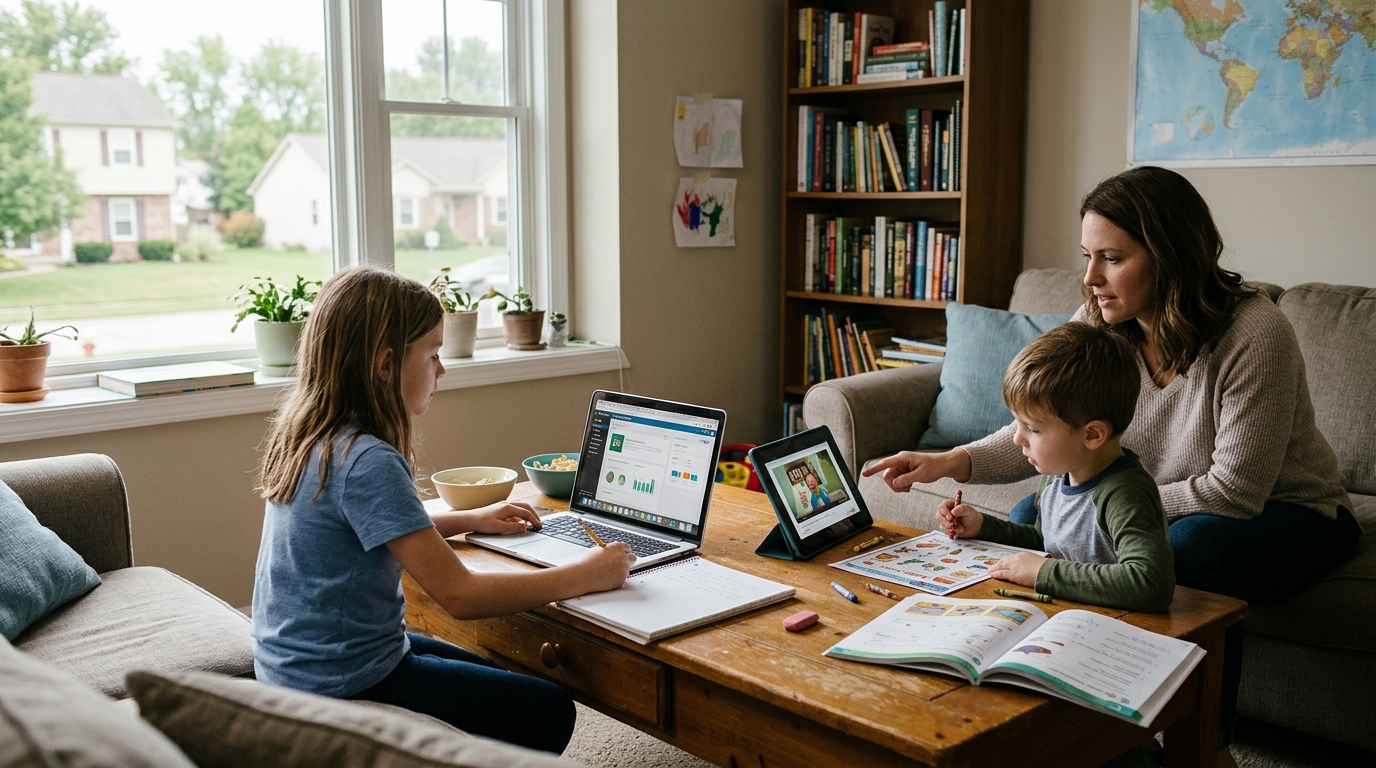
Online programs are where most homeschool Indiana searches eventually land, because the state's rules are short and the shopping list is long. Indiana asks very little of home educators, which means the hard part isn't legal compliance — it's picking a program that matches your child, your budget, and your diploma plans. This guide compares the four program types and eight named options Hoosier families run into most.
Quick Answer
Indiana treats a homeschool as a non-accredited private school, so no online program needs state approval. Your real choice is between three paths: tuition-free virtual public schools like Indiana Connections Academy and Indiana Online (which are public school at home, not homeschooling), accredited private online schools that issue their own diploma, and self-directed curricula where you keep the records and issue the diploma yourself.
TL;DR
- Indiana's legal bar is low — 180 days of instruction, attendance records you keep yourself, and instruction equivalent to public school. See what the state actually requires
- Enrolling in a virtual charter ends your homeschool status. You become a public school family learning at home. Compare the four program types
- Accreditation only matters for four specific goals — credit transfer, NCAA eligibility, some enlistment paths, and some scholarships. Check whether accreditation matters for you
- Costs range from free to full private-school tuition, and the hidden extras matter as much as the headline price. Review the cost breakdown
- Most families end up mixing sources, which works fine if one log holds everything. See how to keep a patchwork coherent
In This Article
- Homeschool Indiana Rules: What Does the State Actually Require Before You Enroll?
- What Are the Four Types of Online Homeschool Programs?
- Which Online Programs Can Indiana Families Actually Use?
- Does Accreditation Matter for an Indiana Homeschooler?
- What Do Online Homeschool Programs Cost in Indiana?
- How Do You Choose Between Them? A 6-Question Filter
- What If No Single Program Fits Your Child?
- What Records Should You Keep While Using an Online Program?
Homeschool Indiana Rules: What Does the State Actually Require Before You Enroll?
Indiana law treats a home education setting as a non-accredited private school. In practice that means instruction for 180 days a year, attendance records kept by the parent, and instruction broadly equivalent to what public schools provide.
A non-accredited private school is a school that operates legally without seeking approval or review from an accrediting body or the state education agency. Indiana homeschools fall into this category, which is why no curriculum — online or otherwise — needs state sign-off.
What Indiana does not require is just as important:
- No curriculum approval. You choose any program, in any order.
- No standardized testing. Testing is optional and private.
- No teacher qualifications. Parents need no credential.
- No state-mandated subject hours beyond the equivalency expectation.
Reporting is limited. Indiana offers a non-accredited school portal through the Department of Education where families can report enrollment, and many families use it for recordkeeping clarity. Verify current filing expectations with the Department of Education before you start, since administrative processes change. For the full legal picture, read our breakdown of Indiana homeschool requirements.
⚠️ Enrolling in a tuition-free virtual charter school legally un-homeschools you. Those programs are public schools. The district or charter holds the attendance records, sets the calendar, and administers state testing. That is a reasonable choice — but it is a different legal status, and it changes who answers for your child's education.
What Are the Four Types of Online Homeschool Programs?
Online homeschool programs in Indiana fall into four categories, and the dividing lines are who teaches, who keeps the records, and who signs the diploma.
A virtual public school is a tuition-free online public school operated by a district or charter authorizer. Teachers are state-licensed, attendance is reported to the state, and the student graduates with a public school diploma. Indiana Connections Academy and Indiana Online are the names families encounter most.
An accredited private online school is a tuition-based institution that delivers courses online, assigns teachers, maintains a transcript, and issues its own diploma. Laurel Springs and Bridgeway Academy are frequently cited examples. Confirm each school's current accreditation and grade coverage directly with the provider.
A boxed online curriculum provides a complete, sequenced course of study across subjects, usually self-paced, with automated grading and progress reports — but the parent remains the teacher of record. Monarch (from Alpha Omega Publications) and Power Homeschool (which uses Acellus courseware) sit here.
An à la carte platform offers individual subjects or classes rather than a full program, letting families assemble their own combination. Khan Academy and Outschool are common examples.
The clearest way to sort them is to ask two questions in order: who keeps the attendance and progress records, and who issues the diploma at the end. Run your answers down this table:
| Who keeps the official records | Who issues the diploma | Program type you're looking at | What comes with it |
|---|---|---|---|
| The school or the state | The public school system | Virtual public school | State testing, set calendar, licensed teachers |
| The school | The provider | Accredited private online school | Provider transcript, assigned teachers, tuition |
| The parent | The parent | Boxed online curriculum | Automated grading, platform progress reports |
| The parent | The parent | À la carte subjects | Parent-built transcript, parent-chosen scope |
If you are still deciding how structured you want your week to feel before you compare providers, it helps to understand how different homeschooling approaches work first — the philosophy usually narrows the shortlist faster than the feature list does.
Key takeaway: The four types differ less in content quality than in who carries the legal and administrative weight of your child's education.
Which Online Programs Can Indiana Families Actually Use?
All of them. Indiana places no restriction on curriculum choice, so the practical question is what each option asks of you and what it hands back.
The table below compares eight options Indiana families commonly shortlist. Program details, grade ranges, pricing, and accreditation status change regularly — treat this as a sorting tool and verify everything directly with the provider before enrolling.
| Program | Type | Who keeps records | Diploma source | Verify before enrolling |
|---|---|---|---|---|
| Indiana Connections Academy | Virtual public school | The school | Public high school diploma | Enrollment windows, attendance rules, state testing |
| Indiana Online | Virtual public / supplemental courses | The school or partner district | Public school diploma | Whether you enroll full-time or by course |
| Laurel Springs | Private online school | The school | Provider-issued | Current accreditation, grade range, tuition |
| Bridgeway Academy | Private online school / curriculum packages | Varies by package | Provider or parent, by package | Which package includes transcripts |
| Power Homeschool (Acellus) | Boxed online curriculum | Parent | Parent-issued | Course catalog depth for high school |
| Monarch (Alpha Omega) | Boxed online curriculum | Parent | Parent-issued | Subject coverage, worldview fit |
| Time4Learning | Boxed online curriculum | Parent (platform reports available) | Parent-issued | Grade range, whether high school is separate |
| Khan Academy | À la carte subjects | Parent | Parent-issued | Subject gaps you'll need to fill elsewhere |
A few patterns worth noticing:
- The free options sit at opposite ends. Virtual public schools are free because they're public; à la carte platforms are free because they're partial.
- The "who keeps records" column predicts your workload more reliably than price does.
- Hybrid packages blur the lines. Several providers sell both a full enrolled program and a curriculum-only version. Ask which one you're buying.
If none of these fit, our broader program roundup covers national options outside the Indiana-specific set.
Does Accreditation Matter for an Indiana Homeschooler?
Usually not. Indiana neither requires nor recognizes accreditation for home educators, and parent-issued transcripts are a normal part of the admissions landscape.
Accreditation is a voluntary review in which an external agency evaluates a school's curriculum, staffing, and administration against published standards. It is an institutional credential — not a legal requirement for families homeschooling under indiana homeschool laws.
Accreditation becomes genuinely useful in four situations:
- Transferring credits back into a public or private high school. Receiving schools set their own credit-acceptance policies, and an accredited transcript is typically simpler to process.
- NCAA eligibility. Student-athletes go through the NCAA Eligibility Center, which publishes its own requirements for homeschooled applicants. Check those requirements early in high school, not senior year.
- Certain military enlistment paths. Enlistment criteria vary by branch and change over time; ask a recruiter directly.
- Some scholarship and dual-credit programs that specify an accredited issuing institution.
For college admissions generally, Indiana's public universities publish policies for homeschooled applicants. Check the specific admissions page for each campus you're considering, because documentation requests — course descriptions, test scores, reading lists — differ between institutions. Whichever path you take, the diploma question is covered in more detail in our guide to what Indiana law says about homeschool diplomas.
Key takeaway: Pay for accreditation when a named external gatekeeper — a receiving school, the NCAA, a recruiter, or a scholarship board — requires it. Otherwise it is an expense without a corresponding benefit.
What Do Online Homeschool Programs Cost in Indiana?
Cost tracks almost exactly with how much of the job the program takes off your plate. Tuition-free virtual public schools sit at one end. Accredited private online schools with assigned teachers, grading, and transcripts sit at the other. Self-paced boxed curricula land in between, usually sold as a monthly or annual subscription per child.
There is no state funding attached to a homeschool Indiana families run themselves. That makes the hidden costs worth budgeting before you commit:
- Testing fees if you choose to benchmark with a nationally normed test.
- Lab kits and consumables for science courses, which boxed curricula often sell separately.
- Device and connectivity requirements. Some programs specify a minimum setup; virtual public schools sometimes loan hardware.
- Co-op, tutoring, and activity fees — frequently the largest line item once a child reaches middle school.
- Per-child pricing. Family discounts vary widely between providers.
Indiana also offers a state income tax deduction for qualifying unreimbursed education expenses for dependents in private school or home education. Amounts and eligibility rules are set by the Indiana Department of Revenue and change — confirm the current figure and what qualifies before you file. For the wider picture on deductions, credits, and what typically doesn't qualify, see how homeschool tax rules work.
How Do You Choose Between Them? A 6-Question Filter
Choose by what you need the program to carry for you — teaching, grading, records, or credentialing. Work through these six questions and the shortlist usually collapses to one or two options.
- Who is doing the teaching? If you want assigned teachers, you need a virtual public school or a private online school. Boxed curricula assume you're present.
- Does the diploma need to come from an institution? If yes, that rules out every parent-issued option immediately.
- How much screen time fits your child? Full online programs are screen-heavy by design. Younger children often do better with a parent-led plan and limited screen components.
- Are you teaching more than one age? Most online programs are built per-student. Teaching three children means three separate logins and three separate paces unless you deliberately combine subjects.
- Do you need records generated for you, or will you keep them? Virtual public schools handle it. Everyone else hands you a report you still have to file.
- Might you move or travel mid-year? Indiana residency matters for virtual public school enrollment. Self-directed curricula travel with you.
Here is how each answer narrows the field:
| Filter question | If your answer is... | It points you toward |
|---|---|---|
| Who is doing the teaching? | "Someone other than me" | Virtual public school or accredited private online school |
| Institutional diploma needed? | "Yes" | Virtual public school or accredited private online school |
| How much screen time? | "Keep it low" | À la carte subjects alongside parent-led work |
| Teaching more than one age? | "Yes" | Boxed curriculum or à la carte, combined where subjects allow |
| Who keeps the records? | "Not me" | Virtual public school |
| Might you move mid-year? | "Possibly" | Boxed curriculum or à la carte subjects |
Answering question three and question four honestly saves the most money, because they're the two that most often cause families to abandon a program a few months in. It also helps to match a program to your homeschool style rather than the other way around — a structured curriculum imposed on a relaxed household tends not to survive February.
What If No Single Program Fits Your Child?
Most Indiana families end up eclectic — a reading program from one provider, math from another, science from a kit, and parent-led work for everything else. That is a normal outcome, not a failure to decide.
The risk with mixing is drift. Three platforms each report progress their own way, none of them knows what the others covered, and by March nobody can say whether the year added up to 180 days of equivalent instruction. The fix is boring and effective: one scope list of what you intend to cover this year, one attendance log, and one place where you note what actually happened each day.
That last piece is where the Sunday-night planning sessions pile up — stitching four sources into a week, then writing down what you taught after the fact. A home education companion like LearnSpark builds the daily plan around where your child actually is and keeps the record updated as you teach, so a patchwork of sources doesn't mean rebuilding a planner every weekend. You can see how the lesson plans built around your child are assembled, including shared plans when several ages sit at the same table.
Key takeaway: A mixed approach works when the logging is centralized. It falls apart when each program keeps its own separate record and none of them is yours.
What Records Should You Keep While Using an Online Program?
Keep four things, regardless of which program you use: an attendance log covering the 180 days, a list of subjects covered, dated samples of your child's work, and — for high school — a running tally of credits earned.
A homeschool portfolio is a dated collection of attendance records, subject lists, work samples, and assessments that documents what a student studied over a given year. It is your evidence if a question ever arises, and your raw material when you build a transcript.
A practical rhythm:
- Weekly: mark attendance, note subjects touched.
- Monthly: save two or three pieces of work per child — one strong, one in-progress.
- Annually: export every platform report as a PDF. Running a Time4Learning or similar progress export each June takes minutes and protects you later.
That last step matters more than parents expect. Platforms close accounts, change plans, and discontinue products. A report you can only see while subscribed is not a record you own. Store the exports somewhere you control, and if you want a system for organizing it all, our guide to how to build a digital homeschool portfolio walks through the folder structure.
⚠️ If you use a virtual public school, the school holds the official record — but request a copy of the transcript and attendance summary before you withdraw or graduate. Access ends when enrollment does.
Summary
That is the homeschool Indiana reality: the state asks for 180 days, records you keep, and instruction equivalent to public school — nothing about which program you use. So the decision is yours to make on fit rather than compliance. Decide first whether you want public school at home, an institutional diploma, or a curriculum you direct yourself. Then check cost, screen time, and multi-age fit. Keep your own log either way, and export anything a platform holds on your behalf.
Frequently Asked Questions
Is Indiana Connections Academy the same as homeschooling?
No. It is a tuition-free public school delivered online, which means the school holds the attendance records, sets the academic calendar, assigns state-licensed teachers, and administers state testing. Legally, you are a public school family whose child learns at home. That can be an excellent fit — but you are not operating a non-accredited private school, and the flexibility that comes with home education does not apply.
Do Indiana homeschoolers have to take standardized tests?
No. Indiana requires no standardized testing for homeschooled students, and no test results are reported to the state. Families who want an outside benchmark often arrange a nationally normed test privately, such as the Iowa Assessments or the California Achievement Test. Confirm current guidance with the Indiana Department of Education, since non-accredited school policies are periodically updated.
Can an online program issue my child an Indiana high school diploma?
Only an accredited private online school issues its own diploma. If you use a boxed curriculum or à la carte platform, you as the parent issue the diploma — which Indiana recognizes, and which Indiana colleges generally accept alongside a parent-prepared transcript and test scores. Check the admissions page of each college your student is considering, because required documentation differs between institutions.
Can I switch online programs partway through the year?
Yes, and no state paperwork is involved, as long as your 180-day attendance log continues unbroken across the switch. Note the one exception: if your child is enrolled in a virtual public school, leaving mid-year means formally withdrawing from that school and beginning your own homeschool record from that date forward. Keep the withdrawal confirmation.
How do you start homeschooling in Indiana mid-year?
Withdraw your child from their current school in writing, begin your own attendance log from the first day of home instruction, and choose a program that fits the remaining months. Indiana asks for 180 days of instruction, so count the days your child already completed at the enrolling school and plan the balance yourself. Check the Department of Education's current reporting expectations for non-accredited schools, then keep your log running without gaps.
Is one online program enough for a full homeschool year?
Often yes for elementary grades, and less often in high school. A boxed online curriculum usually covers the core subjects in sequence, which satisfies the equivalency expectation on its own. High school tends to need additions — a lab science kit, a foreign language, dual-credit coursework, or electives the platform doesn't carry. Check the course catalog for grades 9 to 12 before you assume the program will take you to graduation.
Do online homeschool programs work for teaching several children at once?
They work, but most are priced and paced per student, so three children means three logins and three independent paces. Families teaching multiple ages usually keep each child on their own math and reading track, then combine history, science, and read-alouds at the table. Ask providers about family pricing and whether one parent dashboard covers every child before you buy separate subscriptions.
Information about third-party platforms reflects publicly available details at the time of writing and may have changed. Please verify directly with the provider. See our Terms of Use for more.