
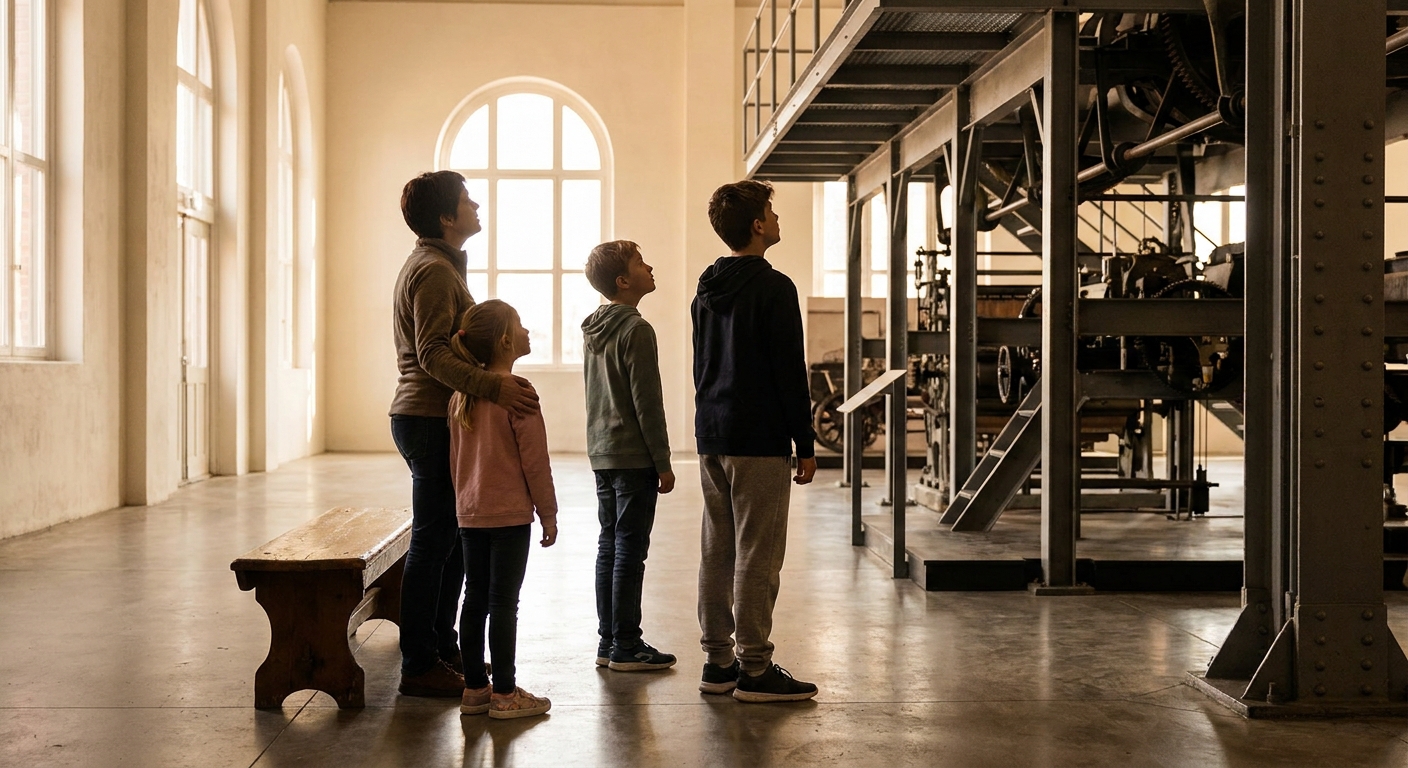
Michigan packs a lot of teaching material into one state: an industrial history you can walk through, two Great Lakes shorelines, a working shipping lock, and dune systems you can climb. That makes planning homeschool field trips here less about finding something and more about choosing well. This guide sorts 30 spots by region, explains what a day out typically costs, and gives you a simple routine for turning the drive home into real learning.
Quick Answer
The best homeschool field trips in Michigan cluster into five regions: Metro Detroit, the Ann Arbor–Lansing corridor (plus the Thumb and Saginaw Bay), West Michigan, the Northern Lower Peninsula, and the Upper Peninsula. Start with The Henry Ford in Dearborn, the Grand Rapids Public Museum, and Sleeping Bear Dunes National Lakeshore. Many museums run designated homeschool days or honor school-group rates for larger groups, and most outdoor sites cost far less than an indoor ticket.
TL;DR
- Michigan's field trip map breaks cleanly into five drivable regions, each with a different academic strength. Start with the Metro Detroit picks
- Several museums schedule homeschool days or apply group pricing, but availability changes year to year — call the group sales line rather than trusting the website. See how the cost bands compare
- Outdoor sites are the budget backbone: state parks run on the Recreation Passport, and federal lands have their own fourth-grade access program. Review the passes worth buying
- A trip sticks when you use a before/during/after loop: one guiding question, three capture prompts, one short retell. Walk through the three-stage routine
- Upper Peninsula destinations are worth it, but plan them as multi-day trips and check seasonal closures first. Read the northern itinerary notes
In This Article
- What Makes a Homeschool Field Trip Actually Worth the Drive?
- Metro Detroit and the Southeast: Where Should You Start?
- Ann Arbor, Lansing and the Mid-State Corridor
- West Michigan: Grand Rapids to the Lakeshore
- Northern Michigan and the Upper Peninsula: Worth the Trip?
- What Do Michigan Homeschool Field Trips Actually Cost?
- How Do You Plan the Trip So Learning Actually Sticks?
- How Do You Record a Field Trip for Michigan Homeschool Records?
- How Do You Run One Trip for Several Ages at Once?
- Frequently Asked Questions
What Makes a Homeschool Field Trip Actually Worth the Drive?
A trip earns its place when it shows your child something a book cannot: scale, process, or physical evidence. A photo of a blast furnace is information. Standing near one is a different kind of understanding.
An educational field trip is a planned off-site visit tied to at least one learning goal the child already has context for. The context part matters most. A visit lands better when the child arrives already holding a question.
Three filters help you choose:
- Hands-on beats glass-case — look for places where children touch, operate, or build something, not only read labels.
- Flexible group size — some sites price and schedule around 25-student classes; ask whether a family of four can join a guided program.
- Staff used to mixed ages — interpreters who can pitch the same story to a five-year-old and a teenager save you the translation work.
Supporters of experiential learning often argue that a single well-framed visit can change how a child notices detail afterward. Whether or not that holds for your family, the practical version is simple: the visit does the showing, and you do the connecting. That is the whole idea behind using any location to turn any trip into a classroom.
⚠️ The most common mistake: booking a trip with no connection to current work. A random aquarium day in the middle of a unit on ancient Rome is a nice day out, but it will not show up in anything your child produces that month.
Metro Detroit and the Southeast: Where Should You Start?
Start with The Henry Ford Museum of American Innovation and Greenfield Village in Dearborn. It is the single densest teaching site in the state: an indoor museum of machines and civil rights artifacts, plus an outdoor village of working historic trades you can walk between in an afternoon.
Six more worth the drive in the southeast:
- Detroit Institute of Arts — world art collections; the institute has offered free general admission to residents of Wayne, Oakland and Macomb counties, so confirm current terms before you budget.
- Detroit Historical Museum — the underground streets of old Detroit and the auto assembly exhibit; strong for local and industrial history.
- Michigan Science Center — planetarium, live demonstrations, and physics you can push and pull.
- Belle Isle Aquarium and Belle Isle Nature Zoo — a small historic aquarium plus a freshwater and woodland ecology stop on the same island park.
- Ford Rouge Factory Tour — an active assembly plant viewed from a walkway; unbeatable for manufacturing process and supply chains.
- Cranbrook Institute of Science — minerals, fossils, and an observatory in Bloomfield Hills.
Several of these have historically scheduled homeschool days or applied school-group pricing to organized groups. Policies shift annually, so phone the group sales line and ask specifically whether a family or a co-op can book the school program.
Tie the booking to the work you already have open. If your child is three weeks into a unit on energy, the Rouge tour is a chapter in that unit, not a detour — which is roughly how LearnSpark works for homeschooling: lessons sit on a sequence rather than floating loose.
Key takeaway: Southeast Michigan gives you industry, art and civic history within one hour's drive of each other, which makes it the easiest region to build a repeatable rotation.
Ann Arbor, Lansing and the Mid-State Corridor
This corridor is the state's science-and-government belt. If you need civics and lab science in one week, base your planning here.
Ann Arbor and the university sites:
- University of Michigan Museum of Natural History — dinosaurs, Michigan geology, and a planetarium, with general admission historically free.
- Ann Arbor Hands-On Museum — built for younger children; everything is meant to be operated.
- Matthaei Botanical Gardens and Nichols Arboretum — conservatory biomes and native prairie trails for botany and plant adaptation.
Lansing and the capital:
- Michigan State Capitol — free guided tours booked through the Capitol Tour Office; pair it with a lesson on how a bill moves.
- Impression 5 Science Center — a strong hands-on stop for elementary ages.
- MSU Abrams Planetarium and the MSU Dairy Store — astronomy plus a food-science stop children will actually request.
- Potter Park Zoo — manageable in half a day, good for animal classification work.
Swinging north and east into the Thumb and Saginaw Bay adds two more: Dow Gardens in Midland for designed landscapes and horticulture, and the Thomas Edison Depot Museum in Port Huron for a short, focused look at early invention and rail.
Key takeaway: book the Capitol tour first, since tour slots drive the rest of the day's schedule, then add a science center in the afternoon.
West Michigan: Grand Rapids to the Lakeshore
Lead with the Grand Rapids Public Museum. It houses a restored 1928 carousel, a planetarium, and regional natural history exhibits in one building on the Grand River — enough for a full day without a second stop.
Six more across West Michigan and the lakeshore:
- Frederik Meijer Gardens and Sculpture Park — a tropical conservatory, a children's garden, and outdoor sculpture; the gardens have offered homeschool-specific programming in past years, so ask.
- Gerald R. Ford Presidential Museum — presidential history, primary documents, and a clear civics tie-in.
- John Ball Zoo — hillside zoo with aquarium and aviary sections.
- Grand Haven Lighthouse and pier — free, open, and excellent for a lesson on navigation, wave action, and why piers exist.
- Silver Lake Sand Dunes — live dune geology you can climb; windy and exposed, so check conditions.
- Windmill Island Gardens, Holland — an operating Dutch windmill for immigration history and simple machines.
A practical sequencing tip: pair one indoor museum with one lakeshore stop on the same day. Children absorb more from an exhibit when the afternoon releases them outdoors.
Northern Michigan and the Upper Peninsula: Worth the Trip?
Yes — but plan them as two- or three-day trips, not day trips. Drive times north of Traverse City are long, and the Mackinac Bridge adds a crossing most families underestimate.
Seven destinations that justify the mileage:
- Sleeping Bear Dunes National Lakeshore — glacial geology, the Dune Climb, and the Pierce Stocking Scenic Drive.
- Mackinac Island and Fort Mackinac — no cars, costumed military demonstrations, and a tight lesson in 18th- and 19th-century frontier history.
- Soo Locks, Sault Ste. Marie — a free observation platform where freighters are raised and lowered in front of you.
- Tahquamenon Falls State Park — the Upper and Lower Falls, tannin-stained water, and a watershed conversation that writes itself.
- Quincy Mine, Hancock — a hoist house and underground tour covering copper mining and immigrant labor history.
- Oswald's Bear Ranch, Newberry — a large rescue sanctuary; a good anchor for a conversation about wildlife rehabilitation ethics.
- Pictured Rocks National Lakeshore — sandstone cliffs best seen from a boat tour, with mineral staining visible from the water.
Framed as a multi-day loop, these become a trip rather than an outing — closer in shape to the educational travel ideas families use for vacations.
⚠️ Check the calendar before you book. Many northern attractions, boat tours and island services operate seasonally and close or reduce hours in winter. Verify opening dates directly with each site, and budget realistic drive time across the bridge.
What Do Michigan Homeschool Field Trips Actually Cost?
Cost varies far more by site type than by region. Outdoor and civic sites sit at the low end; science centers and ticketed historic villages sit at the high end. Building a year around the cheaper categories and splurging on one or two anchor visits keeps the total manageable.
| Site type | Typical cost band (family of four) | Homeschool rate often available? | Best season |
|---|---|---|---|
| Large history museum / historic village | Higher | Yes — ask about homeschool days | Spring and fall |
| Science center | Moderate to higher | Sometimes, via group rates | Winter |
| State park, dunes, falls | Low (pass-based) | Not applicable | Late spring to early fall |
| Zoo or botanical garden | Moderate | Sometimes | Spring and fall |
| Factory or industrial tour | Moderate | Rarely | Year-round (weekdays) |
| Civic site, lighthouse, lock platform | Free or very low | Not applicable | Summer |
Three passes do most of the work:
- Michigan Recreation Passport — added to a vehicle registration, it covers entry to Michigan state parks and recreation areas. Confirm the current fee and renewal process with the Michigan Department of Natural Resources.
- Every Kid Outdoors — a federal program that has provided fourth-graders and their families with access to federal lands and waters. Check current eligibility and sign-up details with the National Park Service.
- Library museum pass programs — many Michigan library systems lend passes to local museums. Ask at your branch; terms differ by system.
If you are hunting for field trip ideas Michigan families can afford on repeat, the lakeshore, the state parks and the free civic sites are where your calendar should live. Save the ticketed museums for the months when the weather closes the outdoor options.
How Do You Plan the Trip So Learning Actually Sticks?
Use a before/during/after loop. It takes about twenty minutes of preparation and turns an outing into something you can point to later.
Before — one question and two words. Write a single guiding question the child will try to answer, plus two vocabulary words they will hear on site. Nothing else.
During — three capture prompts. Give each child a half-sheet with the same three jobs: sketch one thing, measure or count one thing, and ask a staff member one question. The sheet keeps hands busy without turning the day into a worksheet.
After — ten minutes of retelling. On the drive home or that evening, the child explains the answer to the guiding question out loud. If they want to go further, the visit can seed a build or a model, which is the natural entry point to project-based learning lesson plans.
Worked example at the Soo Locks. Guiding question: why does a ship need a staircase? Vocabulary: lock, elevation. On site, the child sketches the lock chamber, counts how long the fill takes, and asks a staff member how much the water level changes. At home, they explain it back — and often reach for a tub and two cups to prove it.
Key takeaway: one question in, one explanation out — that single pairing does more than a packet of printables.
How Do You Record a Field Trip for Michigan Homeschool Records?
Michigan is widely described as one of the least-regulated states for home education. Families educating at home are generally expected to provide instruction in specified subjects, and those who operate as a nonpublic school typically keep attendance and subject records. Reporting expectations depend on which status your family is operating under, so verify your own situation against current Michigan Department of Education guidance.
Whatever your status, a defensible entry is short. Log four things:
- Date and location — the site name and the day.
- Subject or subjects — history, earth science, civics, whatever the visit genuinely covered.
- Hours of instruction — door-to-door time counts as learning time for most families.
- One-paragraph outcome note — the guiding question and what the child could explain afterward.
That fourth item is the one that gets skipped, because it lands at the end of a long driving day when nobody wants to write anything. This is exactly the part a planning and record system can absorb: the lesson you already logged becomes the subject entry, the hours, and a parent-facing progress note, so the write-up is finished before you unload the car and the evening belongs to your family again. If you are building that habit from scratch, a broader primer on homeschool progress tracking is a sensible next read.
Key takeaway: a defensible field trip record is date, place, subject, hours, and one paragraph on what the child can now explain.
How Do You Run One Trip for Several Ages at Once?
Give every child the same location and a different job. Splitting the destination is what exhausts parents; splitting the assignment is what makes a mixed-age day work.
At Greenfield Village, for example, the same two hours can produce three different outcomes:
| Age band | Job on the day | What you keep afterward |
|---|---|---|
| Ages 4–6 | Count and sort: how many tools, which are for wood and which for metal | A sorted drawing or photo set |
| Ages 7–10 | Interview a costumed interpreter with three prepared questions | A written or recorded Q&A |
| Ages 11–14 | Compare two production methods seen on site, in writing | A short comparison piece |
The jobs scale, but the content does not change — which means you explain the context once, to everyone, at the gate. That is the same principle behind teaching multiple children of different ages at the kitchen table.
Two practical notes. Give the youngest child a job that finishes early, because they will run out of stamina first. And let the oldest child pick their own comparison, since ownership does more for a teenager's write-up than any prompt you hand them.
Key takeaway: one location with three assignments beats three separate trips, and costs one admission day instead of three.
Summary
Michigan rewards a regional approach. Southeast Michigan carries industry, art and civic history; the Ann Arbor–Lansing corridor carries science and government; West Michigan pairs museums with lakeshore geology; and the north and Upper Peninsula deliver landscape and mining history worth a multi-day trip. Pick one anchor trip per region per year, lean on passes for the outdoor sites, and run the same before/during/after loop every time. Done that way, homeschool field trips stop being a treat squeezed around the curriculum and start being part of it.
Frequently Asked Questions
Do Michigan museums offer homeschool discounts?
Many do, usually in one of two forms: a scheduled homeschool day with reduced admission, or school-group pricing extended to organized groups above a minimum headcount. The Henry Ford, Impression 5 and the Grand Rapids Public Museum have each run homeschool-oriented programming in past years. Terms change annually, so call the group sales or education line rather than relying on the public website.
How many field trips should a homeschool year include?
One meaningful trip a month is a realistic target — roughly nine or ten across a school year. Frequency matters less than depth. A single well-prepared visit can anchor a six-week unit, supplying the question, the vocabulary and the final project. Three unconnected outings in the same month usually produce three pleasant days and no retained work.
Can a homeschool field trip count as school attendance in Michigan?
Families educating at home under Michigan's home-based education provisions are not required to report attendance to the state at all. Families registered as a nonpublic school typically count a field trip day as instructional time and record it alongside the subjects covered. Confirm which status applies to you using current Michigan Department of Education guidance before relying on either approach.
What should you pack for a homeschool field trip day?
Keep it to one small bag:
- Clipboard or sketchbook, plus two pencils
- A phone for photographs of exhibit labels
- Refillable water bottles and snacks
- The guiding question, printed and in a pocket
- Printed booking confirmation for any group reservation
- Layers — lakeshore and dune sites run colder and windier than the forecast suggests
Information about third-party platforms reflects publicly available details at the time of writing and may have changed. Please verify directly with the provider. See our Terms of Use for more.