
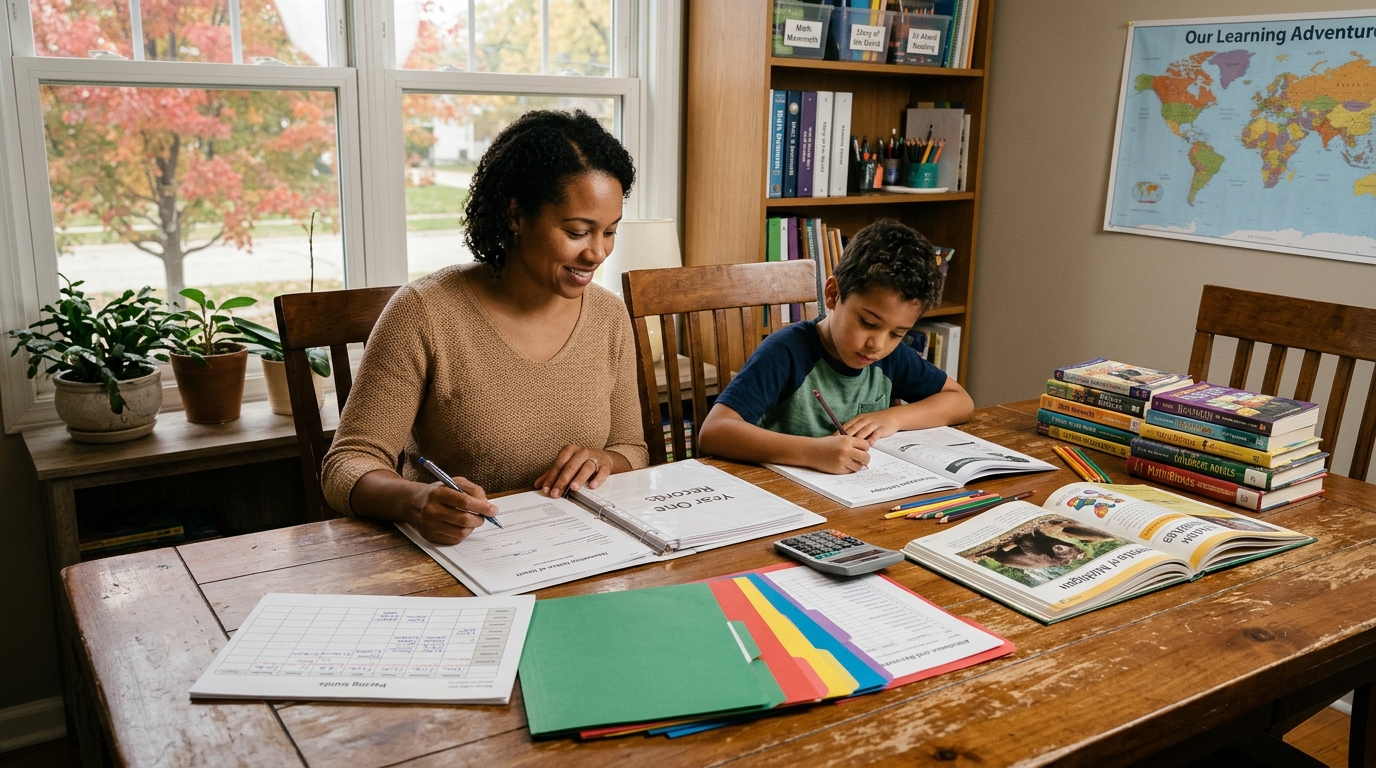
Homeschooling in Michigan: Start-Up Checklist for Year One
Michigan is one of the simplest states in the country to begin home education in, and the homeschool Michigan laws you actually need to follow fit comfortably on a single page. The hard part isn't the legal side — it's the first-year logistics: what to teach, what to keep, where to find other families, and how to stop the whole thing from eating your evenings. This guide walks you through the start-up sequence in order, with a checklist you can work from in week one.
Quick Answer
Michigan is a low-regulation state for home education. Families homeschooling under the home school exemption in the Revised School Code (MCL 380.1561(3)(f)) file no notice with the state, sit no state tests, and need no teaching certificate. You must teach the subjects the statute lists, and you may instead choose to operate as a nonpublic school, which carries different expectations. Everything else — curriculum, schedule, hours, records — is your call.
TL;DR
- No notification is required under Michigan's home school exemption, which is why most families never file anything at all. See the four start-up steps
- The subject list is fixed by statute, but hours, days and curriculum brand are not. Check the required subject list
- Records aren't legally required, but keep them anyway for re-enrollment, dual enrollment, sports and scholarships. See the five records worth keeping
- No state approval list exists for curriculum, so the decision is about fit, not compliance. Compare the four curriculum categories
- Support is regional, not centralised — county groups, co-ops and statewide membership organisations each do something different. Find Michigan co-ops and groups
In This Article
- How Do You Start Homeschooling in Michigan, Step by Step?
- Homeschool Michigan Laws: What Subjects You Must Teach
- How Do You Withdraw a Child From a Michigan Public School?
- What Records Should Michigan Homeschoolers Keep Anyway?
- Which Curriculum Options Fit Michigan Families Best?
- Where Do You Find Homeschool Co-ops and Classes in Michigan?
- Which Statewide Organizations Actually Help Michigan Homeschoolers?
- How Does Michigan Homeschooling Work for High School and Diplomas?
- How Do You Keep the First Year From Burying You in Admin?
How Do You Start Homeschooling in Michigan, Step by Step?
There are four practical steps, and only one of them involves paperwork. Work through them in order and you can be legally homeschooling within a week.
Step 1 — Decide which legal route fits. Michigan gives you two options, and they are not interchangeable.
Home school exemption is the route most Michigan families use: you educate your own children at home under MCL 380.1561(3)(f), teaching the statutory subject list, with no filing, no testing and no certification requirement.
The alternative is operating as a nonpublic school, which comes with different expectations around certified instruction and voluntary reporting to the state. Some families choose it because they want access to certain special education services through their local district. The trade-offs are genuinely different, so read up on Michigan's two legal homeschooling paths before you commit.
Step 2 — Withdraw in writing, if your child is currently enrolled. This is the single piece of paperwork, and it protects you from a truancy inquiry later. Skip to the withdrawal letter steps for the wording.
Step 3 — Choose your subjects and materials. Start with the statutory list, then pick resources that match your child's level — not their grade label. You do not need a complete year planned before you begin.
Step 4 — Set a record habit in week one. Not because Michigan asks for it, but because starting a log in October is far easier than reconstructing one in May.
Here is how that plays out in practice. A parent pulling a third grader out of a Grand Rapids district mid-year sends a dated withdrawal letter on a Monday, requests a copy of the cumulative file, and begins teaching the following Monday using library books and a math program. No state form. No approval wait. The child's legal status changes the moment the family begins educating at home under the exemption — the letter simply documents it.
A second example shows the other starting point. A Marquette family whose daughter has never been enrolled anywhere reaches compulsory attendance age in September. They send nothing, because there is nothing to withdraw from. They pick a reading program and a maths program, open a notebook for the daily log, and that is the whole of how to start homeschooling in Michigan for a never-enrolled child.
Key takeaway: Michigan's start-up process is four steps, only one of which is paperwork — the written withdrawal letter.
Homeschool Michigan Laws: What Subjects You Must Teach
The statute names a specific list of subjects, and that list is the main substantive obligation on a Michigan home educator. Under the home school exemption, you are expected to provide organised instruction in:
- ☐ Reading
- ☐ Spelling
- ☐ Mathematics
- ☐ Science
- ☐ History
- ☐ Civics
- ☐ Literature
- ☐ Writing
- ☐ English grammar
Required subject list refers to the subjects Michigan's Revised School Code identifies for home education under MCL 380.1561 — it sets what must be covered, not how, when, or with which materials.
What the law does not specify matters just as much. There are no required instructional hours. No required number of days. No approved curriculum vendors. No mandated scope and sequence. No state test. This is why Michigan sits at the lighter end of the regulatory spectrum; if you want to see how Michigan compares to other states, the contrast with portfolio-review states is stark.
That openness confuses new parents more than it reassures them, because nine subjects sounds like nine separate lessons. It isn't. Consider one 45-minute morning block with a second grader: you read a chapter of a novel aloud (literature and reading), the child retells it in three written sentences (writing and English grammar), and you spot-correct two misspelled words together (spelling). Four subjects, one sitting, no worksheets.
Civics and history frequently fold into the same reading. Science often lives in a kitchen experiment or a walk. The statutory list is a coverage map, not a timetable.
A sixth-grade week makes the folding obvious. A Lansing family reads a chapter on the state's auto industry (history), traces where the raw materials came from on a map (geography inside history), discusses why a city council votes on factory permits (civics), tests which of three paper-clip bridges holds the most weight (science), and writes a half-page explaining the result (writing, grammar, spelling). That is seven of the nine Michigan homeschool requirements touched in about four hours, spread across five mornings.
How to verify these requirements yourself:
- Read the current text of MCL 380.1561 in the Michigan Legislature's online compiled laws — it is short, and the exemption language is in subsection (3).
- Read the Michigan Department of Education's own home schooling guidance page, which states the department's position on notification and the nonpublic school membership report.
- Call your local district's enrolment or attendance office for anything district-specific, such as part-time elective enrolment or sports.
- Speak to an attorney if your situation involves a truancy dispute, a custody disagreement, or an open Children's Protective Services matter.
⚠️ Statute text and departmental guidance change. Before you rely on any summary — including this one — read the current text of MCL 380.1561 and the Michigan Department of Education's own home school guidance directly, and speak to an attorney if your situation involves a truancy dispute or custody disagreement.
How Do You Withdraw a Child From a Michigan Public School?
Michigan has no statutory withdrawal form, so a dated written letter to the principal, copied to the district office, is what you send. It takes three sentences and it is the single most useful document in your file.
Keep the wording plain. State who, what, and the effective date — nothing more:
Dear Principal [Name], Effective [date], our child [full name], date of birth [DOB], currently in [grade] at [school], will be educated at home under the home school exemption in MCL 380.1561(3)(f). Please remove [name] from your enrolment roll as of that date. We would also like to request a copy of the cumulative record. Sincerely, [parent name and address].
A family leaving a Detroit-area district in October would send exactly that, dated the day they intend to stop attending, with no explanation of their reasons. You are notifying, not requesting.
Practical handling tips:
- Send it in a traceable way — email with a read receipt, or certified mail, so you have proof of delivery.
- Keep your own copy of the letter and any reply, in the same place as your other records.
- Ask for the cumulative file, which contains past grades and assessment results. It is useful if your child ever re-enrols or applies for dual enrolment.
- Expect a phone call from the office. Be polite, repeat the effective date, and refer them to your letter.
- Don't wait for permission. No district approval is required under the exemption.
- Return the school's property — library books, a laptop or tablet, band instrument, sports kit — and ask for a written receipt. Unreturned devices are the most common reason a withdrawal file stays open.
⚠️ The most common first-year mistake in Michigan is telling a teacher verbally and never sending anything in writing. Attendance systems keep counting the absences, and families find themselves answering a truancy letter weeks later over a withdrawal they thought was handled.
What Records Should Michigan Homeschoolers Keep Anyway?
Michigan does not require you to submit records to anyone, but you should still keep them. Records are what you reach for when a child re-enrols, applies for dual enrolment at a community college, tries out for a sports team, applies for a scholarship, or when a well-meaning relative or official asks a question you would rather answer with a folder than an argument.
Portfolio is a dated collection of a child's work samples, logs and progress notes that together demonstrate what was taught and learned over a period of time.
Five record types cover almost every situation a Michigan family runs into:
- ☐ Attendance log — a simple calendar marking days of instruction. A simple way to log homeschool hours keeps this to a minute a day.
- ☐ Subject log — one line per day or week noting which of the statutory subjects were covered.
- ☐ Work samples — a handful per subject per term: a written paragraph, a maths page, a lab sketch, a map.
- ☐ Reading list — titles and dates, running year to year. This one is unexpectedly useful for transcripts later.
- ☐ Progress note — a short paragraph each term describing what improved and what is next.
The paragraph is the part people skip and later regret. A single honest sentence like "moved from counting on fingers to recalling addition facts to 20" is worth more than a stack of graded worksheets, because it describes growth rather than output.
Here is what a week of the subject log can look like, written in under five minutes total: "Mon — read ch. 4, narration, 2 maths pages. Tue — spelling list, Great Lakes map, seed jar day 1. Wed — read ch. 5, paragraph on Ojibwe trade routes. Thu — maths review, seed jar measurements. Fri — library trip, read-aloud, spelling retest." Every statutory subject except civics appears in those five lines, and the gap tells you what to add next week.
Storage format doesn't matter. A binder, a shoebox of papers plus a spreadsheet, or a folder of phone photos all work. What matters is that the habit is small enough to survive a bad week.
| Record | How long it takes | When you'll actually need it |
|---|---|---|
| Attendance log | About a minute a day | Re-enrolment, truancy questions |
| Subject log | One line a week | Showing the statutory subjects were covered |
| Work samples | A few pages per term | Placement conversations, portfolios |
| Reading list | Add titles as you finish them | High school transcripts, college applications |
| Progress note | One paragraph per term | Scholarships, your own planning |
Key takeaway: Michigan asks for no records, but a five-minute weekly habit covers every situation where someone later asks what your child has been learning.
Which Curriculum Options Fit Michigan Families Best?
Because Michigan approves no curriculum and inspects no materials, your decision is purely about fit — your child's level, your available teaching time, and your budget. Nothing you choose can make you non-compliant, which removes the pressure most new families imagine they're under.
Four broad categories cover most of what Michigan families use:
| Category | What it is | Parent prep time | Record support | Best fit for |
|---|---|---|---|---|
| All-in-one boxed | A complete packaged year across subjects, shipped as books and guides | Low — it's scripted and sequenced for you | Usually includes schedules and checklists | First-year parents who want a clear path and don't want to assemble anything |
| Secular online programs | Subject courses delivered through a web platform, often with auto-marking | Low to moderate | Often built-in progress reporting | Independent readers; families wanting screen-based practice |
| Literature-based / Charlotte Mason | Living books, narration, nature study, short lessons | Moderate — you read and discuss alongside the child | Reading lists and narration samples double as records | Families who want discussion-led learning and multiple ages together |
| Eclectic / custom-built | You pick each subject separately from different sources | Highest — you do the assembling | You build it yourself | Parents with a clear picture of their child's strengths and gaps |
Cost tracks roughly with how much assembly is done for you. Free public-domain and open-licence material sits at one end; complete boxed programs, bought new for each child each year, generally sit at the other. Many Michigan families land in the middle by buying one or two anchor subjects and filling the rest from the library and free resources.
There is no single best homeschool curriculum in Michigan, because the state publishes no list to be on. What that looks like in a real house: a Traverse City family with a fifth grader and a kindergartener buys one boxed maths program for the older child, uses a free phonics program for the younger, reads history aloud to both from library books, and does science outdoors. Total spend, one anchor subject. A neighbouring family with three independent readers buys an online program for each and spends five times as much. Both are fully compliant, and both are using a Michigan curriculum in the only sense the state recognises — one that covers the nine statutory subjects.
A note on grade labels: a boxed "fourth grade" set assumes an average fourth grader. If your child reads two years ahead and finds maths hard, a single packaged grade level will frustrate them in both directions. Mixing levels across subjects is normal and entirely legal in Michigan.
If you want the full decision process — learning style, time audit, trial periods, what to do when a purchase doesn't work — our guide on how to choose a homeschool curriculum in your first year walks through it step by step.
Key takeaway: With no state approval list, curriculum in Michigan is a fit decision — match the material to the child's actual level, not the grade on the box.
Where Do You Find Homeschool Co-ops and Classes in Michigan?
Michigan's homeschool support is organised regionally rather than centrally, so the search is local. Four different kinds of group exist, and new families often don't realise they're looking for different things.
- Academic co-ops — parents teach or hire instructors for subjects like writing, science labs or foreign language, usually meeting weekly during term. Often application-based and sometimes with a statement of faith.
- Enrichment days — art, drama, PE and project work rather than core academics. Lower commitment, broader age range.
- Clubs and sports — 4-H runs widely across Michigan counties through MSU Extension, alongside community leagues, scouting and robotics teams that welcome homeschoolers.
- Park days and meetups — unstructured, free, and the fastest way to meet other families in your county.
Where to look, in rough order of usefulness: county-level homeschool Facebook groups (search your county name plus "homeschool"), your public library's youth services desk, statewide organisations' regional group directories, and your county MSU Extension office for 4-H.
A concrete search sequence works better than browsing. A parent in Kalamazoo County searches "Kalamazoo homeschool" and "homeschool co-op Michigan southwest" on Facebook, finds two county groups, asks one question in each — "We're new, 7 and 10, looking for a weekly group within 30 minutes" — and usually has three leads by the next day. She then calls the library youth desk, which keeps a list of which homeschool groups book its meeting rooms, and the MSU Extension office for the nearest 4-H club. Three phone calls and two posts, done in an afternoon.
One Michigan-specific option is worth asking about: some districts allow homeschooled students to enrol part-time in individual nonessential elective courses — band, art, shop, certain lab sciences. This varies district to district and sometimes building to building, so the only reliable answer comes from calling the school directly rather than reading a policy online.
Give any group two or three visits before judging it. Co-op culture varies enormously across the state, and the first meeting is rarely representative. If you're still mapping out the basics alongside the social side, our hub on getting started with homeschooling covers the wider sequence.
Key takeaway: Search by county, not by state — Michigan homeschool support lives in local groups, libraries and 4-H offices rather than any central directory.
Which Statewide Organizations Actually Help Michigan Homeschoolers?
There is no government-run Michigan homeschool association, and no organisation in the state has authority to approve, register or certify your homeschool. Every statewide body is a voluntary membership, advocacy or event organisation — helpful, but optional.
| Organisation type | Primary focus | Typical cost | What members commonly get |
|---|---|---|---|
| Statewide Christian network (e.g. INCH, Michigan's long-running home education organisation) | Conventions, regional group directory, faith-based community | Free to browse; membership and event fees vary | Annual convention, used-curriculum sales, local group listings |
| Secular and inclusive statewide groups | Community and resource sharing without a faith requirement | Often free, volunteer-run | Online forums, regional meetups, resource lists |
| National legal-support membership (e.g. HSLDA) | Legal helpline and advocacy, not Michigan-specific | Annual membership fee | Attorney access for homeschool legal questions, state law summaries |
| County and city groups | Day-to-day local activity | Usually free or a small annual fee | Park days, field trips, co-op access, local knowledge |
Details of what each organisation offers change year to year, so check each group's own published materials before paying for anything — and confirm whether a statement of faith is required if that matters to your family.
What none of them provide is legal status. Joining a Michigan homeschool association does not make your homeschool more legitimate, and declining to join does not weaken your position under the exemption. Many Michigan families homeschool for years using nothing but a free county Facebook group and the library.
Where membership tends to earn its keep is in the first year, when a convention floor lets you physically handle a dozen curricula before buying, and a group directory saves weeks of searching. One first-year parent described a spring convention as the thing that stopped eight weeks of indecision: an hour at the tables, three programs opened and flipped through, one bought used at the sale table that afternoon.
How Does Michigan Homeschooling Work for High School and Diplomas?
Michigan parents issue their own diploma and build their own transcript. The Michigan Merit Curriculum — the credit framework public high schools follow — does not bind home educators operating under the exemption, so you design the course of study yourself.
That freedom comes with a planning responsibility, because three audiences may eventually look at your paperwork: community colleges, four-year admissions offices, and employers.
What those audiences typically ask for:
- A parent-issued transcript listing courses, credits and grades by year
- Course descriptions — a paragraph per course naming texts and major assignments
- Test scores, where the institution requires them
- A reading list or portfolio, requested more often by selective colleges than by community colleges
Two Michigan-specific pathways are worth planning around early. Dual enrolment at Michigan community colleges is a common route for homeschooled teens, with eligibility and placement requirements set by each college — call the admissions office in the spring before you need it, not the week of registration. MHSAA sports participation depends on both association rules and local district policy, and in many cases hinges on the student taking some coursework at the school; the athletic director is the only person who can tell you how it works at your building.
A worked example of the dual enrolment timeline: a tenth grader in Oakland County wants a college English course in eleventh grade. In March of tenth grade the parent calls the community college admissions office, learns which placement test is used and when it is offered, books the test for May, and keeps the score letter in the transcript file. The course appears on the transcript the following autumn as an eleventh-grade credit. The families who miss out are almost always the ones who called in August.
Key takeaway: Start the transcript file in ninth grade. Reconstructing four years of courses and reading from memory in senior year is the single most avoidable stress in homeschool high school.
How Do You Keep the First Year From Burying You in Admin?
Michigan's legal load is light, but the week-to-week load is where new families stall: planning each subject, judging whether a child is actually on track, and teaching two or three ages without repeating yourself three times. None of that appears in the statute, and all of it shows up by November.
Three habits keep it manageable:
- ☐ A 20-minute Friday planning slot. Same time each week. Plan the coming week only — not the term, not the year.
- ☐ One shared lesson across siblings. Teach the topic once to the room, then vary the task by level: the older child writes a paragraph, the younger narrates it aloud.
- ☐ A one-paragraph progress note each term. Written while it's fresh, it becomes your record, your reassurance and your next set of goals in one go.
The shared lesson is worth seeing in detail, because it is the habit that saves the most time. A parent of an eight-, ten- and thirteen-year-old reads one chapter on the Erie Canal aloud to all three. The eight-year-old draws the lock system and labels it. The ten-year-old writes four sentences on why the canal mattered to Michigan. The thirteen-year-old writes a half-page arguing whether the cost was justified, citing the chapter. One preparation, one reading, three levels of output — and three subject-log entries.
The planning piece is the part that can genuinely be handed off. A home education companion like LearnSpark builds the daily plan itself — the teaching script, the materials list, the learning outcome — around where each child actually is, and can group several ages into one shared lesson rather than three separate ones. Because it tracks mastery against standards as you teach, it can help you put together the end-of-term note more easily. That can free up meaningful time each week, pointed at the child in front of you instead of at next week's worksheets. You can see how personalized lesson plans built around your child are put together.
Key takeaway: The first-year load is logistical, not legal — a weekly planning slot, one shared lesson and a termly paragraph handle most of it.
Summary
Michigan asks very little of home educators: no notice, no testing, no approved curriculum, no certification. Under the homeschool Michigan laws found in MCL 380.1561, your real obligations are to teach the listed subjects and — if your child is currently enrolled — to withdraw in writing. Everything else on this checklist exists for your benefit rather than the state's: records that open doors later, a curriculum matched to your child's actual level, a local group so nobody is doing this alone, and a weekly rhythm light enough to survive a hard month. That is the whole of how to start homeschooling in Michigan: meet the short list of Michigan homeschool requirements, then build the parts that serve your family. Start with the withdrawal letter and a one-line daily log. The rest builds from there.
Frequently Asked Questions
Do I have to notify anyone to homeschool in Michigan?
No, not under the home school exemption. Michigan families educating their own children under MCL 380.1561(3)(f) file no notice of intent with the state or their district. Families operating as a nonpublic school are asked to complete the Michigan Department of Education's nonpublic school membership report, which the department describes as voluntary. If your child is currently enrolled in a public school, send a withdrawal letter anyway — that's about attendance records, not registration.
Does Michigan require homeschool testing?
No. Michigan requires no standardized testing, no third-party evaluation and no portfolio review for homeschooled students. Some families choose to test voluntarily — using a nationally normed assessment — to benchmark progress for their own peace of mind, or because a dual enrolment program or scholarship application asks for a score. That choice is entirely yours, and a low score carries no legal consequence in Michigan.
Can Michigan homeschoolers play public school sports?
Sometimes, but it is never automatic. Participation depends on Michigan High School Athletic Association eligibility rules and on your local district's own policy, and in many cases it hinges on the student taking some coursework at the school. Because the rules are applied building by building, the only reliable answer comes from the athletic director at the school your child would play for. Ask in the spring before the season, not the week tryouts open. Community leagues, club teams and homeschool sports groups are the common fallback when a district says no.
Do I need a teaching certificate to homeschool in Michigan?
Not under the home school exemption. Parents teaching their own children at home need no degree, no certification and no state approval. The nonpublic school route is different: that path carries an expectation of certified instruction, which is one of the main reasons most Michigan families stay with the exemption. If you are weighing the two, decide on the basis of what you want from your district — such as access to certain services — rather than on who is allowed to teach.
What age does homeschooling start in Michigan?
Michigan's compulsory attendance age range is the point at which the rules begin to apply to your family. Below that age, nothing is required of you at all — a five-year-old doing letters at the kitchen table is simply a five-year-old doing letters at the kitchen table. Once your child reaches compulsory attendance age, the home school exemption is what covers you, and the statutory subject list applies from that point on. Check the current compulsory attendance provisions in the Revised School Code for the exact ages before you make a start-date decision, since that detail is the one most often misquoted in online summaries.
Is there a specific Michigan curriculum homeschoolers must use?
No. Michigan publishes no approved vendor list, inspects no materials and reviews no lesson plans for families under the home school exemption. The Michigan Merit Curriculum applies to public high schools, not to home educators. In practice this means the search for the best homeschool curriculum in Michigan is a search for fit, not for permission: pick by your child's reading and maths level, the prep time you realistically have each week, and your budget. Mixing a third-grade maths program with fifth-grade reading is normal and fully legal.
What happens if we move to Michigan mid-year from another state?
You stop meeting the old state's requirements on the date you move, and you begin operating under Michigan's. If the other state required an annual notice or portfolio review, close that file properly before you go — send any final notification and keep copies. On arrival in Michigan there is nothing to file. Keep your records from the previous state in the same folder, since they are useful evidence of continuous instruction if a new district asks questions during the transition.
How do I know my child is on track without state testing?
Use three low-cost signals instead of a test. First, the termly progress note: compare this term's paragraph with last term's and look for movement, not perfection. Second, work samples side by side — a September paragraph next to a January one shows handwriting, spelling and sentence length more honestly than a score. Third, a grade-level scope and sequence from any mainstream publisher, used as a free checklist of what is typically covered. If you want an external number, a nationally normed assessment taken voluntarily gives you one without any obligation to report it in Michigan.
How much does it cost to homeschool in Michigan?
It varies more than almost any other factor, because Michigan offers no state funding for home-educated students and also imposes no spending requirement. At the low end, families use the public library, free open-licence materials and household supplies. At the high end, families buy a complete boxed program for each child annually, plus co-op fees, lab kits and outside classes. Most first-year families reduce the number by buying one or two anchor subjects — usually maths and a reading or writing program — and sourcing the rest free. Check current prices directly with each publisher, since they change every year.