
Arizona asks for one notarized form, and then mostly leaves you alone. That is good news with a small catch: when you compare homeschool laws by state, Arizona's light touch means nobody will tell you what to teach, when to test, or what to keep. This guide walks you through the affidavit, the withdrawal letter, the records worth building anyway, and the program options Arizona families actually use.
Quick Answer
To homeschool in Arizona, file a notarized Affidavit of Intent with your county school superintendent within 30 days of starting home instruction. The requirement applies to any child who turns 6 before September 1 and is under 16. Arizona's homeschool statute names five subject areas — reading, grammar, mathematics, social studies and science — and requires no testing, no teacher credentials, and no progress reports.
TL;DR
- One filing, once. A single notarized affidavit covers your child until age 16 or until you stop. See the affidavit walkthrough
- Age 6 to 16 is the window. Kindergarten isn't compulsory, so a 5-year-old needs nothing filed. Check the full requirement table
- Zero records are legally required — which is exactly why building your own matters for transcripts and moves. See the minimum portfolio
- Arizona sits in the low-regulation tier, lighter than Ohio or Pennsylvania, heavier than Texas. Compare the regulation tiers
- Enrolling in a public online school is not homeschooling and changes what you file. Compare the four program lanes
In This Article
- What Are Arizona's Homeschool Requirements?
- How Do You File the Arizona Affidavit of Intent?
- How Do You Withdraw a Child From an Arizona Public School?
- What Records Should You Keep?
- Is Arizona One of the Easiest States to Homeschool In?
- What Programs and Co-ops Exist in Arizona?
- How Do You Choose Curriculum?
- High School and Graduation
- Frequently Asked Questions
What Are Arizona's Homeschool Requirements?
Arizona asks for one notarized affidavit, instruction in five named subject areas, and nothing filed with anyone ever again. There is no annual renewal, no state test, no portfolio review and no qualification requirement for the teaching parent.
Homeschool in Arizona is defined in state law (Arizona Revised Statutes Title 15, §15-802) as a nonpublic school conducted primarily by the parent, guardian, or other person who has custody of the child. That definition matters, because it is what separates home education from enrolling your child in a public program delivered online.
| Requirement | What Arizona asks |
|---|---|
| Who must comply | A child who turns 6 before September 1 and is under 16 |
| Filing | One notarized Affidavit of Intent, within 30 days of starting |
| Where it goes | The county school superintendent — not your school district |
| Attachment | A certified copy of the birth certificate, or another proof of identity named in statute |
| Subjects | Reading, grammar, mathematics, social studies, science |
| Testing | None required by the state |
| Records | None required by the state |
| Parent qualifications | None |
| Renewal | None — file again only if you move counties or stop homeschooling |
Two details trip people up. First, the subject list is a list of areas, not a curriculum: the state names what must be covered and says nothing about materials, hours, sequence or grade level. Second, the clock starts when home instruction begins, not when the school year begins — so a February start means a February affidavit.
Arizona's affidavit does the same job that a notice of intent to homeschool does in most other states, just with notarization added. If you want the wider picture of how other states handle the same step, the overview of homeschooling requirements by state sets Arizona in context.
⚠️ Statute text and county procedures change. Before you file, confirm the current wording with the Arizona Department of Education or your county school superintendent's office rather than relying on a summary.
How Do You File the Arizona Affidavit of Intent?
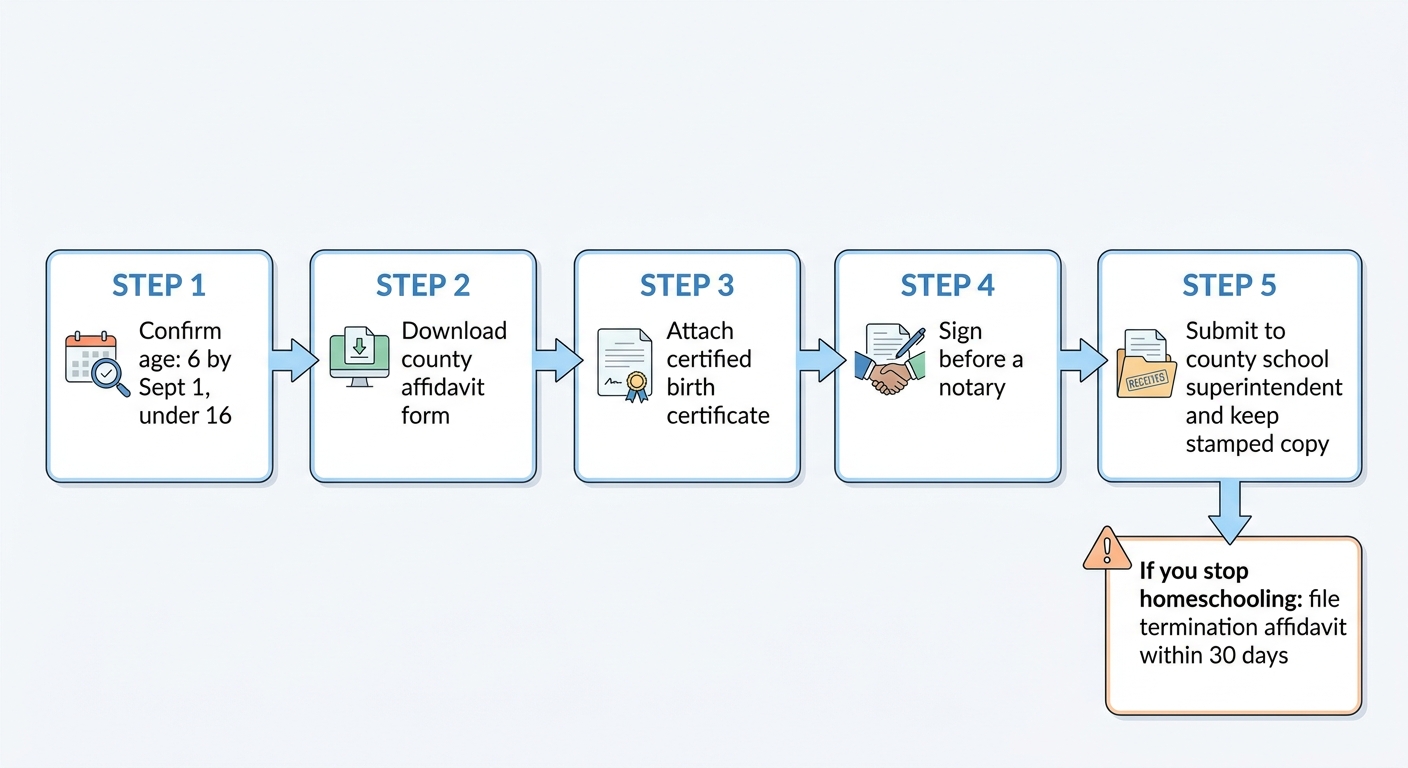
Download the affidavit from your county school superintendent's website, sign it in front of a notary, attach proof of the child's identity, and submit it to that county office. Most counties accept it by mail, in person, or through an online submission page.
Here is the order that keeps it simple:
- Confirm the age trigger. If your child turns 6 before September 1 and is under 16, the requirement applies. Younger than that and nothing is due yet.
- Get the county-specific form. Maricopa, Pima, Pinal, Coconino and the rest each host their own version of the affidavit. Use yours, not a generic copy from a national site.
- Attach proof of identity. A certified copy of the birth certificate is the usual choice; statute lists alternatives if you don't have one.
- Notarize it. Many banks and credit unions notarize free for account holders, and shipping and mailbox stores notarize for a small fee.
- Submit to the county superintendent and keep your stamped copy. That copy is your proof of compliance — store it where you'll keep the rest of your homeschool record keeping.
⚠️ The most common mistake: sending the affidavit to your school district office instead of the county school superintendent. The district cannot accept it, and the 30-day clock keeps running while the envelope sits in the wrong inbox.
You do not re-file each year, and you do not file a new affidavit when your child changes grade level. You do file again if you move to a different Arizona county. And when you stop homeschooling — whether your child enrolls in school, turns 16, or graduates — statute asks you to notify the county superintendent within 30 days by filing a termination affidavit.
How Do You Withdraw a Child From an Arizona Public School?
Send a short written withdrawal notice to the school registrar, then file your affidavit. The order matters less than the timing, because the 30-day affidavit clock starts the day home instruction begins.
Your withdrawal letter needs very little. Include the child's full name, date of birth, current grade, the last day of attendance, and a plain statement that instruction will continue at home under A.R.S. §15-802. Ask for two things in the same letter: a copy of the cumulative file and a copy of the immunization record.
Something like this works:
"Please accept this letter as formal notice that [child's full name], date of birth [DOB], currently in grade [X], is withdrawn from [school name] effective [date]. Instruction will continue at home in accordance with A.R.S. §15-802. Please provide a copy of the cumulative file and immunization records at your convenience."
Before you walk away from the school, collect:
- The cumulative academic file, including any report cards
- Immunization records
- Any current IEP, 504 plan or evaluation reports
- Standardized test results already on file
Mid-year withdrawals are routine, but a gap between leaving the school and filing the affidavit is what occasionally triggers a truancy inquiry. Send the withdrawal letter in writing — email is fine if you keep the sent copy — and file the affidavit promptly rather than waiting for the next school year to start.
What Records Should You Keep Even Though Arizona Doesn't Require Any?
Arizona requires none. But scholarship applications, community college enrollment, high school transcripts, and any future move to a stricter state all depend on records you can only build while the learning is happening.
A portfolio is a dated collection of work samples, reading lists, an attendance or hours log, and short assessment notes. It is not a scrapbook and it does not need to be beautiful — it needs dates and subjects.
A realistic minimum:
- One work sample per subject, per month, scanned or photographed
- A running list of books read, with dates
- A one-paragraph summary at the end of each semester, per child
- Receipts and course descriptions for anything outsourced — co-op classes, tutors, online courses
That's a few minutes a week rather than a project. Families who want the filing handled for them often move to homeschool record keeping software once two or more children are involved.
One Arizona-specific wrinkle is worth understanding clearly. The state's Empowerment Scholarship Account (ESA) program is administered by the Arizona Department of Education and carries its own expense documentation and reporting obligations — rules that are stricter than homeschool statute itself. Families who sign an ESA contract agree to those terms as a condition of the funding, and under Arizona law an ESA student is participating in a separate program rather than filing a homeschool affidavit in the usual way. If you are considering both paths, read the current ESA Parent Handbook from the Department of Education before you file anything.
Key takeaway: Arizona asks for no records, so the records you keep exist for your child's future, not for the state — build the smallest system you'll actually maintain and start it on day one.
Is Arizona One of the Easiest States to Homeschool In?
Yes. Arizona sits in the low-regulation group: one filing, five named subjects, no ongoing contact with any authority. It is marginally more demanding than states that require no notice at all, and far lighter than states that require portfolio review or district approval.
How do homeschool laws by state compare?
| Tier | What's typically asked | Example states |
|---|---|---|
| No notice | Nothing filed with any authority | Texas, Idaho, Oklahoma, Michigan, Illinois, Missouri, Indiana, Alaska, New Jersey, Connecticut |
| Low — notice only | One filing, named subjects, little else | Arizona, California (private school affidavit), Florida, Georgia, North Carolina |
| Moderate | Notice plus hours, testing or annual assessment | Ohio, South Carolina, Virginia, Tennessee |
| High | Notice plus portfolio review, evaluation or approval | New York, Pennsylvania, Massachusetts, Rhode Island, North Dakota |
Tier labels here follow the classification the Home School Legal Defense Association publishes for state homeschool laws. It is one organization's shorthand rather than a legal standard, and statutes change — always confirm against your own state's current text. Our broader guide to homeschooling requirements by state breaks the tiers down further.
The practical difference shows up in your calendar. In a high-regulation state, a parent may spend part of every term assembling evidence, scheduling an evaluator, and meeting submission windows. In Arizona, compliance is a one-time afternoon: form, notary, envelope.
That freedom cuts both ways. With no external checkpoint, nothing in the system will flag a child who has quietly stalled in fractions for eight months. Among the easiest states to homeschool in, Arizona asks the most of your own judgement.
What Homeschool Programs and Co-ops Exist in Arizona?
Arizona families generally choose one of five lanes: independent homeschooling, a private online program, a hybrid or university-model school, a co-op, or enrollment in a public virtual school. Only the last one changes what you file.
| Lane | What it looks like | Affidavit required? |
|---|---|---|
| Independent (DIY) | You choose materials and teach | Yes |
| Private online program | Purchased curriculum, parent-supervised | Yes |
| Hybrid / university-model school | Two or three campus days, home days between | Usually yes — confirm with the school |
| Co-op or enrichment day | Shared classes, parent-run or paid | Yes |
| Public virtual school | Your child is enrolled in a public school, from home | No — this is public school enrollment |
⚠️ Enrolling in a state-funded online public school is not home education, even though the learning happens at your kitchen table. Your child is a public school student, subject to that school's attendance, testing and pacing rules — and no affidavit is filed.
The Phoenix and Tucson metros carry the deepest concentration of hybrid schools, co-ops, enrichment days and microschools, several of the last funded through ESA accounts. Rural counties lean more on online programs and regional meet-ups. Whatever your postcode, the practical search method is the same one described in our guide to finding homeschool programs and enrichment classes near you: start with county-level social groups, then libraries, then churches and community centres.
When people search for the best homeschool programs Arizona offers, they usually mean "the right fit for my child's age and my working hours" — so compare on schedule and cost before you compare on philosophy.
How Do You Choose Curriculum When the State Doesn't Pick One?
Arizona names five subject areas and stops. That means your only real constraints are your child's actual level and the teaching time you have — not a state-approved list.
Start by mapping each statutory subject to one primary resource, then stop buying. Reading and grammar can share a single language arts spine. Social studies and science rotate well as unit studies rather than running daily. Maths is the one subject most families keep on a steady daily rhythm because it builds in order.
A simple mapping approach:
- Reading — a levelled reader or a book list plus discussion
- Grammar — one short daily exercise, or writing-embedded instruction
- Mathematics — one sequential programme, daily
- Social studies — unit studies, documentaries, Arizona history and field trips
- Science — hands-on units rotating each term
Our walkthrough on how to choose a homeschool curriculum goes deeper on matching materials to a child's learning style.
The harder problem is the one Arizona's hands-off rules leave entirely with you: knowing where each child actually stands, and not teaching the same subject three separate times for three ages. That is the part a planning tool can carry — LearnSpark maps each child's level against standards and builds one lesson that holds different activities for different ages, so your evenings go somewhere other than prep.
Because there's no state test, set your own rhythm: a short mastery check every two or three weeks beats discovering a gap in June.
Key takeaway: In a state with no external checkpoints, your Arizona homeschool curriculum only needs to satisfy two judges — your child's actual readiness and your own weekly capacity.
What Happens at High School and Graduation in Arizona?
Arizona issues no state homeschool diploma. The parent issues both the diploma and the transcript, and that document is legally valid for employment, enlistment and college applications.
A transcript is a one-page record listing courses, credits, grades and grade point average, organised by school year. Colleges rarely question a parent-issued transcript on its own; what they ask for alongside it is course descriptions, a reading list, test scores where required, and evidence of outside coursework.
Three things worth planning early:
- Dual enrollment. Many Arizona community colleges admit homeschooled students for credit courses, typically after placement testing rather than a transcript review. Those courses then appear on an official college transcript, which independently verifies the work.
- State testing. Homeschooled students are not part of Arizona's statewide assessment programme. If a scholarship or college requires a test score, it will usually be the SAT or ACT, which you register for directly.
- Sports and activities. Arizona statute (A.R.S. §15-802.01) addresses homeschooled students trying out for public school interscholastic activities. Eligibility conditions are administered at school and association level, so confirm the specifics with the school before the season.
Credit-keeping is simpler if it starts in ninth grade rather than twelfth. Course descriptions, grades and hours recorded as you go make the eventual transcript an assembly job instead of a reconstruction — which is where homeschool record keeping software earns its place for high school families.
Frequently Asked Questions
Do I have to file the Arizona affidavit every year?
No. One affidavit covers that child until they turn 16 or you stop homeschooling. You file a termination affidavit with the county superintendent within 30 days of stopping, and a fresh affidavit if you move to a different Arizona county. There is no annual renewal and no yearly check-in.
At what age does Arizona require the affidavit?
The requirement applies to a child who turns 6 before September 1 of the school year and is under 16. Kindergarten is not compulsory in Arizona, so a 5-year-old learning at home needs nothing filed. Once your child reaches 16, compulsory attendance no longer applies.
Does Arizona require homeschool testing or evaluations?
No. There is no state test, no portfolio review and no annual assessment for homeschooled students in Arizona. Participants in the Empowerment Scholarship Account programme face separate documentation requirements set by the Arizona Department of Education, which are not part of homeschool statute.
Can I use Arizona's ESA money for homeschooling?
It's not a simple yes. Signing an ESA contract means withdrawing from public school and agreeing to the programme's terms, and ESA students participate under that agreement rather than by filing a homeschool affidavit in the usual sense. Terms, eligible expenses and reporting rules change — check the current ESA Parent Handbook from the Arizona Department of Education.
Do Arizona homeschoolers have to track attendance or hours?
No state hour or attendance requirement exists. Many families track homeschool hours anyway, because scholarship applications, high school credit calculations, and a future move to a state like Ohio or Pennsylvania all assume you have the numbers. Starting a log is easy; reconstructing one is not.
Summary: Your Arizona Start-to-Finish Checklist
Arizona's rules are short enough to fit on one page, which is unusual among homeschool laws by state. Work through these in order:
- Confirm the age trigger — 6 before September 1, under 16.
- Send a written withdrawal letter to the school registrar if your child is currently enrolled.
- Request the cumulative file, immunization records and any IEP or 504 documents.
- Download the affidavit from your own county school superintendent's website.
- Attach a certified birth certificate or another proof of identity named in statute.
- Sign in front of a notary — banks and mailbox stores both do this.
- Submit to the county school superintendent, not your school district, within 30 days of starting.
- Keep the stamped copy somewhere you'll find it in four years.
- Cover the five subject areas — reading, grammar, mathematics, social studies, science.
- Choose your lane — independent, private online, hybrid, co-op — and confirm whether it changes your filing.
- Start a records rhythm in week one: monthly work samples, a book list, a semester summary.
- Set your own check-in schedule, since the state sets none.
- File a termination affidavit within 30 days if you stop, move out of state, or your child enrols elsewhere.
That's it. The state hands you the freedom; the structure is yours to build.
Information about third-party platforms reflects publicly available details at the time of writing and may have changed. Please verify directly with the provider. See our Terms of Use for more.