
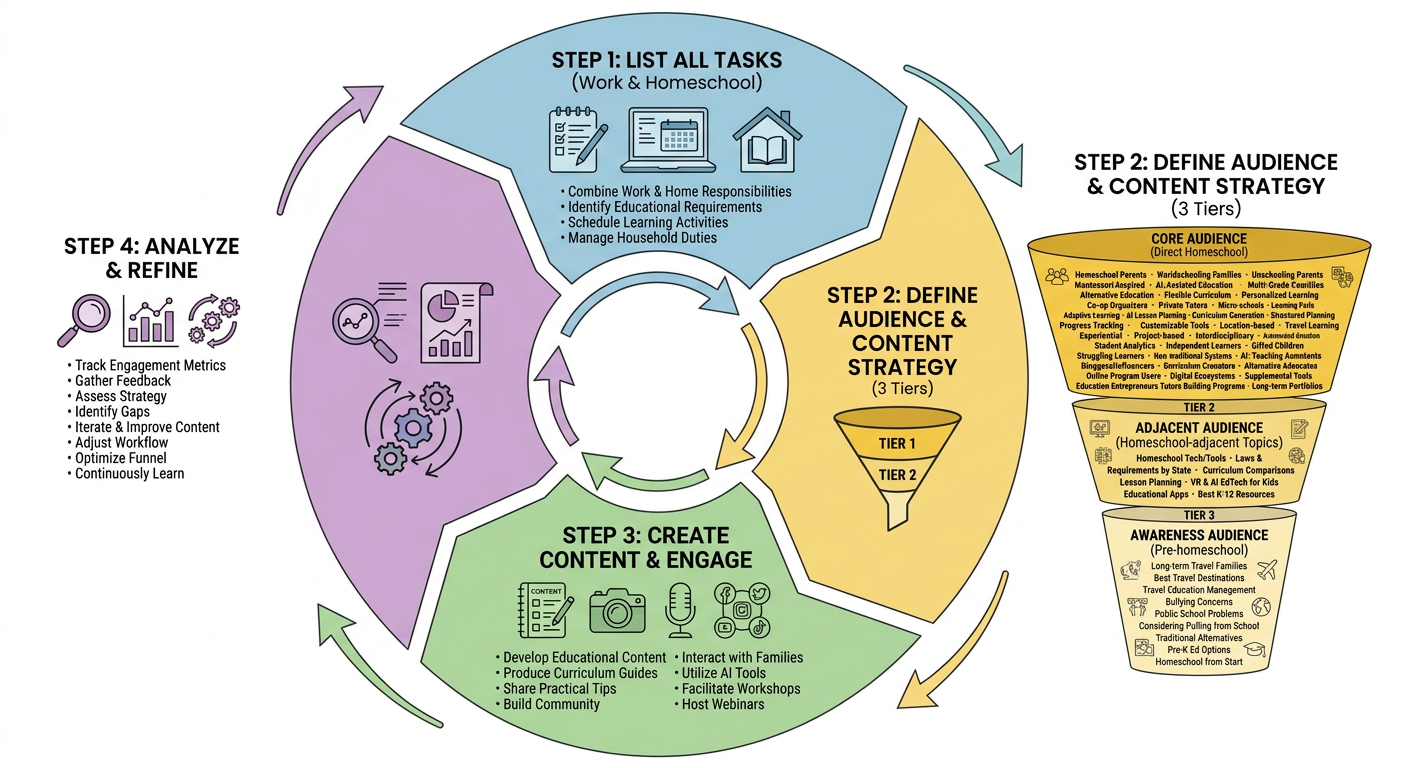
Juggling a career while giving your children a rich home education can feel like an impossible puzzle, but it’s a challenge more families are embracing and mastering every year. The key isn't finding more hours in the day; it's about using the hours you have with intention, flexibility, and the right strategic tools. This guide provides a practical roadmap for creating a homeschooling schedule for working parents that fosters learning without leading to burnout, building on the core principles of simple homeschool planning with strategies tailored for your busy life.
Quick Answer
Yes, you can absolutely create a successful homeschooling schedule for working parents. A practical approach in 2026 can involve using a flexible framework like block or loop scheduling, leveraging technology like AI lesson planners to assist with administrative tasks, and focusing on core subjects during your most available hours. It’s about building a sustainable rhythm that works for your unique family, not replicating a traditional school day.
TL;DR
- Flexible Frameworks are Key: Ditch the rigid 9-to-3 mindset. Models like block scheduling, loop scheduling, and after-hours learning allow you to fit education around your work commitments. Explore the top scheduling frameworks.
- AI Can Be Your Co-Pilot: Modern AI tools can assist working parents by automating lesson planning, resource gathering, and progress tracking. Discover how AI simplifies scheduling.
- Independent Learning is a Superpower: Teaching your children how to learn independently is crucial. It not only builds their skills but also creates focused time for you to work without interruption. Learn strategies to foster student autonomy.
- Burnout Prevention is Non-Negotiable: A sustainable schedule must include self-care and family downtime. Prioritizing your own well-being is essential for the long-term success of your homeschool. Find practical tips for avoiding burnout.
In This Article
- Can You Homeschool Successfully While Working Full-Time in 2026?
- The Core Challenge: Time Management — And How to Conquer It
- Crafting Your Homeschooling Schedule for Working Parents: Flexible Frameworks for 2026
- Harnessing the Power of AI: Your 2026 Scheduling Co-Pilot
- Practical Strategies for Juggling Work and Homeschool in 2026
- Avoiding Burnout: Prioritizing Self-Care and Family Well-being
- Frequently Asked Questions About Homeschooling and Working
Can You Homeschool Successfully While Working Full-Time in 2026?
Yes, you can absolutely homeschool successfully while working full-time. The number of working parents choosing to homeschool has increased, with many families embracing this educational path. Success in 2026 is no longer about replicating a seven-hour school day at home; it’s about efficiency, flexibility, and defining what "success" means for your family.
The rise of remote work, flexible job hours, and powerful educational technologies has made this balance more attainable than ever. For example, a parent working a remote job might structure their day with a two-hour "deep work" session from 6 AM to 8 AM, then dedicate 8:30 AM to 12:30 PM to focused homeschooling. Afternoons could be a mix of independent project work for the kids and less-intensive work tasks for the parent, with another work session in the evening.
The key is to release the guilt and the outdated notion that learning only happens when a parent is directly instructing. A successful working homeschool parent is more like a facilitator or a guide, creating an environment and providing the resources for learning to happen continuously.
The Core Challenge: Time Management — And How to Conquer It
The central challenge for working homeschool parents is not a lack of commitment but a perceived lack of time. Juggling job deadlines and learning objectives can quickly lead to overwhelm, but this struggle is conquerable with a strategic approach to time management. The real enemies are decision fatigue and inefficient workflows, not the clock itself.
Common pain points include:
- Feeling like you have limited hours for direct instruction.
- The constant "what's next?" pressure of planning lessons.
- Guilt over not being 100% present for either work or your child.
Two foundational strategies can reclaim your time and sanity. First, Time blocking is a time management method that involves dividing your day into blocks of time, where each block is dedicated to accomplishing a specific task or group of tasks. This means you aren't just "working," you're "writing the Q3 report from 9 AM to 10:30 AM."
Second, task batching involves grouping similar tasks together. Instead of grading a math worksheet, answering a work email, then finding a science video, you batch it: do all your grading once a day, handle emails in two set blocks, and plan all your week's media resources on Sunday night. Combining these with focus methods like the Pomodoro Technique—working in 25-minute focused bursts—can transform chaotic days into a productive, manageable flow.
Crafting Your Homeschooling Schedule for Working Parents: Flexible Frameworks for 2026
The best homeschool schedule is not one you find online; it’s one you create to fit the unique rhythm of your family and work life. A rigid, minute-by-minute schedule is often the first thing to break under the pressures of a sick child or an urgent work deadline. The most resilient and effective schedules in 2026 are built on flexible frameworks that prioritize consistency over strictness.
Working parents often thrive when they adopt one of three primary models or a hybrid version of them. These frameworks provide structure without being restrictive, allowing you to ensure all educational bases are covered without sacrificing your sanity.
| Scheduling Framework | Best For… | Core Concept | Potential Downside |
|---|---|---|---|
| Block Scheduling | Families who love deep dives, project-based learning, and have kids who can focus for longer periods. | Dedicate large chunks of time (e.g., 90-120 mins) to a single subject for several days or a week. | Can be challenging for kids with short attention spans; some subjects may go a week without being touched. |
| Loop Scheduling | Families with multiple children, many subjects to cover, and a desire to remove the guilt of a "missed" lesson. | A rotating list of subjects is completed in order, regardless of the day. You just pick up where you left off. | May feel less structured for parents who crave a predictable daily rhythm. Progress can feel slower. |
| After-Hours & Weekend | Parents with traditional 9-5 jobs (in-office or remote) and older, more independent children. | Core instruction and collaborative projects happen in the evenings and on weekends, with independent work during the day. | Requires significant family buy-in and can blur the lines between "school time" and "family time." |
1. Block Scheduling: Deep Dives for Focused Learning
Block scheduling involves dedicating large, continuous chunks of time—often 90 minutes or more—to a single subject, allowing for deep dives and project-based work. Instead of a frantic 45 minutes of math followed by 45 minutes of history, you might dedicate a whole morning to a science unit, from experiment to research to writing. This method reduces transition time and helps kids get into a state of "flow."
For a working parent, this could look like dedicating Monday and Wednesday mornings to a "Humanities Block" (history, literature, writing) and Tuesday and Thursday mornings to a "STEM Block" (math, science, coding). This simplifies your planning; you only need to prepare for one or two big things each day. On Friday, you can use the block for art, music, or catching up. This is a core part of creating a great homeschooling schedule for working parents who need to minimize daily prep time.
2. Loop Scheduling: Ensuring All Subjects Get Covered
Loop scheduling refers to a flexible planning system where you create a list of subjects or activities that you work through in order, regardless of the day of the week. This is the ultimate antidote to the "we missed geography again!" guilt. Your loop might include subjects like Art, Music, Poetry, Logic, and Nature Study.
Instead of assigning "Art on Tuesday," you simply do the next subject on your loop whenever you have a free 30-45 minute slot. If you did Art on Monday, the next time you have a slot, you do Music—even if that isn't until Thursday. You just pick up where you left off. This is perfect for integrating enrichment subjects without overwhelming your core schedule and is a fantastic strategy when managing multiple children.
3. After-Hours & Weekend Homeschooling: Maximizing Your Availability
This model shifts the bulk of parent-led instruction to evenings and weekends, leveraging the time when you are fully "off the clock." It works beautifully for parents in non-flexible jobs and with children who are old enough for a significant amount of independent work. A typical week might involve the parent assigning readings, practice problems, and video lessons for the child to complete during the day.
Evenings can then be used for discussion, reviewing work, and direct instruction on tricky concepts. Saturdays become prime time for longer activities that are difficult to fit into a weekday, like science experiments, historical simulations, or educational field trips. This model requires a high degree of student autonomy but can be incredibly effective, turning weekends into rich, shared learning experiences.
Key takeaway: The goal is not to find the "perfect" schedule but to choose a flexible framework that you can adapt week-to-week. The best system is the one you can actually stick with.
Harnessing the Power of AI: Your 2026 Scheduling Co-Pilot
The accessibility of powerful AI is a significant shift for working homeschool parents. What used to take significant planning time can now be done much faster. AI tools are no longer a novelty; they are an essential component of a sustainable homeschool, acting as your personal administrative assistant and curriculum designer. This tech can be a valuable part of a modern homeschooling schedule for working parents.
Imagine this scenario: It’s Tuesday morning, and you have a surprise work meeting at 10 AM, right when you planned to do a history lesson. Instead of panicking, you open an AI platform. You tell it you need a 45-minute independent learning activity for a 10-year-old on Ancient Rome that requires minimal supervision. Quickly, it can generate a full plan, complete with a link to a curated video, a short reading passage, and three comprehension questions.
This is the power of high-quality AI lesson planners. They handle the logistical heavy lifting so you can focus on the human side of teaching. Effective AI tools go beyond simple generation; they can help you with:
- Personalized Planning: Creating weekly schedules based on your child's interests and academic gaps.
- Resource Curation: Finding the best videos, articles, and activities online so you don't have to.
- Progress Monitoring: Helping you with tracking progress against learning standards without endless testing.
This technology can help you feel more like a confident educational guide.
Practical Strategies for Juggling Work and Homeschool in 2026
A great schedule is the skeleton of your homeschool, but these practical strategies provide the muscle that makes it all move smoothly. Success comes from the daily habits and systems you build around your schedule.
1. Set Clear Boundaries (And Stick to Them!)
Your ability to be present in one role depends on your ability to set boundaries around the other. This means establishing dedicated work hours and homeschool hours and communicating them clearly to everyone involved—including your kids and your employer. A closed door with a sign that says "Mom is on a work call until 10:30" teaches your children about respecting work, while putting your phone away during a math lesson shows them they have your full attention.
Successful working homeschool families often prioritize protecting these boundaries. This might mean not checking work email after 6 PM or having a "no screens" rule during your dedicated family learning block. Visual cues, like a special lamp that's on during "quiet work time," can be surprisingly effective for younger children.
2. Embrace Independent Learning & Self-Paced Work
You cannot and should not be the sole source of your child's education. A key part of your job as a homeschool parent is to teach your child how to learn independently. This is arguably one of the most valuable skills they will ever acquire. Start small, by teaching them how to find answers to their own questions (safely), follow a checklist, or use a rubric for self-assessment.
For times when you need to be in a meeting or on a deadline, having a toolkit of self-paced resources is a lifesaver. This can include:
- Online Platforms: Khan Academy, IXL, or Outschool classes provide structured, engaging content.
- Audiobooks & Podcasts: A great way to cover literature or history while you work.
- Project Bins: A pre-prepared box with all the materials for a hands-on activity, from building a LEGO catapult to starting a small craft project.
3. Find Your Village: Support Systems for Working Homeschool Parents
Doing it all alone can significantly increase the risk of burnout. A strong support network can be highly beneficial. This "village" can take many forms, and building it is an active process. Look for ways to delegate and collaborate, both for your child's learning and your own sanity.
Consider joining a local homeschool co-op that offers classes in subjects you’re less confident in, like chemistry labs or a foreign language. Trade teaching with another parent—you teach their kids writing for a few hours a week, and they teach your kids math. Online communities can also provide invaluable emotional support and practical advice from other parents who are in the trenches with you. Don’t forget your partner or other family members; have an explicit conversation about dividing the educational and household labor.
Avoiding Burnout: Prioritizing Self-Care and Family Well-being
Preventing burnout isn't about spa days; it's about building a sustainable life. For a working homeschool parent, this is the most critical and often the most overlooked part of the entire equation. You cannot pour from an empty cup. Recognizing the early signs of burnout—irritability, constant exhaustion, loss of joy in activities—is the first step to addressing it.
Here are some concrete, non-negotiable strategies:
- Schedule "Off" Time: Just as you schedule math, you must schedule downtime for yourself and for the family. Put "30-minute quiet read for Mom" or "Family walk, no school talk" on the calendar.
- Embrace "Good Enough": Did you get through the core subjects today? Did everyone feel loved and safe? That’s a win. The house doesn't have to be perfect, and you don't have to finish every page of the workbook.
- Simplify Everything: Look at every commitment—from curriculum choices to extracurriculars—and ask, "Does this simplify our life or complicate it?" If it's the latter, it's okay to let it go. Scheduling "nothing" can be a very productive thing a parent can do for their family's well-being. Turn to expert resources for more homeschooling burnout solutions if you feel overwhelmed.
Key takeaway: Your well-being is not separate from your homeschool's success—it is the foundation of it. Taking care of yourself is taking care of your family's education.
Ready to Simplify Your Homeschool Schedule? Try LearnSpark AI Today!
Frequently Asked Questions About Homeschooling and Working
How many hours a day should I homeschool if I work?
A: The number of hours varies greatly by your child's age, your state's legal requirements, and your educational style. Importantly, homeschool hours are not equivalent to public school hours. Thanks to one-on-one attention and a lack of classroom management time, homeschooling is far more efficient. Focused instruction for elementary, middle school, and high school can be efficient.
What are the best tools for working homeschool parents?
A: The best tools are those that save you time and reduce mental load. Key categories include an AI lesson planner like LearnSpark for automating your schedule and curriculum design. A digital organization app like Trello or Notion helps track assignments and resources. Finally, high-quality online learning platforms like Khan Academy, IXL, and Outschool provide excellent, self-paced content that allows you to focus on your work.
Is it possible to homeschool a child with special needs while working?
A: Yes, it is possible, and many parents find homeschooling allows them to create the ideal, supportive environment their child needs. However, it requires an even greater level of planning and support. Success often involves leveraging adaptive technologies, working with specialists like online tutors or therapists, and connecting with support groups specifically for families of children with similar needs.
How can I make time for my own work and my children's education?
A: Making time is a combination of strategic scheduling, empowering your children, and being ruthless about your priorities. Start by choosing a flexible scheduling framework (like block or loop) that fits your work. Next, actively teach your children independent learning skills and use a curated set of self-paced tools. Finally, use technology to automate planning, build a support system, and be willing to let go of what’s "non-essential" to make your homeschooling schedule for working parents a sustainable, joyful reality.
Key Takeaways
- Embrace Flexibility: A successful homeschooling schedule for working parents abandons the rigid 9-to-3 school day. Adopt flexible frameworks like block, loop, or after-hours scheduling to fit education around your work and family life.
- Leverage AI as Your Assistant: Use AI lesson planners to automate time-consuming tasks like scheduling, curriculum design, and resource gathering. This frees you from administrative work to focus on teaching and connecting with your child.
- Cultivate Independent Learners: A core goal is to teach your children how to learn on their own. This builds their confidence and creates essential, uninterrupted time for you to focus on your career.
- Prioritize Well-being to Prevent Burnout: Your own mental and physical health is the foundation of a sustainable homeschool. Schedule downtime, set clear boundaries between work and school, and embrace the "good enough" principle.
- Build Your Support System: You don't have to do it all alone. Actively seek out and build a "village" through homeschool co-ops, online communities, or by sharing teaching responsibilities with other parents or family members.