
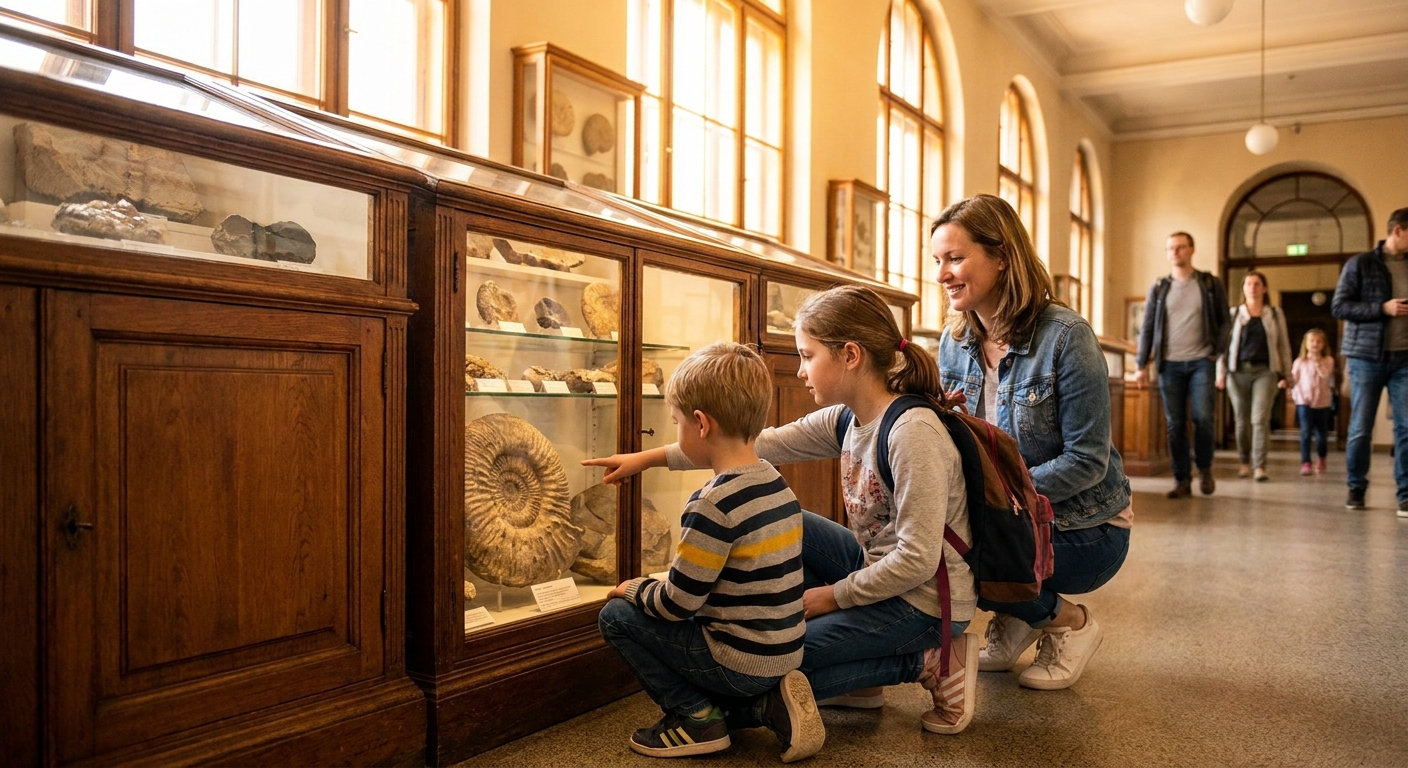
The best homeschool field trip ideas aren't the ones with the nicest gift shop — they're the ones that answer a question your child already has. A wastewater plant can teach more about ecosystems than a ticketed aquarium if the visit is tied to what you're studying this month. Here's an idea bank sorted by subject and age, plus how to find local trips, keep them nearly free, and log them so they count.
Quick Answer
The most useful homeschool field trips connect to a unit you're already teaching: a working bakery during a fractions unit, a municipal water treatment plant during an ecosystems unit, a county courthouse during a civics unit. Most communities offer free or very low-cost options through public libraries, state and national parks, and municipal facilities like fire stations and post offices. Pick the learning goal first, then find the venue that matches it.
TL;DR
- Field trips stick when you attach one clear question to them before you leave the house. See how an anchor question works
- Ideas are easiest to use when sorted by the subject they naturally teach — science, civics, math, arts, and careers. Browse the subject-by-subject idea bank
- You rarely need a different venue for different ages. You need a different task. Compare the four age bands at one venue
- Libraries, parks departments, homeschool associations and museum homeschool days are where local trips actually come from. See the five places to look first
- A three-part structure — question before, capture task during, short debrief after — turns an outing into documented instructional time. Read the before, during and after method
In This Article
- What Makes a Field Trip Actually Educational?
- Homeschool Field Trip Ideas by Subject
- How Should You Adjust a Field Trip by Age?
- Where Do You Find Homeschool Field Trips Near You?
- What Field Trips Are Free or Nearly Free?
- Homeschool Activities When You Can't Leave the House
- How Do You Turn a Trip Into a Lesson That Counts?
- Common Field Trip Mistakes (And Easy Fixes)
- A Sample Year of Field Trips
What Makes a Field Trip Actually Educational?
A field trip becomes educational the moment it has a question attached to it. Without one, a museum visit is a pleasant walk. With one, every exhibit either helps answer the question or it doesn't — and your child starts sorting information instead of absorbing scenery.
A field trip is any visit to a real place where the place itself carries the content of the lesson. The building, the machinery, the animals, or the people doing the work replace the textbook page for an hour or two.
An anchor question is the single question your child is trying to answer during the visit. One question. Written down. Carried in a pocket or on a clipboard.
Good anchor questions are narrow enough to answer and open enough to argue about:
- Science — "Where does the water in our kitchen tap go after it leaves the sink?"
- History — "What jobs did people in this town do a hundred years ago that nobody does now?"
- Civics — "Who decides what happens in this room, and who chose them?"
- Math — "How much does it cost this bakery to make one loaf?"
Educators who work in museums, parks and science centers often make the same argument: what children remember from these places is rarely the facts on the placards. It's the thing they personally noticed and had to explain. That's why the question matters more than the venue.
This is the same principle behind location-based learning activities — the place supplies the content, and your job shrinks to framing it.
Key takeaway: Choose the learning goal first and the venue second. One written question before you leave the driveway does more for retention than any admission ticket.
Homeschool Field Trip Ideas by Subject
Below are more than sixty homeschool field trip ideas grouped by the subject each one naturally teaches. Start with the subject you're behind on or excited about, then pick the venue that's closest and cheapest.
| Subject | Sample venues | Typical cost |
|---|---|---|
| Science & nature | Water treatment plant, state park ranger program, working dairy | Free to low |
| History & civics | County courthouse, living history farm, state capitol | Usually free |
| Math & engineering | Grocery store, bakery, construction viewing area | Free |
| Language arts & arts | Radio station, library archives, community theatre rehearsal | Free to low |
| Careers & community | Fire station, animal shelter, post office | Free |
If you're trying to match trips to specific learning goals, it helps to know what your state expects — our guide to homeschool curriculum aligned to standards covers how to read a standards strand without drowning in it.
Science and Nature Trips
Science trips are the easiest to get for free, because most of the interesting infrastructure is publicly owned.
- Municipal water treatment or wastewater plant — many run public tours by appointment. Pairs with water cycle, filtration, and ecosystems.
- Recycling or waste transfer station — materials sorting, decomposition, human impact.
- State park ranger programs — many US state park systems run free naturalist talks and Junior Ranger activity booklets for children.
- National parks and federal lands — the National Park Service has run a program giving fourth-graders and their families free access to federal sites; check the current year's terms before planning around it.
- Working dairy, apiary, or orchard — life cycles, animal husbandry, food systems.
- University observatory public nights — astronomy departments frequently host free viewing evenings.
- Nature center or Audubon sanctuary — bird identification, habitat, seasonal change.
- Fish hatchery — life cycles and wildlife management.
- Weather station or local news station weather desk — data collection and forecasting.
- Quarry, cave system, or road cut — geology you can put your hand on.
- Botanical garden — plant classification and adaptation.
- Tide pools or a riverbank — free, repeatable, and different every visit.
Two practical notes. Industrial sites usually require closed-toe shoes and a minimum age, so ask when you book. And repeat visits to one site across seasons often teach more than four different sites once each.
History, Civics and Culture Trips
Civics trips are chronically underused, and they're almost always free.
- County courthouse public gallery — sit in on a real proceeding, then discuss who does what in the room.
- City or town council meeting — local government in its least glamorous, most understandable form.
- State capitol tour — branches of government, lawmaking, state symbols.
- Local historical society or county archives — primary sources, handwriting, census records.
- Living history farm or village — daily life, tools, labor before machines.
- Historic cemetery walk — gravestone rubbings, epidemic years, family names that match local street names.
- Immigrant heritage or tribal museum — migration, culture, whose story gets told.
- Battlefield or fort — geography's role in conflict.
- Smithsonian museums in Washington, D.C. — these do not charge admission, which makes a D.C. trip unusually affordable for history-heavy families.
- Old mill, mine, or railway depot — industry and how your region got its economy.
- Courthouse records office — deeds and maps showing how land changed hands.
Tie each one to a strand you're already covering: sources and evidence, civic institutions, or continuity and change over time.
Math, Money and Engineering Trips
Math trips need the least planning and produce the most eye-rolling — until the numbers get real.
- Grocery store unit-price hunt — comparison, division, decimals.
- Bakery or pizza kitchen — fractions, ratios, scaling a recipe.
- Bank branch tour — interest, accounts, how money moves.
- Construction site viewing area — measurement, angles, load.
- Bridge, dam, or lock system — force, scale, engineering trade-offs.
- Maker space or community workshop — tolerance, measurement, iteration.
- Hardware store — estimating materials for a real project.
- Farmers market — pricing, negotiation, profit.
- Car repair shop — diagnostics and systems thinking.
Here's a worked example you can run this week. Give a fourth grader a hypothetical grocery budget — say $40 — and a shopping list for three family dinners. Their task: buy everything on the list, compare at least four items by unit price, and come home with change. The receipt is the assessment.
Language Arts, Art and Music Trips
These trips give children a look at how creative work is actually produced, which is usually messier than they expect.
- Local newspaper or radio station — interviewing, editing, audience.
- Public library archives or rare books room — ask the reference librarian; most love the question.
- Community theatre dress rehearsal — many companies allow quiet observers.
- Symphony open rehearsal — some orchestras set aside free student seats.
- Pottery, printmaking, or glassblowing studio — process, material, patience.
- Bookstore author event — how a book gets from draft to shelf.
- Public mural or sculpture walk — visual analysis, local identity.
- Sign language or poetry open mic — language as performance.
The output task matters here. Ask for a review, an interview transcript, or a written description of one artwork — not a general "what did you learn."
Career and Community Helper Trips
These are usually the easiest yes, because small businesses and public services like community goodwill.
- Fire station — equipment, emergency systems, community safety.
- Veterinary clinic — animal anatomy and care.
- Animal shelter — responsibility, intake systems, volunteering.
- Post office sorting room — logistics and addressing systems.
- Airport observation deck or tower viewing area — flight, scheduling, air traffic.
- Family-run restaurant kitchen — prep, timing, food safety.
- Dentist, pharmacy, or optometrist office — health careers.
- Greenhouse or landscaping business — seasonal work and plant care.
Use this four-line script when you call:
- Introduce — "Hi, I homeschool two children, ages 7 and 10, here in town."
- Be specific — "We're studying how mail gets sorted, and I'd love for them to see it."
- Be small and flexible — "It would just be the three of us, any weekday morning that suits you, for about 30 minutes."
- Give an easy exit — "If that's not something you can do, no problem at all — thank you for your time."
How Should You Adjust a Field Trip by Age?
The venue can stay exactly the same. The task is what changes. A five-year-old and a thirteen-year-old can walk through the same aquarium on the same morning and come home with completely different work.
| Pre-K–K | Grades 1–3 | Grades 4–6 | Grades 7–8 | |
|---|---|---|---|---|
| Focus span | 45–60 min | 1–1.5 hrs | 2 hrs | 2–3 hrs |
| What to bring | Snack, small notebook | Clipboard, crayons | Clipboard, pencil, camera | Notebook, phone, question list |
| Aquarium task | Find three animals with stripes | Count how many tanks are cold-water vs. warm | Record what each of five species eats | Interview a staff member about one species' care |
| Output | Drawing of a favourite animal | Labelled sketch with three facts | Photo log with captions | Half-page written summary or recorded interview |
A few things make this work in practice. Give the youngest child a task they can finish early, so the rest of the visit is free exploration. Give the oldest child something that requires speaking to an adult who isn't you — it's the fastest confidence builder a trip offers. And accept that the middle children will need one reminder of what their task is, roughly ten minutes in.
If you're running this across a wide age spread regularly, the mechanics of teaching multiple children of different ages apply on trips exactly as they do at the kitchen table: one shared context, layered tasks.
Key takeaway: One venue, four tasks. You are not planning four field trips — you are planning one trip with differentiated work attached to it.
Where Do You Find Homeschool Field Trips Near You?
Five sources produce almost every good local trip, roughly in order of how often they pay off:
- Your public library's event calendar — libraries run children's programming constantly and often partner with museums, parks and local experts.
- Your state or regional homeschool association — most maintain event listings and can tell you which venues already work with home educators.
- Local Facebook groups — search "[Your City] Homeschool" and "[Your County] Homeschool." This is where a parent posts that the tannery is doing tours next Thursday.
- Municipal parks and recreation catalogs — seasonal booklets full of naturalist walks, farm programs, and cheap classes.
- Museum "homeschool day" pages — many museums run discounted or dedicated homeschool days during the school year. Look under Education or School Programs rather than Visit.
When you search for homeschool field trips near me and keep hitting group-rate pricing, that's the reason co-ops exist. Most venues set a minimum party size before group rates or private tours apply, and a single family almost never meets it. Joining a group solves the booking problem and the socialization problem at once — our guide to find homeschool co-ops and groups near you walks through how to locate or start one.
One more trick that costs nothing: email the venue's education coordinator directly rather than using the general contact form. Ask whether they honour a homeschool educator rate and whether they have a quieter weekday slot. The answer is surprisingly often yes.
What Field Trips Are Free or Nearly Free?
Most of them, if you skip ticketed attractions. Free homeschool field trips are less about hunting coupons and more about choosing publicly funded or community-facing places.
| Free or low-cost idea | Best age fit | What to prep |
|---|---|---|
| Fire station visit | Pre-K–grade 3 | Call ahead; ask for a non-shift-change time |
| Public library archives room | Grades 4–8 | Email the reference desk with your topic |
| State park ranger program | All ages | Check the park's events page; bring water |
| Farmers market | Grades 1–6 | Small cash budget and a shopping task |
| Airport observation area | Pre-K–grade 5 | Check public access rules first |
| Factory or bottling plant tour | Grades 3–8 | Closed-toe shoes; confirm minimum age |
| Town council meeting | Grades 5–8 | Read the posted agenda beforehand |
A few programs are worth checking specifically:
- Library museum passes — many public library systems lend passes that admit a family to local museums free or at a steep discount. Ask at the desk; these are often not advertised online.
- Federal lands access for fourth-graders — the National Park Service program for fourth grade families has offered free entry to federal sites. Terms change year to year, so confirm on the official program page before you build a trip around it.
- Smithsonian museums — no admission charge at the D.C. institutions.
- Retail children's workshops — some national home-improvement and craft chains run free build-something sessions for kids. Check your local store's events page.
- Bank cardholder museum programs — a few banks waive museum admission for cardholders on set weekends. Worth a look at your own bank's benefits page.
Free doesn't mean costless. Parking, gas and food are where a "free" trip quietly turns into a $50 day. Pack lunch, and if you're watching every line item, our notes on homeschooling on a budget cover the same thinking applied to curriculum.
Homeschool Activities When You Can't Leave the House
The learning goal survives a change of container. When illness, weather, a newborn, or a car in the shop cancels the outing, the same anchor question works indoors.
Virtual field trips are guided digital visits to places you realistically cannot drive to. Strong free options include Google Arts & Culture's museum walkthroughs, NASA's virtual facility tours, and live animal cams from aquariums and zoos such as the Monterey Bay Aquarium and the San Diego Zoo. Availability changes, so check before you schedule one.
Citizen science turns your backyard into the venue. Children submit real observations to real databases:
- eBird — record the birds you see; the data goes to ornithologists.
- iNaturalist — photograph plants and insects for community identification.
- NASA GLOBE Observer — log clouds, mosquito habitats, and land cover.
Kitchen and garage investigations cover what a science center would have covered: density columns with oil and syrup, mold growth on bread slices kept in different conditions, a two-week bean germination log, or pH testing with red cabbage water.
Set these up exactly like a trip. Write the anchor question, give each child a task matched to their level, and do the debrief afterward. Skipping the structure is what makes at-home homeschool activities feel like filler instead of school. For more indoor options built around engagement rather than worksheets, see our roundup of engaging activities for teaching.
⚠️ Don't treat virtual visits as a permanent substitute for local ones. They're excellent for places out of reach — a research vessel, a foreign museum, a volcano — and weak replacements for a place your child could touch.
How Do You Turn a Trip Into a Lesson That Counts?
Three parts: an anchor question before you go, a capture task during the visit, and a fifteen-minute debrief after. That's the whole method, and it's what separates a logged instructional day from a nice Tuesday.
Before (10 minutes, night before). Write the anchor question on an index card per child. Tell them what they'll be asked to produce. Look up one fact about the venue together so they arrive with a hook.
During (the visit). Each child carries a capture task — a sketch, a photo log, a tally, a set of three questions to ask a staff member. The task is small on purpose. A child collecting evidence behaves differently from a child being shown things.
After (15 minutes, same day or next morning). Run these prompts verbatim:
- What did you find out about your question?
- What surprised you?
- What did you see that you still can't explain?
- What would you want to see next time?
- Show me your evidence — what have you got?
A learning outcome is a specific statement of what the child can now do or explain as a result of the lesson — "can describe three stages of water treatment," not "visited the water plant."
For records, log five fields the same day: date, hours, subject area, the standard or skill touched, and the evidence you kept. Evidence can be a photo, a ticket stub, the sketch, or the debrief notes. Several US states allow field trips to count toward instructional hours, and portfolio-review states expect artifacts rather than assertions — so keep the physical scrap. Our walkthrough on how to track homeschool hours covers what a defensible log actually looks like.
Here's the honest friction point. Planning the trip is enjoyable. Writing three differentiated tasks the night before, then sitting down afterward to write the progress note while everyone's tired — that's the part families quietly drop. LearnSpark handles that half: it builds one shared lesson with a different task for each child based on where they are, and it writes the parent-facing progress note once the session's done, so the documentation stops being a separate evening job.
Key takeaway: The debrief is the lesson. If you only have fifteen minutes of structure to give a trip, spend them on the five questions afterward rather than on preparation.
Common Field Trip Mistakes (And Easy Fixes)
The top mistake is booking the venue before picking the learning goal. Everything else follows from that.
- No anchor question — the trip becomes sightseeing. Fix: one written question per child, on paper, before you leave.
- Too many hours — a three-hour museum visit with a six-year-old ends badly for everyone. Fix: plan to leave while it's still going well.
- No snack plan — most meltdowns are blood sugar, not behaviour. Fix: food in the bag, always, regardless of how long you'll be out.
- Group too large for the space — a working kitchen or archive can host four people, not fourteen. Fix: ask the venue what number actually works and respect the answer.
- Skipping the debrief — the learning stays unfiled. Fix: fifteen minutes, same day, five prompts.
- Over-scheduling — a month of nothing but trips means no math got done. Fix: one trip a month, protected, with normal weeks around it.
Run this pre-trip checklist the night before:
- Booking confirmed, with a name and a phone number
- Water and snacks packed
- Phone charged for the capture task
- Clipboard or hard surface for writing
- Anchor question cards printed or written
- Bathroom and parking situation checked
- Closed-toe shoes if it's an industrial site
⚠️ Ask about minimum age before you book any plant, kitchen, or workshop tour. Being turned away at the door with a toddler in tow is a genuinely rotten morning, and it's entirely avoidable with one question on the phone.
A Sample Year of Field Trips
One trip a month is plenty. Here's a September-to-May rhythm where each outing supports something you'd plausibly be teaching anyway.
| Month | Trip | Unit it supports |
|---|---|---|
| September | Apple orchard or farm | Plant life cycles, ratios |
| October | Historic cemetery walk | Local history, primary sources |
| November | Post office sorting room | Systems, community helpers |
| December | Symphony open rehearsal | Music, listening, performance |
| January | Water treatment plant | Water cycle, filtration |
| February | County courthouse | Branches of government |
| March | Maker space or workshop | Measurement, engineering |
| April | Nature center or tide pools | Habitats, classification |
| May | Local newspaper or radio station | Interviewing, writing, media |
Two adjustments most families end up making. Move the outdoor trips to whichever months your weather cooperates — a January water plant tour is indoor by design, which is why it sits where it does. And if you take a longer trip during the year, let it absorb two or three months' worth of outings; our ideas for how to turn a family vacation into educational travel cover that overlap.
Book the whole calendar in one sitting if you can. Venues fill up, and a booked date survives a busy week in a way that a good intention doesn't. Pairing the calendar with a simple homeschool schedule planner keeps the surrounding weeks from getting squeezed.
Frequently Asked Questions
Short answers to the questions homeschool parents ask most often about planning trips.
How many field trips should a homeschool family take per year?
Eight to ten — roughly one a month during the school year — is a rhythm most families find sustainable. More than two a month tends to collapse the rest of the schedule, because each trip costs a travel day plus a recovery day, and core subjects get pushed. If you want more outings, make some of them short, local, and repeatable, like a monthly return visit to the same riverbank.
Do field trips count as school hours?
In most US states with hour requirements, yes — provided you log the time as instruction with a subject area and keep some evidence. Rules vary considerably by state, so check your state homeschool association's summary of the current law. In portfolio-review states such as Pennsylvania, the artifact matters as much as the hours: keep the sketch, the photo, the worksheet or the ticket stub alongside your log entry.
How do I get a group discount as a single family?
Join or form a group. Most venues set group rates at a minimum party size a single family won't meet, which is why co-ops and library-organized homeschool days exist. It's also worth emailing the venue's education coordinator to ask directly whether they honour a homeschool educator rate — some do, and it's rarely advertised. A standing arrangement with two or three other families usually solves this permanently.
What should we bring on a homeschool field trip?
Water, snacks, a clipboard with the anchor question written on it, a phone or inexpensive camera for the capture task, and cash for parking. Add closed-toe shoes for any industrial or farm site, and a spare layer if any part of the visit is outdoors. Keep the bag small — anything a child has to carry for two hours will be handed to you by minute forty.
Are virtual field trips worth it?
Yes, for places you genuinely cannot reach: NASA facilities, deep-sea habitats, foreign museums, research stations. They're a weaker substitute for local places your child could actually touch and smell. Google Arts & Culture and aquarium live cams such as Monterey Bay's are strong free options. Treat them the same way as a real trip — anchor question, capture task, debrief — or they become passive screen time.
Summary
The field trip ideas that work aren't the expensive ones — they're the ones attached to a question your child carries into the building. Pick the learning goal, find a venue that fits it, adjust the task rather than the destination across your different ages, and spend fifteen minutes afterward debriefing and logging what happened. Libraries, parks, municipal facilities and local businesses supply most of what you need at little or no cost, and one outing a month is a pace you can actually hold for a whole school year.
Information about third-party platforms reflects publicly available details at the time of writing and may have changed. Please verify directly with the provider. See our Terms of Use for more.