
Filing a letter of intent to homeschool Florida families can rely on takes about ten minutes once you know what the state actually asks for. This guide walks through the legal requirement, exactly what the letter must contain, a copy-and-paste template, where to send it, and the record-keeping duties that begin the day you file.
Quick Answer
Florida Statute 1002.41 requires a parent to send a written notice of intent to the district school superintendent in their county of residence within 30 days of establishing a home education program. The notice must list the name, address, and date of birth of each child and be signed by the parent or guardian. There is no state form, no approval process, and no teaching credential requirement. The district acknowledges the notice — it does not grant permission.
TL;DR
- Florida gives you a 30-day window from the day home education begins to notify your county superintendent in writing. Read what the statute requires
- The letter needs only four things: each child's name, address, date of birth, and your signature. See required vs. optional details
- You can copy a ready-made letter and fill in the brackets rather than writing one from scratch. Use the fill-in template
- Filing clears your child's attendance record — delaying it while they are still enrolled risks unexcused absences. Check the school withdrawal timing
- After filing, you owe an ongoing portfolio and an annual educational evaluation. Compare the five evaluation options
In This Article
- What Does Florida Law Actually Require?
- What Information Must the Letter Include?
- Letter of Intent to Homeschool Florida: Fill-In Template
- Where Do You Send It and How?
- When Should You File if Your Child Is Currently Enrolled?
- What Happens After You File?
- How Do You Keep the Portfolio Florida Expects?
- What Are the Most Common Filing Mistakes?
- Frequently Asked Questions
What Does Florida Law Actually Require?
Florida Statute 1002.41 is the entire rulebook for home education in the state. It sets out one entry requirement — written notice to the district superintendent within 30 days of establishing your program — and two ongoing duties: keeping a portfolio and obtaining an annual educational evaluation.
A notice of intent is a short written notification to your county superintendent stating that you are establishing a home education program for named children. If you want the general concept before the Florida specifics, we cover what a notice of intent is across states in a separate guide.
Three points trip up new families more than anything else:
- Notification is not permission. The statute asks you to inform the district. It does not give the district authority to approve, deny, or evaluate your plan before you begin.
- There is no credential test. Florida does not require parents to hold a teaching certificate or a particular level of education to run a home education program.
- The clock starts when you begin, not when you decide. The 30 days run from establishing the program, so most families file at the same time they withdraw from school rather than weeks later.
Florida sits in the middle of the national regulatory spectrum — lighter than states that require curriculum approval, heavier than states with no filing at all. Advocacy groups commonly describe it as a moderate-regulation state because of the portfolio and evaluation duties that follow the notice.
One practical caution: the statute is the floor, and individual districts publish their own instructions on top of it. Those instructions may suggest a preferred form or a specific email address. Following them is usually easier than arguing about it, but the legal requirement remains a signed written notice with the required details.
Key takeaway: Florida asks you to notify, document, and evaluate — not to seek approval before you start teaching.
What Information Must the Letter Include?
The statute requires the name, address, and date of birth of each child entering the home education program, plus the parent or guardian's signature. That is the legal minimum. Everything else is optional, though a few extras make the district's job easier and reduce follow-up calls.
A home education program is a parent-directed sequential program of instruction conducted at home and registered with the district under Florida law — distinct from enrolment in a private school, a virtual public school, or an umbrella program.
| Item | Status | Why it matters |
|---|---|---|
| Each child's full legal name | Required | Must match school records to clear enrolment |
| Home address | Required | Establishes county of residence |
| Each child's date of birth | Required | The single most commonly omitted field |
| Parent or guardian signature | Required | An unsigned letter is routinely returned |
| Date of the letter | Strongly advised | Starts your evaluation anniversary |
| Current or previous school name | Helpful | Speeds up the school withdrawal record transfer |
| Grade level of each child | Helpful | Some districts request it for their records |
| Email and phone number | Helpful | How the district sends your acknowledgment |
| Curriculum description | Not required | Florida does not require curriculum approval |
Families moving between southeastern states often expect more paperwork than Florida asks for. Georgia's declaration of intent, for example, is filed on a state form with its own annual rhythm, so the muscle memory does not transfer cleanly. In Florida, a plain signed letter is enough.
Letter of Intent to Homeschool Florida: Fill-In Template
Copy the version that matches your family, replace the bracketed fields, print, sign, and send.
Single child:
[Your Full Name]
[Street Address]
[City, FL ZIP]
[Email] | [Phone]
[Date]

Office of the Superintendent
[County] County Public Schools
Attn: Home Education Office
[District Office Address]

Re: Notice of Intent to Establish a Home Education Program

Dear Superintendent,

In accordance with Florida Statute 1002.41, I am notifying you
of my intent to establish and maintain a home education program
for the following child:

Name: [Child's Full Legal Name]
Date of Birth: [MM/DD/YYYY]
Address: [Street Address, City, FL ZIP]

The program begins on [Start Date]. Please direct any
correspondence to the address above.

Sincerely,

_______________________________
[Your Full Name], Parent/Guardian
Multiple children — replace the single child block with:
Name: [Child One Full Legal Name]
Date of Birth: [MM/DD/YYYY]

Name: [Child Two Full Legal Name]
Date of Birth: [MM/DD/YYYY]

Address (both children): [Street Address, City, FL ZIP]
A worked example: a parent in Orange County with a 10-year-old and a 7-year-old lists both children in the second block, uses the same home address for both, dates the letter the day they stop attending their assigned Florida school, and mails it to the district's home education office the same week.
Pre-send checklist:
- Names spelled exactly as they appear on school records and birth certificates
- Dates of birth included for every child named
- Signed by hand — a typed name alone is not a signature
- Dated, because that date anchors your annual evaluation deadline
- A copy saved as a PDF scan or photocopy before it leaves your hands
Key takeaway: Keep a dated copy of the letter and proof of delivery. If a district ever queries your filing date, that copy is the whole argument.
Where Do You Send It and How?
Send it to the district school superintendent's office in your county of residence — not to your child's school, and not to the Florida Department of Education. All 67 Florida counties maintain a home education contact, usually inside a student services or school choice department.
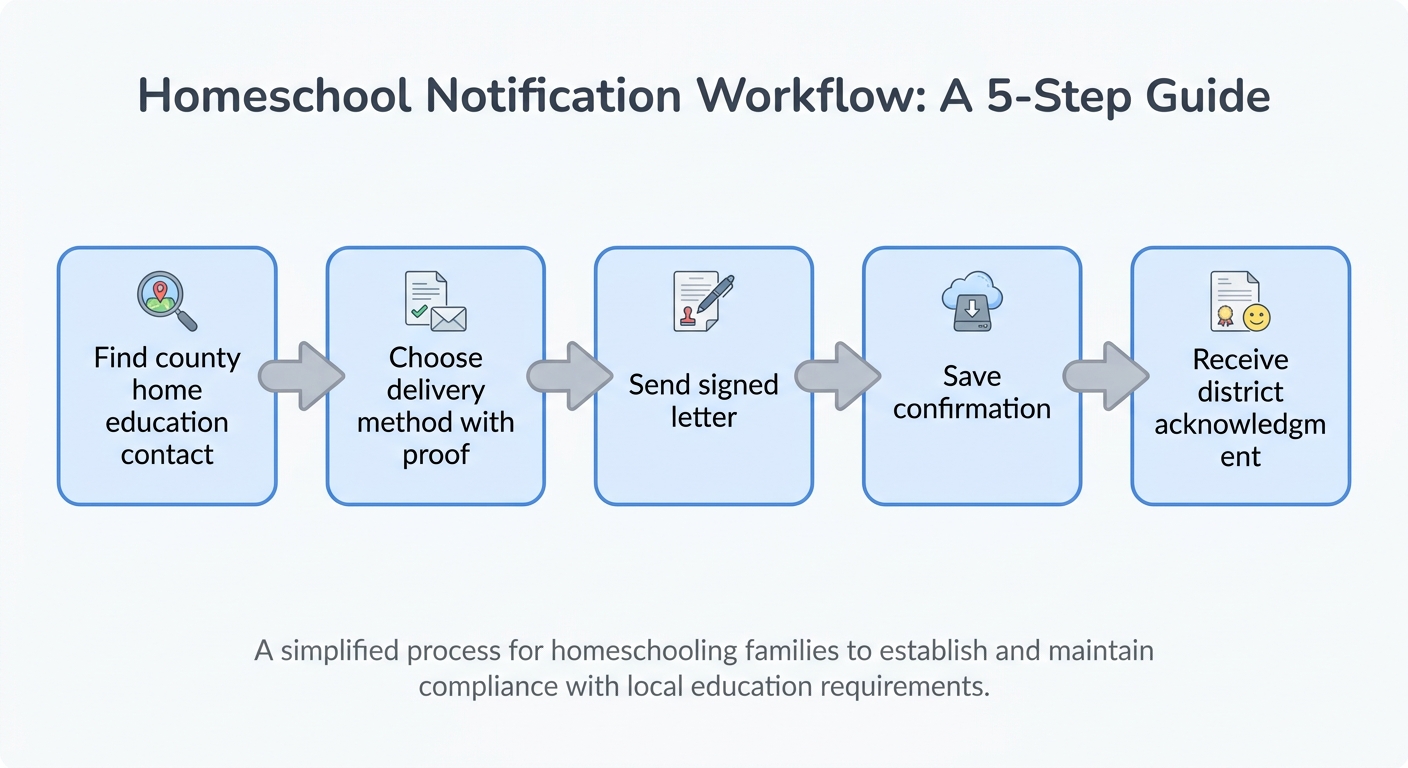
Delivery methods vary by county. Many districts publish an email address or an online submission portal alongside a mailing address, and some offer an optional local form. Check your district's home education page before choosing, then follow these steps:
- Find your county's home education contact on the district website.
- Choose a delivery method that produces evidence — certified mail with return receipt, email with a read confirmation, or a portal that issues a submission reference.
- Send the signed letter with any attachments the district requests.
- Save the confirmation — receipt, screenshot, or sent-mail record — with your copy of the letter.
- Follow up after about two weeks if no acknowledgment arrives.
If this letter is the first item on a much longer to-do list, our full step-by-step checklist for starting out covers what comes before and after the paperwork.
When Should You File if Your Child Is Currently Enrolled?
File within 30 days of beginning home education — and in practice, file the same week your child stops attending. The district uses your notice to close out the enrolment record. Without it, the school may keep marking your child absent.
Steps for a mid-year transition:
- Tell the school in writing that your child is withdrawing to a registered home education program.
- Send the notice of intent to the district at the same time, not after the dust settles.
- Request records — report cards, transcripts, test results, and any IEP or 504 documentation — before the file is archived.
- Confirm the withdrawal date in writing so your notice and the school's records agree.
⚠️ Caution: Simply keeping your child home while you "get around to it" is the riskiest version of a Florida school withdrawal. Unexcused absences can accumulate in the gap between the last day of attendance and the day the district processes your notice, which is how otherwise compliant families end up in a truancy conversation.
What Happens After You File?
Most districts send an acknowledgment letter within a few weeks confirming your program is registered. From that point you carry three ongoing duties: maintain a portfolio of records and work samples, keep that portfolio available to the district for two years, and submit an annual educational evaluation for each child.
Florida Statute 1002.41 lists five accepted evaluation methods. You choose; the district does not assign one.
| Evaluation option | Who administers it | Notes |
|---|---|---|
| Teacher review of the portfolio | A Florida-certified teacher chosen by the parent | Includes a discussion with the student |
| Nationally normed standardized test | Administered by a certified teacher | Parent selects the test |
| State student assessment | Administered at a local public school site | Taken at a time and place agreed with the district |
| Licensed psychologist evaluation | A psychologist holding a Florida licence | Uses standard measurement tools |
| Another valid measurement tool | Mutually agreed with the district superintendent | Requires written agreement in advance |
Costs vary by provider and region, so contact local evaluators or testing services for current pricing rather than assuming a figure.
The evaluation is due each year on the anniversary of your filing date, which is why that date on your letter matters. Families who treat it as a year-end scramble usually struggle; families who keep tracking progress through the year generally arrive at the deadline with the evidence already gathered.
Key takeaway: The notice is a one-time filing. The portfolio and evaluation are the recurring commitments that define homeschooling in Florida.
How Do You Keep the Portfolio Florida Expects?
Florida asks for two things: a log of educational activities made contemporaneously with the instruction, including titles of reading materials used, and a sample collection of writings, worksheets, workbooks, creative materials, and tests. Keep both for two years and make them available to the superintendent on 15 days' written notice.
A monthly rhythm beats an annual rescue mission. File each month:
- The dated activity log for that month, including reading titles
- Two or three writing samples per child, showing a range of effort
- A worksheet or workbook page from each core subject
- One creative or project artifact — a photo counts if the original is bulky
- Any quizzes or tests, with the dates visible
Scanning as you go makes the year-end packet trivial to assemble, and our guide to building your portfolio online covers the practical mechanics.
The honest difficulty is that the log has to be written while you teach, on days when teaching already fills the hours. This is the part LearnSpark takes off the table: it builds the lesson, then records the activity, the materials used, and the mastery notes as the lesson is delivered — so the log and samples accumulate during the year instead of being reconstructed in April. What you get back is the evening you would otherwise spend reverse-engineering nine months of paperwork.
What Are the Most Common Filing Mistakes?
Four errors cause most district follow-up calls: missing dates of birth, an unsigned letter, sending the notice to the child's school rather than the district office, and filing after the 30-day window has closed.
Two more are worth naming:
- Assuming approval is required. Some parents wait for a reply before beginning instruction. The statute does not ask you to. Teach from your start date and keep your proof of filing.
- Forgetting the termination notice. If you end your home education program — because your child enrols in school, graduates, or moves out of state — Florida expects written notice to the superintendent within 30 days.
⚠️ Caution: An unsigned or undated letter can be treated as not filed. If the district later questions when your program began, the burden of proof sits with you, which is why the saved copy and delivery receipt matter more than the letter's wording.
Requirements differ sharply across state lines, so families comparing options — or relocating — will find it useful to see how North Carolina handles the same filing, where the process runs through a state agency rather than a county office.
Summary
A letter of intent to homeschool Florida parents send is short, unglamorous, and the only thing standing between you and a legally registered home education program. Name each child, give their date of birth and address, sign it, date it, send it to your county superintendent within 30 days, and keep proof. The paperwork that follows — the activity log, the work samples, the annual evaluation — is where the real ongoing effort lives, and it is far easier handled monthly than annually.
Frequently Asked Questions
Do you need a specific form, or will a letter do?
A signed letter is legally sufficient under Florida Statute 1002.41. Many counties also publish an optional form on their district website, and either is accepted. If your district offers a form, using it can speed up processing — but no family is required to wait for one.
Can a Florida school district reject your notice of intent?
No. The statute requires notification, not approval, so a district has no authority to deny a properly filed notice. A district may contact you if a required detail is missing — most often a date of birth or a signature — and asking you to supply it is not a rejection.
Do you have to file a new letter every year?
No. The notice is filed once when you establish the program, and it stays in effect while the program continues. What recurs is the annual educational evaluation, due each year on the anniversary of your filing date. If you stop homeschooling, Florida expects a written termination notice to the superintendent within 30 days.
What if you move to a different Florida county?
File a new notice of intent with the superintendent of your new county of residence, and send a termination notice to the county you left. Doing both keeps your record clean in each district and avoids an old file sitting open indefinitely.
Does the letter need to describe your curriculum?
No. Florida does not require curriculum approval or a description of materials in the notice of intent. You may include a line about your approach if you wish, but it adds nothing legally — and the subjects you cover will show up in the portfolio anyway.