
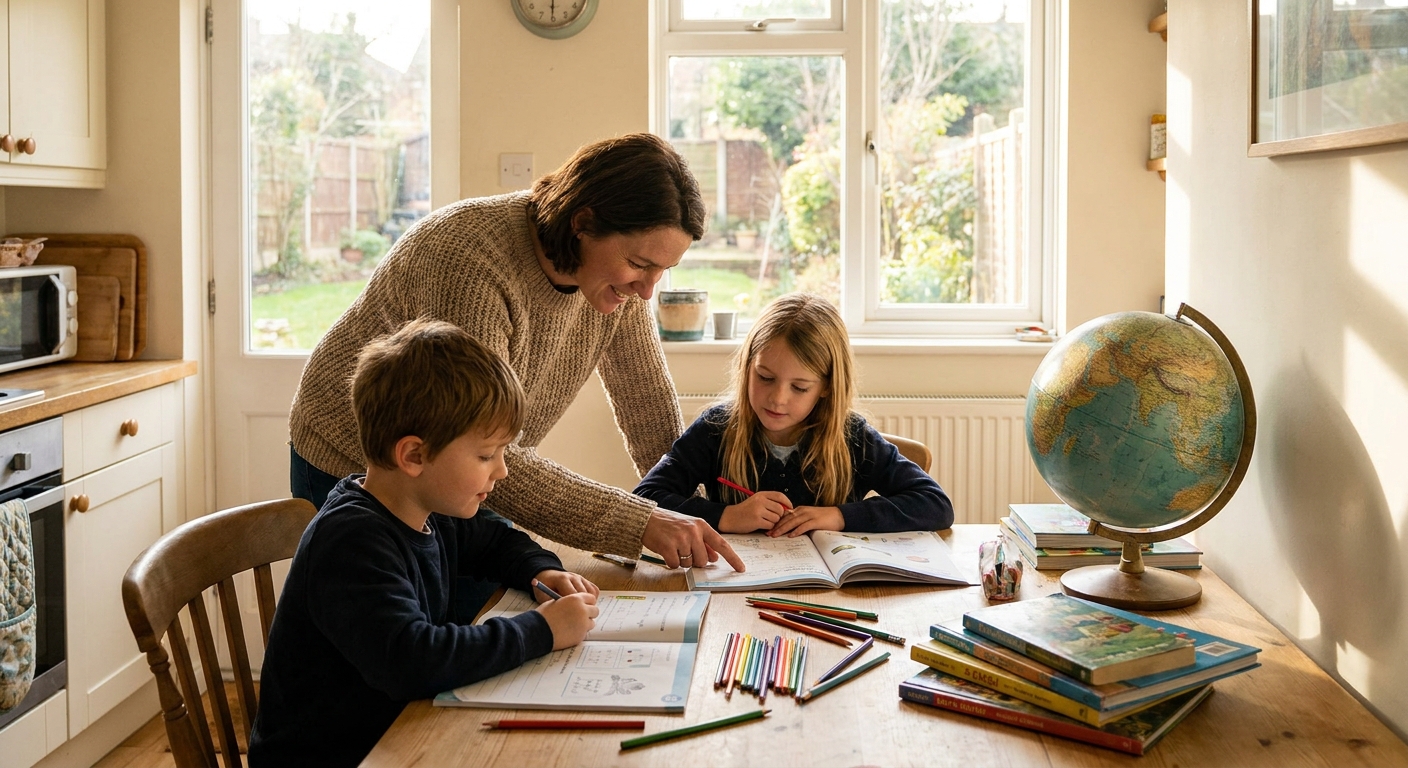
Most parents picturing homeschool imagine a kitchen table version of a classroom: six periods, a bell schedule, a parent in front of a whiteboard. The reality looks almost nothing like that. Here's an honest, plain-language picture of what homeschooling is, how an ordinary day runs, what it costs, and what families actually have to keep track of.
Quick Answer
Homeschooling is parent-directed education delivered at home, or on the road, instead of at a public or private school. It is legal across the United States and in most of the UK, Canada, Australia and New Zealand, though the paperwork varies widely by state and region. A homeschool day is usually much shorter than a school day — families commonly report a couple of hours of focused academic work in the early years, and a few more by middle school. The rest of the day goes to reading, projects, chores and outside activities.
TL;DR
- Homeschooling means the parent is legally responsible for the child's education — it is not the same as a free online public school. See how the three commonly confused options differ
- The teaching day is short. Most of the calendar is reading, play, errands and project work, not desk time. Walk through a sample weekday
- **Many families land somewhere between five recognised styles and end up mixing them over time. Compare the five main approaches
- Your legal obligations depend entirely on where you live — some places want a single notice, others want annual assessment. Check what your jurisdiction expects
- Records matter more than new families expect, even in low-regulation states. See the four things to keep
In This Article
- What Does Homeschooling Actually Mean?
- What Does a Normal Homeschool Day Look Like?
- What Are the Main Homeschooling Styles?
- Is Homeschooling Legal Where You Live?
- What Does Homeschooling Cost in a Year?
- How Do Homeschooling Families Keep Records?
- What Do Kids Miss Out On — and What Do They Gain?
- How Do You Decide If It's Right for Your Family?
What Does Homeschooling Actually Mean?
Homeschooling means you — the parent, or a tutor you choose and pay — are the person legally accountable for your child's education. No school district signs off on your weekly plan. You choose the materials, set the pace, and keep whatever records your jurisdiction asks for.
Three things get mixed up constantly:
- Homeschooling — the family selects the curriculum and directs the learning. Nobody enrolls the child in an institution.
- Virtual or online public school — the child is still enrolled in a public school, just attending remotely. A state-funded online charter provides the teacher, the schedule and the grades. This is not homeschooling in the legal sense.
- Unschooling — a child-led approach that sits inside homeschooling, not beside it. It's worth understanding why unschooling and homeschooling aren't the same thing before you pick a label.
The distinction matters practically, not just semantically. If you enroll in a free online program, you generally inherit that school's attendance rules, testing calendar and teacher oversight. If you homeschool, you inherit the freedom and the paperwork.
⚠️ Watch for this: a program advertised as "free online school" is usually a public school delivered at home. You may still be counted as publicly enrolled, with the schedule and reporting that comes with it. Read the enrollment terms before you sign anything.
What Does a Normal Homeschool Day Look Like?
A normal homeschool day is short, front-loaded and interrupted on purpose. Families commonly describe shorter core academic sessions in the early elementary years, gradually lengthening by middle school. The reason isn't laziness — one-to-one instruction moves faster than whole-class instruction, and there's no lining up, no register, no transitions between rooms.
A typical weekday might run like this:
- 8:30 — Morning basket. Everyone together: read-aloud, a poem, a map, a discussion question. Siblings of different ages all get something out of the same twenty minutes. This is the core trick behind running one lesson across several ages.
- 9:15 — Math. One child works directly with the parent; the other works independently and swaps.
- 10:00 — Outside. Not a reward, a reset. Bikes, garden, walk to the shop.
- 10:30 — Literacy. Reading, copywork, spelling or writing, depending on age.
- 11:30 — Project or subject rotation. Science on Mondays and Wednesdays, history on Tuesdays and Thursdays, art on Fridays.
- Afternoon — Open. Co-op, library, sport, music lesson, independent reading, or nothing at all.
A travelling family's day looks different in shape but similar in length. Core work often happens early, before the heat or the museum queues, and the afternoon becomes the lesson — a market becomes maths, a ruin becomes history. The academic hours don't vanish; they relocate.
Key takeaway: Homeschooling isn't school compressed into a house. It's a shorter core block surrounded by a lot of life that also counts as learning.
What Are the Main Homeschooling Styles?
Five approaches cover most families, and the majority end up blending them within the first year. Eclectic homeschooling is the practice of mixing methods and materials from several philosophies — a classical spine for history, a hands-on maths programme, child-led afternoons — rather than committing to one system.
| Style | What a day feels like | Prep load for the parent | Often suits |
|---|---|---|---|
| School-at-home | Scheduled subjects, textbooks, tests | Low prep, high supervision | Families new to homeschooling, or returning to school later |
| Classical | Memory work, logic and discussion, staged by age | Moderate to high | Parents who want a structured, language-heavy path |
| Charlotte Mason | Short lessons, living books, narration, nature study | Moderate | Younger children and read-aloud households |
| Unit studies / project-based | One theme pulls in several subjects for weeks | High prep, high engagement | Mixed-age siblings learning together |
| Unschooling | Child-led, interest-driven, no set timetable | Low prep, high attentiveness | Self-motivated children and confident parents |
A few practical notes on what these look like in the room. Classical education stages the work by age — memorisation early, reasoning in the middle years, articulate argument in high school. Charlotte Mason leans on narration, where a child retells what they've just heard in their own words instead of filling in a worksheet. Unit studies let one topic — rivers, ancient Egypt, bridges — carry maths, reading, writing and science for a month.
Very few families stay pure. You will probably start with whichever style you read about first, discover in October that half of it doesn't fit your child, and quietly swap pieces out. That's normal, and it's easier if you've chosen materials you can adapt rather than a rigid year-long package. If budget is part of that decision, our guide to picking materials without overspending walks through the trade-offs.
Is Homeschooling Legal Where You Live?
Yes — homeschooling is legal throughout the United States and in most English-speaking countries. What differs enormously is the paperwork, and that difference should shape your first month more than any curriculum decision.
In broad terms, US states fall into three groups:
- Low notification — Some states have historically had minimal or no notification requirements, but requirements change, so confirm current rules with your state education agency.
- Notice plus basics — a letter of intent, sometimes a subject list or attendance count.
- High reporting — Some states have historically had more extensive requirements such as periodic reporting, annual assessment, or portfolio review, but requirements change, so confirm current rules with your state education agency.
Outside the US, rules are set regionally too. Home education in England, in Canadian provinces and in Australian states each follows its own registration and review process, so a friend's advice from another region may simply not apply to you.
Do not take any article — including this one — as legal advice. Read your own state or regional statute, or a current summary of it, before you spend a dollar on curriculum. Our breakdown of homeschooling requirements by state is a reasonable starting point for orienting yourself, but the statute itself is the authority.
Key takeaway: Your first job isn't choosing a curriculum. It's reading your own jurisdiction's rules and calendaring any deadlines they impose.
What Does Homeschooling Cost in a Year?
Homeschooling can cost almost nothing or a great deal, depending entirely on how much you outsource. Materials are the small part; outside classes, sports and tutoring are usually what move the number.
| Route | What's included | Where the money goes |
|---|---|---|
| Free / near-free | Public library, free online lessons, printables, secondhand books | Printing, consumables, a few used workbooks |
| Middle | A purchased core programme plus a weekly co-op | Curriculum, co-op fees, art and science supplies |
| Premium | Accredited programme, outside tutors, paid extracurriculars | Tuition, tutoring hours, sports and music fees |
Two things new families underestimate. First, consumables — printer ink, science kit refills, replacement workbooks for the second child — accumulate quietly. Second, outsourced instruction. One weekly maths tutor can outweigh every book you bought.
Two things families overestimate: the need to buy a full boxed curriculum for every subject, and the need to replicate a classroom's equipment. A kitchen counter and a library card carry a surprising amount of elementary science.
Several US states now run education savings accounts or similar funding programmes that home educators may be eligible for, with rules that vary by state and change between legislative sessions — check your own state's current programme rather than assuming. If you're building a plan around a tight budget, start with homeschooling well on a small budget.
How Do Homeschooling Families Keep Records?
Most families keep four things, and it's worth setting the habit up in week one rather than reconstructing it in June.
- Attendance or hours — a simple log of days or hours taught, if your jurisdiction counts them.
- A work sample portfolio — dated examples across subjects, a few per term.
- A progress log — subject by subject, what was covered and what was mastered.
- A transcript — for high school only, listing courses, credits and grades.
A homeschool portfolio is a dated collection of a child's work — writing samples, photos of projects, reading lists, test results — assembled to show what was actually learned over a period. Formats range from a shared phone album, to a three-ring binder, to a spreadsheet, to purpose-built record keeping software that handles transcripts.
Records matter even where nobody asks for them. They help if you move to a stricter state mid-year, they underpin a college application later, and — most usefully day to day — they tell you whether a shaky week was a blip or a pattern.
That last part is where the real burden sits. The second-guessing about whether a child is genuinely on track, plus the after-hours job of writing up what happened, is what quietly wears parents out. A platform like LearnSpark maps each child's mastery against local standards as you teach and produces the progress notes from that, so you stay the teacher while the planning gets handled — and the hour you'd spend rebuilding the record goes back to the evening.
What Do Kids Miss Out On — and What Do They Gain?
The honest trade is fewer built-in daily peers in exchange for far more one-to-one instruction time and a schedule shaped around one child instead of thirty.
What's genuinely lost, and worth planning around:
- Automatic social contact. Friends have to be scheduled, not stumbled into.
- School facilities. Labs, orchestras and team sports may be unavailable in your district, or available only through outside clubs.
- Parental free time. This is the cost families name most often.
What's commonly gained, according to what homeschooling parents and advocates report: instruction pitched at the child's actual level, more time outdoors, the ability to move fast where a child is strong and slow where they're not, and a family calendar that isn't hostage to a bell schedule. Research organisations that study home education publish summaries on academic and social outcomes; findings are debated and sampling methods vary, so treat any headline figure — in either direction — with care.
Socialization is mostly a logistics problem. Co-ops, sports clubs, library programmes, music groups and neighbourhood friendships all exist; they just require a calendar entry. Parent burnout, by contrast, is a structural risk worth taking seriously from the start — our guide to spotting and recovering from homeschool burnout covers the early signs.
Key takeaway: Socialization is a scheduling question with known solutions. Parent capacity is the harder constraint, and it deserves planning, not willpower.
How Do You Decide If It's Right for Your Family?
Decide on three questions, in this order.
- Can one adult reliably supervise a short daily block? Not teach nonstop — supervise, and teach directly for part of it. If nobody can, look at pods, hybrid programmes or part-time arrangements instead.
- Can you meet your jurisdiction's paperwork? Read the rules first. If annual assessment feels unmanageable, you need to know that now, not in March.
- Is the current situation actively harming your child? Bullying, unmet learning needs, or a child who has stopped talking about school are different inputs than general curiosity. They change the urgency.
If the answers point yes, you don't have to commit to twelve years. Three common on-ramps: run a trial over the summer with no legal implications, allow a short deschooling period after withdrawal before starting formal work, or simply begin at kindergarten age and never enroll. When you're ready for the mechanics, a step-by-step first-year checklist walks through withdrawal letters, notices and first-term planning in order.
Frequently Asked Questions
How many hours a day is homeschooling?
Families commonly report shorter focused academic sessions in early elementary, gradually increasing by middle and high school. One-to-one teaching simply covers ground faster than whole-class teaching. Some states define the school year in days or instructional hours rather than by a daily schedule, so check whether yours sets a minimum you need to log.
Can you homeschool if both parents work?
Yes, and many families do. The common patterns are front-loading core work into early mornings, shifting some subjects to evenings and weekends, sharing a learning pod with another family, or splitting the teaching week between two working parents. Loop scheduling — rotating through a list of subjects rather than assigning each to a fixed day — makes an irregular week much easier to absorb.
Do homeschooled kids get a diploma?
Yes. In the US, a parent-issued diploma alongside a detailed homeschool transcript is accepted by many colleges, which typically weigh coursework, test scores and portfolio evidence., which typically weigh coursework, test scores and portfolio evidence. Families who want third-party backing can enroll with an umbrella school or an accredited programme that issues the diploma instead. Requirements differ outside the US, so check your own region's route to recognised qualifications.
What is the hardest part of homeschooling?
Most parents describe the planning load and the self-doubt as harder than the teaching. Deciding what comes next, finding materials, and wondering whether a child is behind consumes more energy than the lesson itself. Parents who report burnout often point to the invisible administrative work rather than time spent with their children.
Do you need a teaching qualification to homeschool?
In most US states, no — a high school diploma or equivalent is the most any state typically asks of a home-educating parent, and many ask for nothing at all. A handful of jurisdictions set a parental education requirement, and rules outside the US vary by region, so confirm yours before you plan. What matters far more in practice is consistency and a willingness to look things up alongside your child.
Can you homeschool a child with a speech delay or other learning needs?
Yes, and it's a common reason families start. A speech delay is when a child's spoken language develops later than typical age expectations, while a language delay describes difficulty understanding or putting together words and sentences. Homeschooling doesn't replace professional support — if you suspect either, seek an assessment and, where recommended, speech therapy through your usual health or education route. What homeschooling does offer is flexibility around it: appointments fit the day, a homeschool curriculum can be paced to the child rather than the grade, and oral work can be adjusted while written work moves ahead. Note that withdrawing from public school may change the services your child is entitled to, so check your local rules first.
How do you switch curriculum mid-year without losing progress?
Finish the current unit if you can, then note exactly where the child stopped — topic, skill, last completed lesson — in your progress log. Most homeschool curriculum publishers post scope-and-sequence charts free, so you can match the new programme's entry point to that note instead of restarting from page one. Expect a week or two of overlap while your child adjusts to different wording and layout; that's normal, not lost ground.
Summary
Homeschooling, in practice, is a short daily core of direct teaching wrapped in a lot of ordinary life. The legal picture varies by state and region, so read your own rules before buying anything. Costs stretch from near-zero to substantial, driven mostly by outside classes rather than books. Keep four kinds of records from day one — hours, work samples, a progress log, and a transcript for high school — and the rest of the decisions get easier to make and easier to revise.