
Tennessee gives families three separate legal routes to homeschool, and almost every question about testing, attendance and diplomas has a different answer depending on which route you choose. This guide walks through all three — what you file, what you track, who tests your child, and who signs the diploma at the end. It's written for parents at the "wait, how does this actually work?" stage, not for lawyers.
Quick Answer
Tennessee families can homeschool one of three ways: as an independent home school registered with the local school district, through a church-related umbrella school, or by enrolling in an accredited online or satellite school. Independent homeschoolers file a notice of intent with their district before the school year, teach four hours a day for 180 days, keep attendance records, and have their children take the state-mandated test in grades 5, 7 and 9. Parents issue the diploma themselves.
TL;DR
- Three legal pathways exist, and they carry different paperwork. The independent option answers to your district; umbrella and accredited-school options answer to the school you enroll with. See the three options compared
- Independent homeschoolers file a notice of intent with the local district, not the state. It is submitted before the school year starts and re-filed annually. Walk through the filing steps
- The attendance standard is four hours a day across 180 days. Field trips, read-alouds and co-op classes count toward it. See how a real week adds up
- Standardized testing applies in grades 5, 7 and 9 under the independent option. Umbrella schools set their own testing policy, which is one reason many Tennessee families choose them. Check the testing rules by grade
- The state does not issue homeschool diplomas. Parents or umbrella schools do, and the transcript behind it is what colleges and employers actually read. See what a valid diploma needs
In This Article
- What Are the Three Legal Ways to Homeschool in Tennessee?
- How Do You File a Notice of Intent in Tennessee?
- How Many Hours and Days Does Tennessee Require?
- What Are Tennessee's Homeschool Testing Requirements?
- What Records Should Tennessee Homeschoolers Keep?
- What Are Tennessee Homeschool Graduation Requirements?
- What Does Homeschooling in Tennessee Cost, and Is There Funding?
- Frequently Asked Questions
What Are the Three Legal Ways to Homeschool in Tennessee?
Tennessee's home school law (TN Code Ann. § 49-6-3050) recognizes three distinct arrangements, and your obligations flow from whichever one you register under.
An independent home school is a home education program run by the parent and registered directly with the local education agency — your county or city school district. You are the school. You file, you track, you test, you graduate your student.
A church-related umbrella school is a private school operated by a church-related organization that enrolls home-educated students and carries the recordkeeping responsibility on their behalf. Families often encounter programs like HomeLife Academy when researching this route; confirm enrollment terms, fees and testing policy directly with any program before you commit, as details change.
An accredited online or virtual school enrollment means your child is a student of that school, not a home school registrant. The Tennessee Department of Education publishes a public virtual schools list for families exploring this path (page consulted October 2026).
| Independent home school | Church-related umbrella | Accredited online / virtual | |
|---|---|---|---|
| Who you notify | Local district superintendent | The umbrella school | The school or program |
| Who sets the calendar | You, within state minimums | The umbrella's policy | The program |
| Standardized testing | State-mandated in grades 5, 7, 9 | The umbrella's own policy | The program's policy |
| Attendance records held by | You, reported to the district | The umbrella school | The school |
| Diploma issued by | The parent | The umbrella school | The school |
| Day-to-day flexibility | Highest | High | Lowest |
Tennessee sits in the middle of the national regulatory spectrum — more paperwork than a low-regulation state, far less than a portfolio-review state. If you're comparing before a move, our overview of homeschooling requirements by state shows where Tennessee lands next to its neighbours.
Key takeaway: Choose your pathway first. Every deadline, test and record described below depends on which of the three you registered under.
How Do You File a Notice of Intent in Tennessee?
Independent homeschoolers submit a notice of intent to the superintendent of their local school district before the school year begins, and re-file it each year. Many districts request it by August 1 — confirm your own district's date, because it is set locally and can shift.
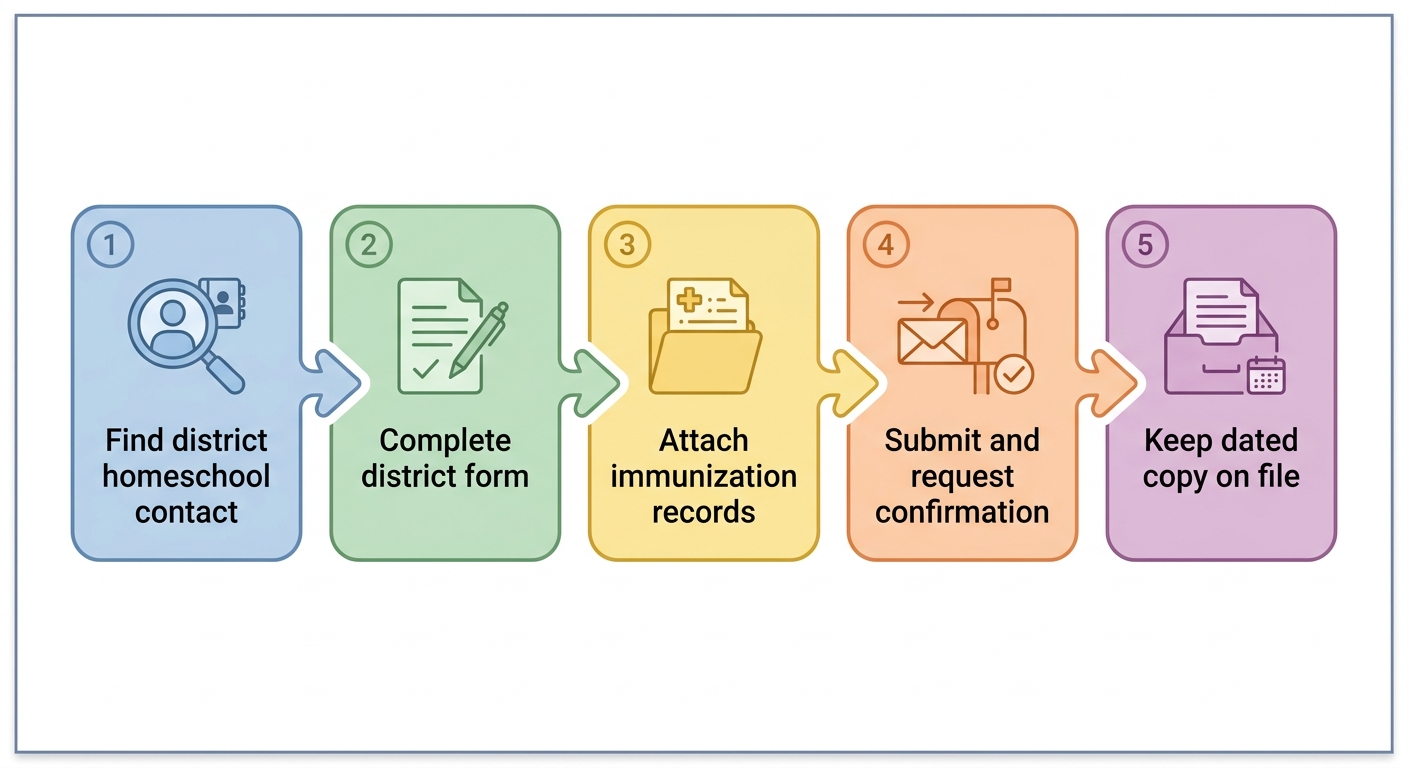
The five steps look like this:
- Find your district's homeschool contact. Most Tennessee districts, including large ones like Knox County Schools and Metro Nashville Public Schools, post a homeschool page with a downloadable form and an office email (verify current forms on your district's site).
- Complete the district form. Expect fields for each child's full name, date of birth, grade level for the coming year, your address, and proof of required immunizations or a valid exemption. Our guide to what goes in a notice of intent covers the standard fields in detail.
- Attach supporting documents. Immunization records are the most commonly requested attachment.
- Submit and get confirmation. Email with a read receipt, or hand-deliver and ask for a date stamp.
- Keep a dated copy for your own file. This is your proof of compliance if anything is ever questioned.
Withdrawing mid-year works the same way, with one addition: send a written withdrawal letter to the child's current school and your notice of intent to the district office, ideally on the same day, so there is no gap where the child appears truant.
⚠️ The most common filing mistake is assuming the state collects your form. It doesn't. The notice of intent goes to your local district, and sending it to the Tennessee Department of Education will not register your homeschool.
How Many Hours and Days Does Tennessee Require?
Under the independent home school option, Tennessee's standard is four hours of instruction per day across 180 days per year, with attendance documented and reported to the district. Umbrella-school families follow their umbrella's calendar and reporting rules instead.
"Four hours" is broader than it sounds. It is instructional time, not desk time. A reasonable week might include:
- Morning core work — reading, writing and math at the table
- A museum or state park visit that anchors a history or science unit
- Co-op classes taught by another parent or a hired tutor
- Read-alouds and audiobooks that carry literature and history content
- Documented project work — a build, an experiment, a research write-up
A worked example: four hours Monday through Thursday at home, plus a four-hour Friday field trip, puts you at 20 hours and five attendance days — a full week logged without a single bell schedule. The trick is recording it the same day, because reconstructing eight weeks of attendance in May is where most families lose their patience. Our walkthrough on how to track homeschool hours covers simple logging systems that survive a messy week.
Key takeaway: Count instructional time generously but honestly, log it daily, and keep the log in one place you'll actually open.
What Are Tennessee's Homeschool Testing Requirements?
Under the independent home school option, Tennessee requires students to take the state-mandated standardized test in grades 5, 7 and 9. Other grade levels carry no state testing requirement under that option. Testing is typically arranged through the local district, and districts can differ on scheduling and location.
| Grade level | Independent home school | Church-related umbrella | Accredited online / virtual |
|---|---|---|---|
| K–4 | No state test required | Per umbrella policy | Per school policy |
| 5 | State-mandated test | Per umbrella policy | Per school policy |
| 6 | No state test required | Per umbrella policy | Per school policy |
| 7 | State-mandated test | Per umbrella policy | Per school policy |
| 8 | No state test required | Per umbrella policy | Per school policy |
| 9 | State-mandated test | Per umbrella policy | Per school policy |
| 10–12 | No state test required | Per umbrella policy | Per school policy |
Two details matter more than parents expect. First, if a student's scores come in significantly low, the statute contemplates consultation with the district and a remediation plan — it is a conversation and a correction, not an automatic end to homeschooling. Second, church-related umbrella schools set their own testing policy, which is a major reason many Tennessee families register under an umbrella rather than independently.
Because testing windows, vendors and registration deadlines are set locally and reviewed year to year, confirm the current-year details with your district office before you plan around them. Families comparing more than one state can download our free state requirements reference to see testing rules side by side.
Who administers the test?
Testing for independent homeschoolers is generally arranged through the local district, which may seat your child with public school students or offer a separate session. Ask three questions when you call: which test, which window, and what you need to bring. Put the answers in your records file the same day.
What Records Should Tennessee Homeschoolers Keep?
At minimum, keep attendance for 180 days, immunization records, test results from grades 5, 7 and 9, and — once high school begins — a running credit log. Tennessee does not formally require a portfolio, but families who keep one are rarely sorry.
A portfolio is an organized collection of a student's work, assessments and activity records gathered over the school year. It provides evidence of what was taught and what was learned, which is exactly what an evaluator, a college or a future district will ask for.
A practical record set for a Tennessee family:
- Attendance log — date, hours, and a one-line description of what was covered
- Subject-by-subject progress notes — what the child mastered, what still needs work
- Reading list — titles and dates, running all year
- Work samples — three collection points a year (fall, winter, spring) per subject
- Test results and immunization records — scanned and backed up
- High school credit log — course title, hours, grade, credit value
The part most parents dread is not the teaching — it's writing up what happened after a long day, usually from memory, usually on a Sunday. That reporting burden is the piece that can be handed off: LearnSpark builds the day's lesson from where each child actually is, then turns the completed session into progress notes and mastery records on its own, so the attendance and progress file keeps filling itself while your attention stays on the kid in front of you. If you'd rather see where a child stands by skill than by chapter, our guide to mastery-based progress tracking explains the approach.
Key takeaway: Record as you go. A thin file kept daily beats a thick one assembled in panic.
What Are Tennessee Homeschool Graduation Requirements?
Tennessee does not issue diplomas to independent homeschoolers. The parent issues the diploma — or the umbrella school does, if you're enrolled with one — and it is generally accepted for employment, college admission and military enlistment when it is backed by a credible transcript and, where relevant, test scores.
| Parent-issued | Umbrella-issued | Accredited online school | |
|---|---|---|---|
| Who signs | The parent-administrator | The umbrella school | The issuing school |
| Transcript source | Parent-maintained credit log | School records | School records |
| Course choice | Fully yours | Usually yours, within policy | Set by the program |
| Common follow-up request | Test scores, course descriptions | School transcript | School transcript |
Most Tennessee families build a high school plan that mirrors the state's public high school diploma framework, which is commonly described as roughly 22 credits covering English, math, science, social studies, world language, physical education and wellness, personal finance, and electives. Confirm the current credit structure with the Tennessee Department of Education before you lock a four-year plan, since graduation policy is reviewed periodically.
Two Tennessee-specific items worth planning around early:
- The HOPE Scholarship. The Tennessee Student Assistance Corporation administers HOPE eligibility, and home school graduates have historically qualified through a test-score route rather than a GPA route. Check TSAC's current-year criteria during your student's sophomore year, not senior year, because the testing timeline matters.
- Dual enrollment. Tennessee community colleges enroll high-school-age students in credit-bearing courses. Dual enrollment creates an external, verifiable record alongside your parent-issued transcript — which quietly solves the credibility question for admissions offices.
Key takeaway: A parent-issued diploma is a formality. The transcript, test scores and any outside coursework are what people actually evaluate.
How Do You Build a Tennessee Transcript Colleges Accept?
A homeschool transcript is one page: student name and date of birth, school name and address, courses by year, credits, grades, a cumulative GPA, graduation date, and your signature and date. Nothing fancy, nothing padded.
A sample of three rows from a ninth-grade year:
| Course | Credit | Grade |
|---|---|---|
| English I | 1.0 | A |
| Algebra I | 1.0 | B+ |
| Biology I (with lab) | 1.0 | A– |
Credits come from your course log. A standard full-year course is one credit; a semester course is half. Keep a short course description file alongside the transcript — one paragraph per course listing texts used and major assignments — because selective colleges sometimes request it.
For a lightweight system that keeps the log current without a spreadsheet rebuild each term, see our approach to simple homeschool planning.
What Does Homeschooling in Tennessee Cost, and Is There Funding?
Tennessee does not provide direct state funding or a dedicated tax credit to independent homeschoolers. Your costs are whatever you choose to spend, plus any umbrella school enrollment fee.
| Pathway | Typical cost drivers | Funding notes |
|---|---|---|
| Independent home school | Curriculum, testing fees, co-op dues, supplies | No direct state funding |
| Church-related umbrella | Annual enrollment fee per student, plus curriculum | Fees vary by program — verify directly |
| Accredited online / virtual | Program tuition, or free if a public virtual school | Public virtual options are publicly funded |
Scholarship and education savings account programs in Tennessee have generally been structured around enrollment in participating private schools rather than independent home education. Rules in this area change between legislative sessions, so verify current-year eligibility before you build a budget around any program. Our breakdown of does Tennessee give money to homeschoolers covers the landscape in more detail.
Two ways families trim the bill without trimming the education: join a local group for shared classes and bulk curriculum buys — TheHomeschoolMom's Tennessee co-op directory and the MTHEA support group list are both commonly used starting points — and lean on public libraries, which cost nothing and carry more than most parents realize.
Frequently Asked Questions
These are the questions Tennessee parents ask most often in the first few weeks — testing, sports, withdrawal timing and where the paperwork actually goes.
Do you have to pass a test to homeschool your child in Tennessee?
No. There is no exam for the parent. Tennessee has historically applied parent education qualifications differently by grade band, and those provisions have been amended over time, so confirm the current requirement with your district before you file. The testing obligation falls on the student: grades 5, 7 and 9 under the independent home school option.
Can homeschoolers play sports or take classes at Tennessee public schools?
Yes, in many cases. Tennessee's "Tebow law" allows home school students to try out for athletics at their zoned public school, with eligibility administered through the Tennessee Secondary School Athletic Association (TSSAA). Many districts also permit part-time enrollment in specific courses such as band, labs or advanced math. Availability is decided locally, so call the school directly rather than assuming.
What can Tennessee homeschoolers get for free?
More than you'd expect. Public library systems including Nashville Public Library and Knox County Public Library offer books, databases, museum passes and children's programming at no cost. Tennessee State Parks run ranger-led educational programs. Online, Khan Academy covers core K–12 subjects free. Required standardized testing is often administered through the district without charge — confirm with your district office.
How do I withdraw my child from a Tennessee public school mid-year?
Submit a written withdrawal letter to the child's current school and your notice of intent to the district office, ideally the same day, so there is no window where the child is recorded as absent. Request the cumulative record and any special education documentation. Start counting your 180 days and daily hours from your first instructional day at home. Keep dated copies of everything you send.
Do I send my notice of intent to the state or to my school district?
To your district. The notice of intent for an independent home school goes to the superintendent of your local education agency — your county or city school district — before the school year begins, and it is re-filed every year. Sending it to the Tennessee Department of Education does not register your homeschool. Ask for a date stamp or a read receipt, and keep a dated copy in your own file.
Do umbrella school students have to take the grade 5, 7 and 9 tests?
Not automatically. The grades 5, 7 and 9 testing requirement applies to the independent home school option. Church-related umbrella schools set their own testing policy, so some test more often, some less, and some use a different assessment entirely. Ask any umbrella program for its written testing policy before you enroll, since it is one of the biggest practical differences between the pathways.
What happens if my child's standardized test scores come back low?
It starts a conversation, not a shutdown. Where scores come in significantly low, the statute contemplates consultation with the district and a remediation plan — a documented effort to bring the student back up in the weak subject area. Keeping progress notes and work samples through the year makes that conversation much shorter, because you can show what has already been covered and where the gaps are.
Which Tennessee homeschool option involves the least paperwork for parents?
Usually the accredited online or virtual school, because the school owns the attendance records, testing and transcript. A church-related umbrella sits in the middle: you teach, they hold the records and issue the diploma, and you pay an enrollment fee. The independent home school gives you the most day-to-day freedom and the most administrative work — the notice of intent, the 180-day attendance log, the grades 5/7/9 testing and the diploma are all yours.
Can I switch between the three Tennessee homeschool options mid-year?
Usually yes, but the handover is where families get caught. Moving from independent to an umbrella school means your district filing ends and the umbrella's enrollment begins — ask the program in writing when its record-keeping responsibility starts. Moving the other direction means filing a notice of intent with your district and picking up attendance tracking yourself from that day. In both cases, carry your existing attendance log, test results and work samples across, since nobody rebuilds them for you.
What immunization records does Tennessee ask homeschoolers for?
Districts typically request proof of the state's required immunizations for each child named on the notice of intent, or documentation of a valid exemption. The simplest approach is to request an official copy from your child's physician before you file, scan it, and attach it to the form. Requirements and accepted exemption forms are set at the state and district level and reviewed periodically, so confirm the current list with your district office rather than reusing last year's assumptions.
Summary
Homeschooling in Tennessee is manageable once you pick a lane. Register independently and you own the notice of intent, the 180 days at four hours, the grades 5/7/9 testing, the records and the diploma. Register under a church-related umbrella or an accredited school and most of that shifts to them, along with their fees and their calendar.
Whichever route you take, the habits are the same: file on time with your local district, log attendance the day it happens, keep test results and work samples where you can find them, and build the high school credit log from ninth grade rather than from senior year. Verify every date, form and credit requirement with your district and the Tennessee Department of Education for the current year — local policy is where the real detail lives.
Information about third-party platforms reflects publicly available details at the time of writing and may have changed. Please verify directly with the provider. See our Terms of Use for more.