
Indiana is one of the simplest states in the country to begin home education, and that simplicity is exactly what trips new families up. There is no form to file, no one to ask permission from, and no checklist handed to you — which leaves most parents wondering whether they've missed something. This guide walks through the first ninety days of a new Indiana homeschool: the withdrawal letter, the records that matter, how to choose a program, and how a diploma actually works.
Quick Answer
To start a homeschool in Indiana, you do not need state approval or a notice of intent. Withdraw your child in writing from their current school, then operate as a non-accredited non-public school: teach 180 days a year, provide instruction in English, and keep attendance records. The Indiana Department of Education offers a voluntary online portal where non-accredited non-public schools can report enrollment. That's the whole legal picture.
TL;DR
- No state approval or permission is needed to begin. Indiana treats your home school as a non-accredited non-public school with a short list of duties. See what Indiana actually requires
- Withdrawal is a letter, not an application. Send it in writing, keep a dated copy, and request the cumulative file. Walk through the withdrawal steps
- Attendance is the one record Indiana names — but three others make your life easier later. See the four records worth keeping
- Accreditation is optional, and "free virtual school" usually isn't homeschooling. Compare the four program routes
- Parents issue the diploma in Indiana. The state does not set homeschool graduation requirements. See how Indiana homeschool graduation works
In This Article
- What Does Indiana Actually Require of Homeschool Families?
- How Do You Withdraw Your Child From an Indiana Public School?
- What Records Should You Keep — and for How Long?
- How Do You Choose an Online or Boxed Program in Indiana?
- What Does a Typical Indiana Homeschool Year Look Like?
- How Do Indiana Homeschoolers Graduate and Get a Diploma?
- How Do You Keep Transcript-Ready Records Without Drowning in Paperwork?
What Does Indiana Actually Require of Homeschool Families?
Indiana asks for three things: instruction on at least 180 days each year, instruction given in English, and attendance records that show it happened. That's the core of homeschooling in Indiana requirements, and it comes from the state's compulsory attendance statute at Indiana Code 20-33-2-28.
A non-accredited non-public school is Indiana's legal category for a privately run school — including a family teaching at home — that operates without state accreditation. Your kitchen table and a one-room private academy sit in the same bucket under state law.
| Requirement | What the statute establishes | What it means day to day |
|---|---|---|
| 180 instructional days | Instruction must be provided for at least 180 days per school year | You choose the calendar; no set start or end date |
| Instruction in English | Teaching is delivered in the English language | Second languages are welcome alongside it |
| Attendance records | Records must be kept and produced on request | A simple dated log satisfies this |
| Enrollment reporting | Reporting through the state's non-public school portal is offered to schools in this category | Many families do it voluntarily for their own paper trail |
What's not on the list matters just as much. Indiana does not require a notice of intent, standardized testing, portfolio review, an outside evaluator, parent qualifications, or an approved subject list. Compared with states that mandate annual evaluations and testing windows, Indiana sits at the light end of the spectrum — you can see the contrast across homeschool requirements by state if you're moving or splitting time between states.
That freedom comes with one responsibility: if a school attendance officer ever asks, you're the one who produces the evidence. Nobody collects it from you in advance, so nobody reminds you to build it. For the full statutory detail, including definitions and exemptions, see the deeper Indiana homeschool law details.
Key takeaway: Indiana requires 180 days, English instruction, and attendance records — and asks for nothing in advance, which makes your own recordkeeping the whole safety net.
How Do You Withdraw Your Child From an Indiana Public School?
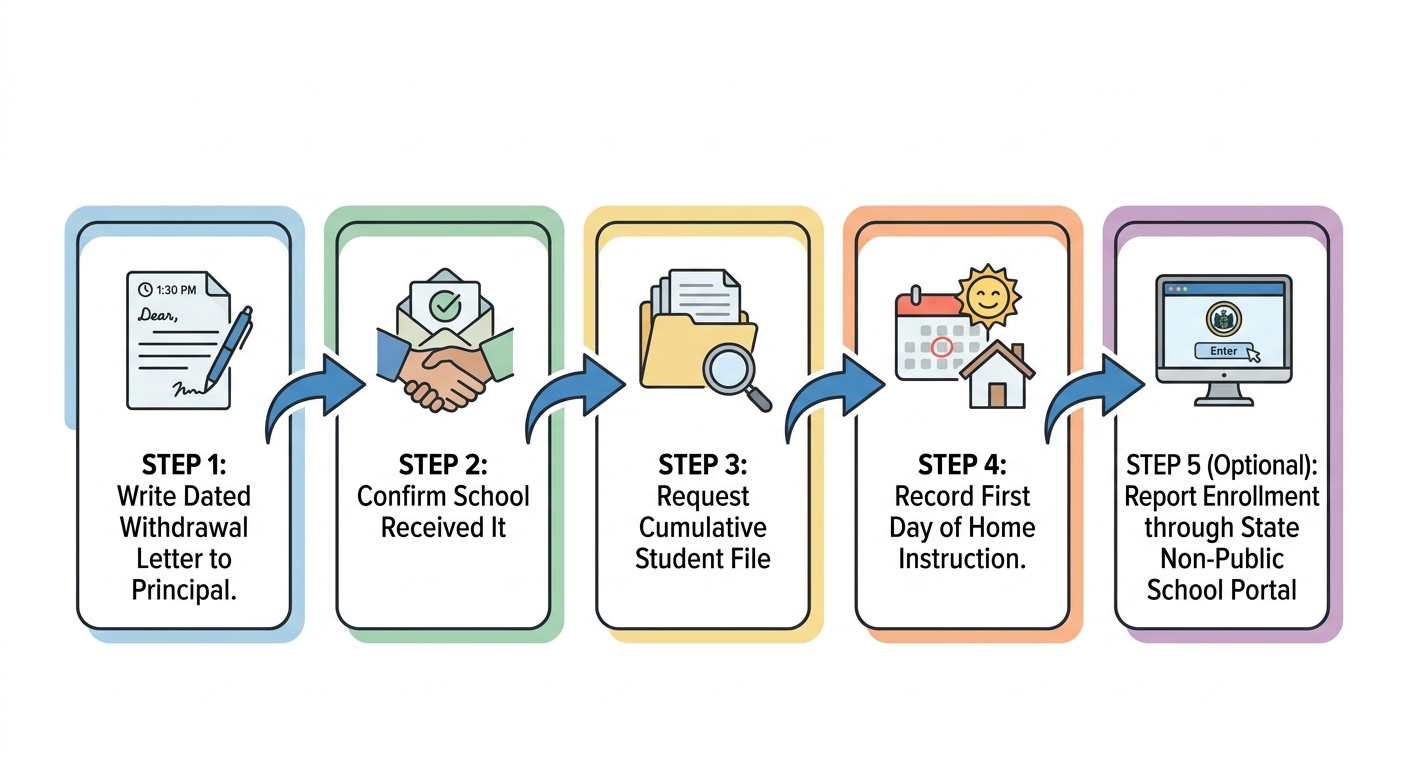
Send a short written withdrawal letter to the principal, keep a dated copy for yourself, and begin counting your 180 days from your first day of home instruction. Withdrawal is a notification, not a request — you are informing the school, not asking it.
The five steps:
- Write the letter. Keep it to a few lines: your child's full name, date of birth, grade, the effective date, and a sentence stating the child will be enrolled in a non-accredited non-public school as of that date. No explanation of your reasons is needed.
- Confirm receipt. Email and ask for a reply, or deliver it in person and ask the front office to date-stamp your copy. This single piece of paper is your proof the child was not truant.
- Request the cumulative file. Ask for transcripts, immunization records, standardized test results, and any special education documentation. These are far harder to collect a year later.
- Mark your start date. Whatever day you begin instruction is day one of your count. Write it down.
- Decide on voluntary reporting. Indiana's non-public school enrollment portal lets you report your school. It isn't mandated, but some families report so a record exists on the state side.
What if the attendance officer calls?
Occasionally a district follows up — sometimes because the withdrawal didn't get coded correctly internally. Respond calmly and briefly. Confirm in writing that your child is enrolled in a non-accredited non-public school, give the start date, and reference your withdrawal letter. You are not obligated to submit curriculum plans or test scores. Most of these calls end there.
If you're also sorting out curriculum, scheduling, and your first-month rhythm at the same time, the broader step-by-step homeschool start checklist covers the non-legal side of launching.
What Records Should You Keep — and for How Long?
Attendance is the only record Indiana names, but families who stay comfortable long-term keep four. The other three aren't legal obligations — they're the difference between a calm transcript week and a frantic one.
Attendance record is a dated log showing that instruction took place on at least 180 days. It can be a wall calendar with an X on each school day. It does not need hours, subjects, or signatures.
The four records worth keeping:
- Attendance log — the legally named one. Dated, simple, ongoing.
- Work samples — a few pieces per subject per term, showing progression rather than perfection.
- Reading list — running list of books read aloud and independently. Invaluable for high school English credit later.
- Course record — for grades 9-12, a running list of courses, texts used, and grades or mastery notes.
Here's what a logged week actually looks like: Monday through Thursday marked present, Friday marked as a field trip to a state park with a one-line note, and three work samples dropped into a folder. Recordkeeping for a week like this takes only a few minutes.
Indiana imposes no portfolio requirement, unlike states such as Pennsylvania where an annual portfolio review by an approved evaluator is part of the law. Many Indiana families still keep one, because it makes conversations with grandparents, co-op leaders, and admissions offices easier. If that appeals, you can build a digital homeschool portfolio without printing a single page.
How long should you hold records? A practical rule: keep attendance through the end of compulsory attendance age, and keep high school course records permanently. Transcripts get requested at strange moments — a scholarship application, a late college transfer, sometimes a job.
⚠️ The most common Indiana recordkeeping mistake isn't keeping the wrong records. It's keeping nothing for two years, then trying to reconstruct attendance from memory when someone asks.
How Do You Choose an Online or Boxed Program in Indiana?
Indiana does not require an accredited curriculum, so accreditation matters only in specific situations: you want a third-party transcript, you expect to re-enroll in public school, or you're pursuing a scholarship that requires an accredited diploma. Otherwise, choose on fit.
One distinction catches new families off guard. A tuition-free virtual charter school enrolls your child as a publicly funded public school student. That means attendance, testing, and curriculum follow the school's rules — you are not operating a home school in the legal sense. Indiana Connections Academy, for example, describes itself as a tuition-free online public school option for Indiana students. That can be a great fit, but it isn't homeschooling.
| Route | Accredited? | Legally homeschooling? | Typical cost structure | Who it fits |
|---|---|---|---|---|
| Virtual public charter | Yes, as a public school | No — child is a public school student | No tuition to the family | Parents wanting structure and oversight without legal responsibility |
| Accredited online private school | Yes | Yes, if enrolled privately | Annual tuition | Families who want a third-party transcript and diploma |
| Boxed or subscription curriculum | Varies by provider | Yes | Subscription or per-course purchase | Parents who want content delivered but keep control |
| Parent-built plan | No | Yes | Materials only | Families wanting full flexibility across ages |
Among subscription options, Power Homeschool and Time4Learning both market online course libraries to homeschooling families, with the parent remaining the school of record. Details, grade coverage, and pricing change — verify directly with each provider before enrolling, as of October 2026.
What questions should you ask a program before paying?
- Who is the school of record? If it's them, you're enrolled, not homeschooling.
- Does it issue a transcript or diploma? Ask what that document says and who signs it.
- Does it track attendance for you? Some produce reports that double as your Indiana attendance log.
- Can one subscription cover multiple children at different grades? Ask before assuming.
- What happens mid-year if it's not working? Refund windows vary widely.
If you're weighing several at once, it helps to compare online homeschool programs by structure type rather than by brand name — the structure is what you'll live with daily.
What Does a Typical Indiana Homeschool Year Look Like?
Any 180 days count. Indiana sets no school calendar, no minimum hours per day, no required start month, and no mandated subject list. Two families can both be fully compliant with completely different weeks.
Two shapes that work well:
- Four-day weeks across about 45 weeks. Fridays stay open for co-op, appointments, library days, or catch-up. The extra weeks absorb sick days without panic.
- Year-round in a three-weeks-on, one-week-off loop. Steady rhythm, frequent breaks, and no long summer slide to recover from each August.
Compulsory attendance in Indiana runs from age 7 through age 18. A student may exit earlier — at 16 — through the formal exit process, which requires consent from the parent and the school and an exit interview. Before age 7, kindergarten-style learning is entirely your call.
Because Indiana names no subjects, your subject mix is a family decision rather than a legal one. Most families cover language arts and math daily, with science, history, and the arts rotating in blocks. That flexibility is why the question "which homeschooling approach suits us?" matters more here than "what does the state want?" — it helps to pick a homeschooling style that fits your week before buying anything.
Key takeaway: In Indiana, the calendar is yours. Build the week around your family's energy, then count the days.
How Do Indiana Homeschoolers Graduate and Get a Diploma?
| Core 40 subject area | Typical homeschool equivalent |
|---|---|
| English/language arts | Literature study, composition, reading list by year |
| Mathematics | Algebra I, geometry, Algebra II sequence or equivalent |
| Science | Biology, a physical science, and one additional lab course |
| Social studies | U.S. history, world history/civilization, government, economics |
| Directed electives | World language, fine arts, or career-technical study |
| Physical education and health | Sports, structured fitness, health study |
Credit counts and course titles within Core 40 are set by the state and get revised periodically — check the current Indiana Department of Education Core 40 documentation when you build your plan rather than relying on a figure from an article.
Will Indiana colleges accept a parent-issued transcript?
Generally yes. Indiana public universities commonly admit homeschool applicants using a parent-prepared transcript alongside standardized test scores, course descriptions, or a portfolio. Admissions requirements differ by institution, so contact each admissions office in your student's junior year and ask what homeschool applicants must submit.
⚠️ State financial aid is the one place where accreditation can bite. Some Indiana aid programs, including the 21st Century Scholars pathway, have historically included diploma and school-based requirements that a parent-issued diploma may not satisfy. If state aid is part of your plan, confirm eligibility rules with the state agency administering the program well before senior year — not after.
Families who want an accredited diploma on paper sometimes enroll for the final years with an accredited online private school, or build credits through dual-enrollment at a community college. Both produce third-party records. For the statutory background behind all of this, the fuller Indiana homeschool law details article covers the code sections directly.
How Do You Keep Transcript-Ready Records Without Drowning in Paperwork?
Decide once how you'll log the day, then log it the same way every day. Systems fail from inconsistency, not from being too simple.
Three lightweight approaches that hold up:
- The one-line daily log. Date, subjects touched, one sentence. Takes under a minute.
- The monthly photo dump. Snap work samples as you go, drop them into a dated folder on the first of each month.
- The credit tracker. For high school, a single spreadsheet row per course: title, materials, hours or units, grade.
The realistic failure point is predictable. Nobody abandons recordkeeping in September. It slips in February, and the gap surfaces the week a transcript is due — which is when parents end up reconstructing three months of attendance from calendar memory and camera rolls.
That reconstruction work is the part worth designing out. When the record is generated from lessons you've already taught — progress notes, mastery against standards, what was covered and when — the attendance log and course record accumulate as a by-product of teaching rather than as a second job after it. That's the problem LearnSpark was built around for Pre-K through 8th grade: the adult teaches, and the documentation of what happened assembles itself instead of waiting in a pile. The payoff isn't administrative tidiness. It's the evening you don't spend catching up.
Key takeaway: Pick one logging method you can do in sixty seconds a day, and make the record a by-product of teaching rather than a separate task.
Summary
Starting a homeschool in Indiana takes a letter, a start date, and a log. The state asks for 180 days of instruction in English and attendance records — no notice of intent, no testing, no evaluator, no approved curriculum. That leaves the real decisions to you: which program structure fits your family, what your week looks like, and what the transcript needs to say by senior year. Build the recordkeeping habit in month one, and home education in Indiana stays as straightforward as the law makes it.
Frequently Asked Questions
Do you have to notify the state to homeschool in Indiana?
No. Indiana does not require a notice of intent or any state approval to begin home education. The Indiana Department of Education provides an online portal where non-accredited non-public schools may report enrollment, but using it is voluntary. Some families report anyway so a record exists if a school attendance officer ever follows up after a withdrawal.
Does Indiana require standardized testing for homeschoolers?
No. Indiana requires no state testing, no portfolio review, and no outside evaluator for home-educated students. Families who test usually do it for their own benchmarking or for college admissions. The Iowa Assessments and the California Achievement Test are examples of norm-referenced tests that some homeschool families use as optional benchmarking tools. Availability and administration rules vary by provider.
Can homeschooled students play public school sports in Indiana?
Access depends on your district. IHSAA bylaws tie athletic eligibility to enrollment at the member school, so a homeschooled student's options usually hinge on whether the local district permits part-time enrollment and how it applies that policy. Call the athletic director at your zoned school and ask directly — policies differ between districts and can change year to year.
At what age can a child stop homeschooling in Indiana?
Compulsory attendance in Indiana runs from age 7 through age 18, under Indiana Code 20-33-2. A student may exit at 16 through the state's formal withdrawal process, which requires an exit interview and consent from both the parent and the school. Before age 7, attendance is not compulsory, so early years are entirely at the family's discretion.
Is a parent-issued homeschool diploma valid in Indiana?
Yes. Because Indiana treats a home school as a non-accredited non-public school, the school — meaning the parent — issues the diploma. What matters practically is the transcript supporting it. Colleges, employers, and the military each set their own documentation standards, so check requirements with the specific institution well before graduation.
Information about third-party platforms reflects publicly available details at the time of writing and may have changed. Please verify directly with the provider. See our Terms of Use for more.