
Ohio is one of the more straightforward states to homeschool in, but the paperwork changed in 2023 and most guides still describe the old system. This walkthrough covers your first year end to end: the notification you file, the 900 hours you teach, the records you keep, the curriculum you pick, and how an Ohio homeschool diploma actually works when your student applies to college.
Quick Answer
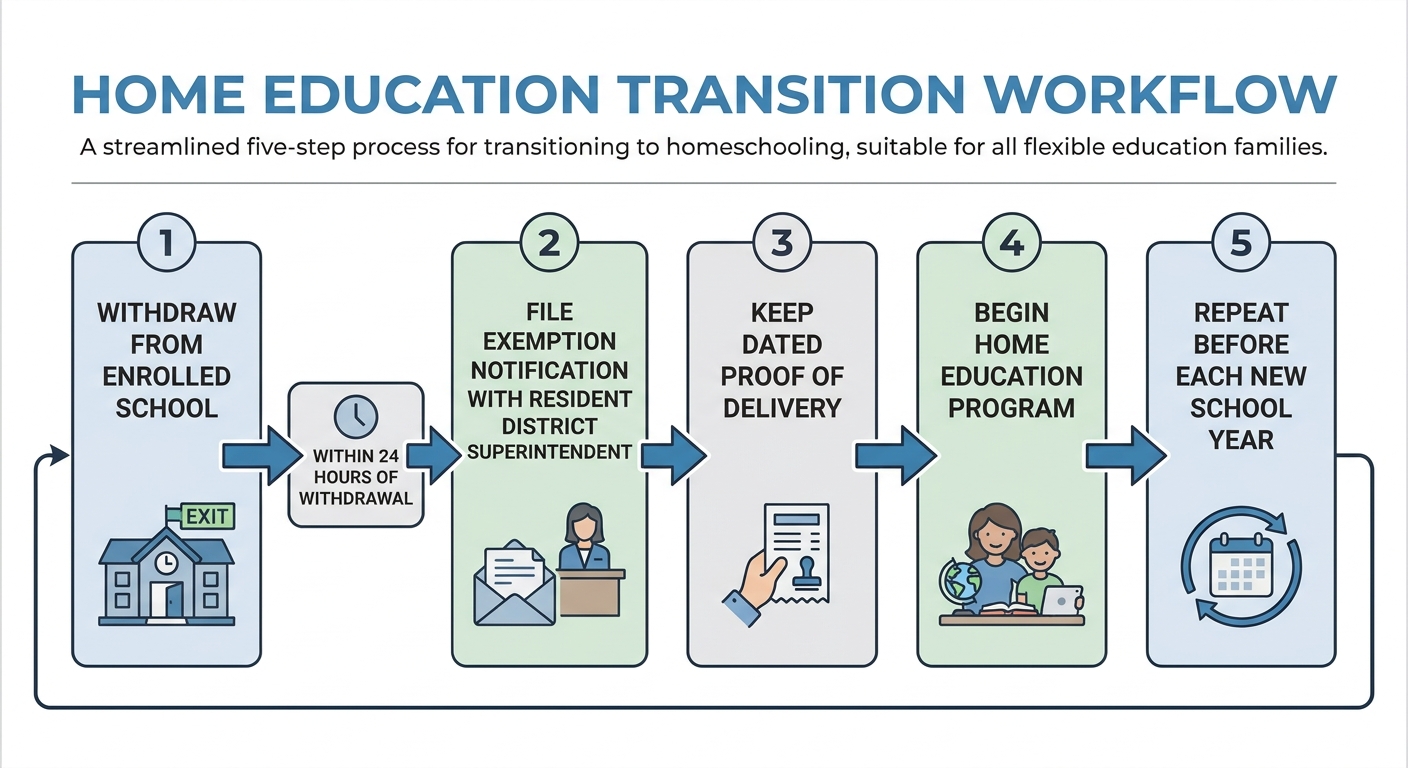
To homeschool in Ohio, send an Exemption Notification to the superintendent of the district you live in before the school year starts, or within 24 hours of withdrawing your child. Teach at least 900 hours a year across Ohio's listed subject areas and keep your own records. Ohio's home education rules were revised effective October 3, 2023, replacing the former Home Education Notification Form — confirm current requirements with your district before filing.
TL;DR
- The Exemption Notification is a notice, not an application — the district does not approve or deny it. See the filing walkthrough and sample wording
- Ohio sets 900 hours per school year, with no required daily schedule — you choose the calendar. See how the 900 hours break down
- Families typically assess progress by portfolio review or a nationally normed test, though what gets submitted changed in 2023. Compare the two assessment routes
- There is no state-approved curriculum list in Ohio, so fit matters more than compliance. Compare the four curriculum formats
- Ohio does not issue diplomas to home-educated students — the parent does, backed by a transcript. See how an Ohio homeschool diploma works
In This Article
- What Does Ohio Actually Require of Homeschooling Families?
- How Do You File the Exemption Notification (With Sample Wording)?
- What Counts Toward the 900 Hours?
- Portfolio Review or Standardized Test: Which Assessment Fits?
- What Records Should You Keep Through the Year?
- Which Curriculum Works Best for Ohio Families?
- How Does an Ohio Homeschool Diploma Work?
- What Does an Ohio School Year Look Like Month by Month?
- Frequently Asked Questions
What Does Ohio Actually Require of Homeschooling Families?
Ohio asks for five things: notification, instructional hours, subject coverage, your own records, and an honest account of your child's progress. Nothing else is inspected on a routine basis.
Exemption Notification is the one-page notice an Ohio parent sends to the resident district superintendent to be excused from compulsory school attendance. It replaced the older Home Education Notification Form as of October 3, 2023. It is a notice of what you intend to do — not a request for permission.
| Requirement | What it means in practice | When |
|---|---|---|
| Exemption Notification | Written notice to your resident district superintendent | Before the school year begins, or within 24 hours of withdrawal |
| 900 hours | Total instruction across the school year; you set the daily rhythm | Across the year |
| Subject areas | Ohio lists the broad subjects, not specific books or courses | Ongoing |
| Records | Hour log, work samples, reading list, progress notes — kept by you | Weekly is easiest |
| Progress check | Portfolio review or nationally normed test, depending on current rules | Spring, before the next notification |
Ohio sits in the middle of the regulatory range. It asks more than a notice-only state and far less than states requiring approved curriculum or district visits. If you are comparing a possible move, our overview of homeschool requirements by state lays the tiers out side by side.
⚠️ Because the 2023 revision changed both the form and the submission process, verify the current Exemption Notification contents with your own district or the Ohio Department of Education and Workforce before you file. District offices sometimes circulate outdated packets.
Key takeaway: Ohio homeschool requirements come down to one annual notice, 900 hours, broad subject coverage and records you keep yourself.
How Do You File the Exemption Notification (With Sample Wording)?
File it with the superintendent of the district where you live — not the school building, and not the district your child attended if you have moved. Send it before the school year begins, or within 24 hours if you are pulling your child out mid-year. No approval is needed, and no one has to sign off.
Here is the information your notification generally needs to carry:
- Parent details — full name and home address.
- Child details — full name and date of birth, one notification per child.
- School year — the specific year the notification covers.
- Assurance of hours — a statement that the child will receive at least 900 hours of home education.
- Subject outline — a brief list of the subject areas you will cover.
- Parent qualification — a statement that you hold a high school diploma or equivalent, or that you will teach under the direction of someone holding a bachelor's degree.
What wording can you copy and adapt?
Adapt the paragraph below to your family. Keep it short — long notifications invite questions that the law does not require you to answer.
Dear Superintendent [Name],
This letter serves as notification that [Child's full name], born [date of birth] and residing at [address], will be home educated for the [20XX–20XX] school year under Ohio's home education provisions.
[Child's name] will receive no fewer than 900 hours of instruction during the school year. Instruction will include English language arts; mathematics; science; history, government and social studies; health; physical education; fine arts; and first aid, safety and fire prevention.
I hold a high school diploma (or its equivalent) and will be responsible for this instruction.
Please confirm receipt of this notification. Thank you.
[Your name, address, signature, date]
Send it by certified mail or by email with a read receipt, and keep the proof with your records. That receipt is the only evidence you were ever asked for in most Ohio districts.
If you are pulling a child out of an enrolled school, sequence matters — the 24-hour clock starts at withdrawal. Our step-by-step guide to withdrawing your child from school in Ohio covers the order of operations and the letter that goes to the building office.
What Counts Toward the 900 Hours?
Almost anything that teaches a required subject. Ohio sets a yearly total and gives no daily or monthly schedule, so field trips, read-alouds, co-op classes, music lessons, nature study and long project work all count when they serve the subject areas.
The arithmetic is less intimidating than the number sounds:
- 180 days at 5 hours a day = 900 hours
- 4 days a week across 36 weeks = 6.25 hours a day
- Year-round, 48 weeks at 4 days a week = under 5 hours a day
Required subject areas in Ohio cover English language arts, mathematics, science, history and government, health, physical education, fine arts, and first aid and safety. Ohio does not dictate textbooks, sequence or grade-level content within them.
A realistic Tuesday for an eight-year-old might look like: 40 minutes of math, 30 minutes of reading aloud together, 25 minutes of independent reading, a 45-minute science walk with a notebook, 30 minutes of piano, and an hour at the pool. That is roughly 3.8 hours, and every piece of it maps to a listed subject.
The hard part is not reaching 900 hours — it is recording them in a way that still makes sense in May. Writing a one-line outcome next to each block, rather than just a time stamp, turns a log into something you can actually assess from. If you want a format for those outcome lines, our guide on how to write learning objectives keeps them short and concrete.
Portfolio Review or Standardized Test: Which Assessment Fits?
Two formats dominate home education in Ohio: a written narrative from an Ohio-licensed teacher who reviews a sample of your child's work, or a nationally normed achievement test. Under the rules that applied before October 3, 2023, one of these was submitted annually; the 2023 revision changed the notification process, so confirm with your district what must be submitted now.
Many Ohio families still complete one each spring regardless. It gives you an outside read on progress, and it produces documentation you will want if your child ever re-enrolls or applies somewhere that asks.
| Portfolio review | Nationally normed test | |
|---|---|---|
| What it is | A licensed teacher reviews work samples and writes a narrative | A standardized achievement test such as the Iowa Assessments, Stanford Achievement Test or CAT |
| Who administers | An Ohio-licensed or certified teacher you choose | An approved test administrator, often a licensed teacher or testing service |
| What you hand over | Samples across subjects, plus your log and reading list | The scored report |
| Typical timing | Scheduled anytime in spring; takes one sitting | Fixed testing window; usually a few hours across days |
| Cost | Set by the reviewer; fees vary widely by region | Set by the test provider or proctor |
| Suits | Project-based, interest-led or neurodivergent learners | Families who want a benchmark number, or teens building a record |
Costs for both routes vary by provider and county, so ask two or three reviewers or testing services directly rather than relying on a figure from a blog. Prices change year to year.
What does a reviewer actually look at?
A reviewer is looking for evidence of reasonable progress, not polish. In practice that means:
- Work across the year, not just September's best pages
- A visible progression — early attempts alongside later ones in the same skill
- Range across subjects, even if some are thin
- Your own notes on what the child found hard and what changed
That emphasis on progression over perfection is why a mastery-based learning and assessment approach travels so well into a portfolio review. If you can show where a skill was shaky and where it firmed up, you have already written the reviewer's narrative for them.
⚠️ A below-standard test score is not an automatic return to school. The traditional response in Ohio has been a remediation plan and a retest, not enrollment. Ask your district what their current process is before you panic about a percentile.
What Records Should You Keep Through the Year?
Ohio does not routinely inspect homeschool records, but you need them for three real situations: the annual assessment, a future transcript, and any re-enrollment. Keep four buckets and nothing else.
- Hour log — date, subject, activity, minutes, one-line outcome
- Work samples — a few pieces per subject per term, dated
- Reading list — titles and dates, read-alouds included
- Progress narrative — a short paragraph per term, in your own words
A single log row does more work than most parents expect:
| Date | Subject | Activity | Minutes | Outcome |
|---|---|---|---|---|
| Oct 14 | Math | Long division, 2-digit divisors | 40 | Correct method, still slow on estimation |
That last column is what turns a compliance log into an assessment packet. It tells you what tomorrow's lesson needs to do.
Key takeaway: Records kept weekly take minutes; records reconstructed in May take a weekend you do not have.
Paper binders work fine for one child. With two or more, most families eventually move to something searchable — our comparison of homeschool record keeping software covers what to look for before you pay for anything.
Which Curriculum Works Best for Ohio Families?
There is no state-approved curriculum list in Ohio, so the honest answer to "what is the best homeschool curriculum Ohio allows" is: all of them. The real question is which format fits your week, your budget and your child's actual level.
| Format | How it works | Prep time | Best fit |
|---|---|---|---|
| All-in-one boxed sets | Full year of materials for every subject, scripted and sequenced | Low | First-year families who want structure |
| Online self-paced programs | Child works through lessons on screen; platform tracks completion | Low | Independent learners; working parents |
| À la carte by subject | Strongest fit chosen per subject, assembled by you | High | Children well ahead in one area and behind in another |
| Parent-led personalized plans | Lessons built around the child's current level and interests | Varies | Multi-age households and interest-led learners |
Four names Ohio families commonly mention, described neutrally: Time4Learning markets a self-paced online K–12 program; Khan Academy offers free practice and video instruction across core subjects; Oak Meadow publishes a Waldorf-influenced, materials-based curriculum; and The Good and the Beautiful publishes a faith-based curriculum with free and paid levels. Check pricing, scope and philosophy directly with each provider, as of November 2026 details change between editions.
The pattern worth noticing: the best homeschool programs Ohio parents stick with in year two are rarely the most complete ones. They are the ones that survive a bad week. A boxed set you fall three weeks behind in creates its own stress; a flexible plan absorbs a sick child and a snow day without a catch-up spiral.
If you are still deciding, our walkthrough of how to choose a homeschool curriculum steps through learning style, budget and time before you spend anything.
Key takeaway: Ohio approves no curriculum, so choose for fit and sustainability, not for compliance.
How Does an Ohio Homeschool Diploma Work?
Ohio does not issue diplomas to home-educated students. You issue it. Its weight comes entirely from the transcript, test scores and portfolio standing behind it — and Ohio public universities have established admissions pathways for homeschool graduates based on transcripts and test scores.
An Ohio homeschool diploma is typically a one-page document naming the student, the graduation date, and the parent or home education program issuing it. The transcript is what admissions offices actually read.
A high school transcript should carry:
- Course titles by year, grouped into subject areas
- Credits earned — a commonly used convention is a set number of instructional hours per Carnegie credit, which varies by institution
- Grades and a cumulative GPA, with your grading scale explained
- Graduation date and the issuing parent's signature
- Supporting items — standardized test scores, dual enrollment transcripts, major projects
Our guide to homeschool transcripts and report cards covers formatting and credit math in more detail.
What makes an Ohio homeschool diploma stronger?
Outside verification. Anything that comes from someone other than the parent adds weight to a parent-issued credential.
- College Credit Plus — Ohio's dual enrollment program lets eligible students take college courses, producing a real college transcript before graduation.
- Standardized testing — ACT or SAT scores give admissions a common yardstick.
- Community college coursework or industry certifications in a chosen field.
- A portfolio of substantial work, especially for art, writing or technical programs.
Admissions requirements for home-educated applicants differ between Ohio institutions, and they change. Check each university's homeschool applicant page directly, ideally by the start of junior year, so you can build the record they ask for rather than assembling it retroactively.
What Does an Ohio School Year Look Like Month by Month?
The compliance year has only three fixed moments: notify before the year starts, assess before you notify again, and keep hours in between. Everything else is your own calendar.
| Window | What happens |
|---|---|
| July–August | File the Exemption Notification; keep delivery proof |
| September–April | Teach and log; collect work samples each term |
| March–May | Book the reviewer or schedule the test |
| June–July | Assemble the packet and prepare next year's notification |
The administrative weight is not in any single step. It is in the accumulation: hours tallied by hand, a sense of whether your child is actually on track against grade-level expectations, and a progress narrative written from a standing start every spring.
That is the specific burden a home education companion like LearnSpark is built around — the lesson plans it generates record what was covered, track mastery against the standards you select, and produce progress notes as you go, so the spring packet is largely assembled from work you had already done. The evening you would have spent reconstructing the year goes somewhere better.
Frequently Asked Questions
Short answers to the questions Ohio parents ask most often in their first year.
Do I need a teaching degree to homeschool in Ohio?
No. A high school diploma or its equivalent is enough to serve as the instructing parent. Parents without one have traditionally been able to teach under the direction of someone holding a bachelor's degree until the child's assessment results meet the standard. Confirm the current wording with your district, since the 2023 rule revision touched the notification contents.
Can an Ohio homeschooler play public school sports?
Yes. Ohio law permits home-educated students to try out for interscholastic athletics and other extracurricular activities at their resident district school. In practice you will complete district registration paperwork and OHSAA eligibility forms, and meet the same physical, academic and participation rules as enrolled students. Contact the athletic director early — tryout deadlines are often months before the season.
Is there an Ohio homeschool tax credit?
Ohio has in the past offered a nonrefundable credit for qualifying home education expenses, though eligibility and amounts have changed over time. Confirm the current-year figure and what expenses qualify on the Ohio Department of Taxation website before filing, as the number has changed. Our overview of education tax credits homeschool families can use covers how state credits interact with other options.
What happens if I start homeschooling mid-year?
You can begin at any point. Withdraw your child, file the Exemption Notification within 24 hours, and count hours from your start date. A January start leaves roughly half a school year, which most families treat as about 450 hours. Ask your district how they expect partial-year hours to be reported, since practice varies.
Do Ohio homeschoolers have to use state standards?
No. You must cover the listed subject areas, but Ohio's Learning Standards are a reference, not a requirement. Many families align loosely anyway for two practical reasons: it makes an annual assessment easier to interpret, and it smooths re-enrollment if a child ever returns to a classroom.
Summary
Learning how to homeschool in Ohio comes down to a handful of repeatable actions. File one notification a year with your resident district superintendent. Teach 900 hours across the listed subjects on whatever calendar suits your family. Keep a weekly log, termly work samples and a short progress narrative. Choose curriculum for fit, because Ohio approves none of it. And when the time comes, issue the diploma yourself, backed by a transcript that shows the work.
The families who find year two easier than year one are almost always the ones who built small habits in year one — a log line a day, a work sample a month, a reviewer booked in March rather than May.
Information about third-party platforms reflects publicly available details at the time of writing and may have changed. Please verify directly with the provider. See our Terms of Use for more.