
Florida gives families a lot of freedom in how they educate at home — and almost no guidance on what it will cost. If you are planning your first year to homeschool in Florida, the useful question isn't "what's the average?" but "which lines on my budget are legally required, which are optional, and which quietly double everything?" This guide breaks the year into those exact lines so you can price your own version.
Quick Answer
The cost of homeschooling in Florida is mostly a choice, not a bill. Registering a home education program with your district superintendent costs nothing to file, and curriculum can be free if you want it to be. The one unavoidable recurring expense is the annual educational evaluation required under Florida's home education statute (Fla. Stat. 1002.41). Everything above that — curriculum, co-ops, classes, sports — is discretionary, and it's where family budgets diverge wildly.
TL;DR
- Filing your notice of intent costs nothing; the annual evaluation is the only recurring cost Florida law actually requires of a home education program. See which costs the statute mandates
- Your legal route changes your budget more than your curriculum does — home education program, private umbrella school, and full-time virtual school carry very different cash and paperwork profiles. Compare the three Florida routes side by side
- Curriculum is the biggest discretionary line, and first-year families often pay for it twice because the first pick doesn't fit the child. See how to avoid the double-buy
- Outside classes, co-ops and sports — not academics — are usually what separates a lean year from an expensive one. See where co-op and activity spending stacks up
- Florida's county library systems, used-curriculum markets and public-school activity access are the three biggest levers for cutting spend without cutting quality. See the cost-cutting checklist
In This Article
- What Does Homeschooling in Florida Cost Per Year?
- Which Florida Homeschool Costs Are Actually Required by Law?
- How Do the Three Florida Legal Routes Change Your Budget?
- What Should You Budget for Curriculum?
- What Do Evaluations, Testing and Record Keeping Really Cost?
- How Much Do Co-ops, Classes and Extracurriculars Add?
- Three Sample Florida Homeschool Budgets
- Where Can Florida Families Cut Costs Without Cutting Quality?
- Frequently Asked Questions
What Does Homeschooling in Florida Cost Per Year?
Your year-one total is the sum of seven line items, only one of which the state requires. Price each one locally rather than trusting a national average — evaluator fees, co-op dues and curriculum prices vary by county, provider and year, and a stale figure is worse than no figure.
Home education program is Florida's term for a parent-directed program of instruction registered with the district superintendent, operating under Fla. Stat. 1002.41 rather than under public or private school rules.
| Line item | Required? | Typical budget weight | Can it be zero? |
|---|---|---|---|
| Notice of intent filing | Yes | None — no fee | Already free |
| Annual educational evaluation | Yes | Small, fixed, per child, per year | Rarely |
| Core curriculum | No | Largest discretionary line | Yes |
| Consumables and supplies | No | Small but recurring | Nearly |
| Co-op or class fees | No | Second largest; scales per child | Yes |
| Field trips and memberships | No | Moderate; front-loaded if you buy passes | Yes |
| Extracurriculars and sports | No | Highly variable; often the biggest surprise | Yes |
Two things stand out. First, the mandatory portion of the Florida homeschool budget is genuinely small — the paperwork step itself costs nothing, and you can handle it yourself with a Florida letter of intent to homeschool template. Second, the lines that scale per child are the ones to watch: an evaluation and a co-op membership for three children cost roughly three times what they cost for one, while a single curriculum often stretches across siblings.
Build your estimate in that order. Start with the required floor, add the curriculum tier you've actually chosen, then add outside activities last — because that's the line you'll adjust when the total looks wrong.
Key takeaway: In Florida, almost every dollar you spend on home education is a dollar you chose to spend. Start from the legal floor and add upward.
Which Florida Homeschool Costs Are Actually Required by Law?
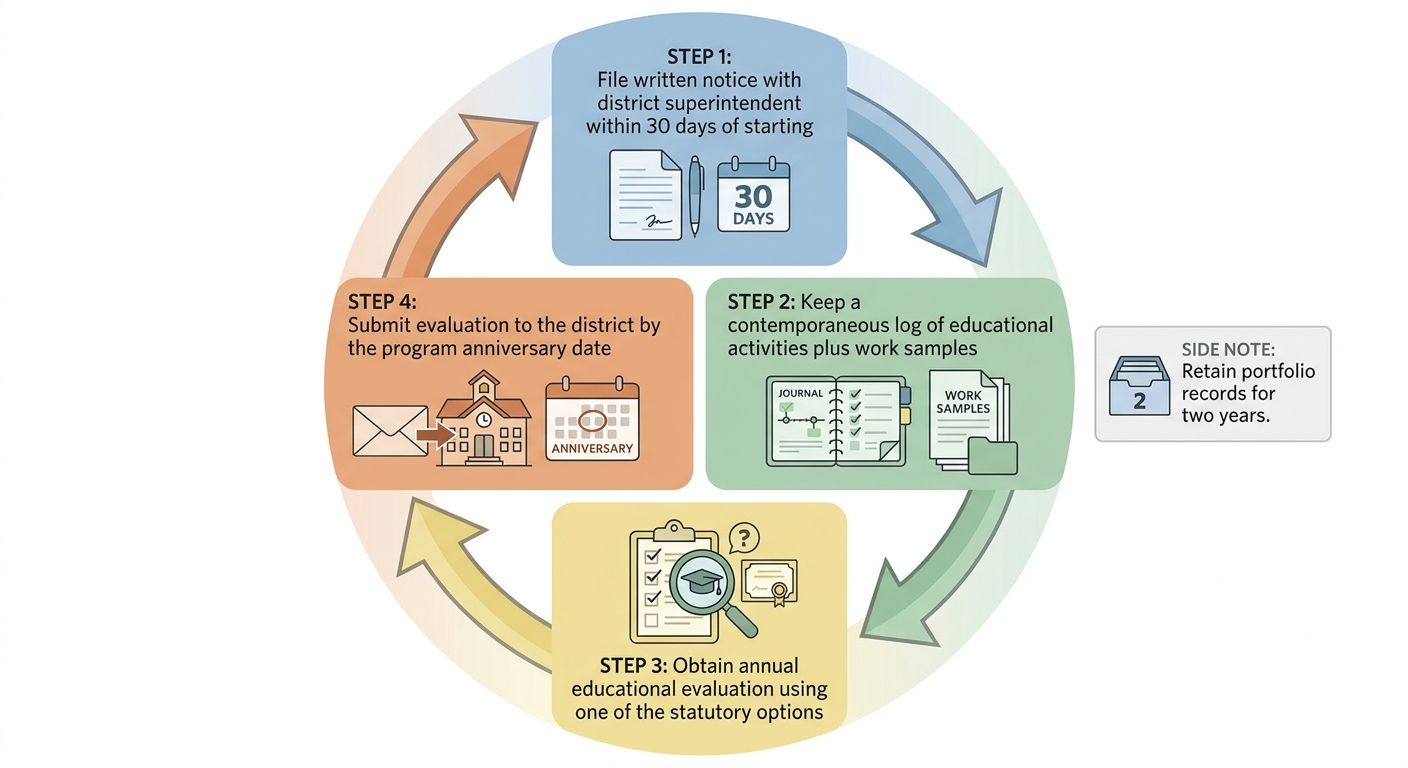
Only one recurring expense is mandated: the annual educational evaluation. Florida law also requires you to notify your district superintendent in writing within 30 days of establishing the program, maintain a portfolio, and have the student evaluated once a year — but notification and record keeping carry no state fee.
Portfolio refers to the record Florida requires a home education program to keep: a log of educational activities made contemporaneously with the instruction, plus samples of materials used and the student's work.
Florida's statute lists several acceptable evaluation methods. Each has a different price profile:
- Certified-teacher portfolio review — a Florida-certified teacher reviews the portfolio and interviews the student. This is the most commonly chosen route and usually the cheapest paid option.
- Nationally normed standardized test — administered by a qualified person. You pay for the test and sometimes a proctor.
- State student assessment — taken at a district-designated location. Availability varies by district.
- Evaluation by a licensed psychologist — a formal assessment, typically the most expensive option.
- Any other valid measurement tool mutually agreed upon by the parent and the district superintendent.
⚠️ The record-retention rule catches families out. Florida requires the portfolio to be preserved for two years and made available for inspection by the superintendent if requested. Deleting last year's log after you file the evaluation is a mistake you won't notice until someone asks.
Compared with states that require nothing beyond a one-time notice, Florida sits in the middle of the regulatory range — if you're weighing a move or comparing jurisdictions, see how the rules stack up in this overview of homeschooling requirements by state. Families entirely new to the process may want the broader step-by-step guide to starting homeschooling before pricing anything.
Verify current requirements with your own district office. Districts differ in how they accept submissions and in what they ask for.
How Do the Three Florida Legal Routes Change Your Budget?
Your legal structure sets your cost floor before you buy a single book. Florida families generally choose one of three paths, and the trade is almost always cash versus paperwork.
| Home education program | Private umbrella school | Full-time virtual public school | |
|---|---|---|---|
| What it is | You register directly with the district under Fla. Stat. 1002.41 | You enroll under a private school that files on your behalf | You enroll in a public virtual program such as Florida Virtual School |
| Filing fee | None | Annual enrollment fee set by the provider | None — publicly funded |
| Annual evaluation | Required | Generally not required; the private school sets its own policy | Not applicable; public assessment rules apply instead |
| Who owns the records | You | The umbrella school, with your input | The school |
| Curriculum freedom | Highest | High, within provider policy | Lowest — the program sets the courses |
| Schedule freedom | Highest | High | Lower; attendance and pacing rules apply |
The cash comparison is rarely the whole story. A home education program has no filing fee but carries the annual evaluation and the portfolio obligation. An umbrella school charges a fee and takes the compliance burden off your plate. A full-time virtual public school charges no tuition but replaces your autonomy with a school's calendar, courses and testing requirements.
Ask yourself one question before choosing: do I want to own the accountability, or pay someone to hold it? Families who enjoy record keeping usually save money self-managing. Families who dread it often find the umbrella fee buys back something they value more than the money.
What Should You Budget for Curriculum?
Curriculum is the single largest line you control, and it spans from genuinely free to a full boxed program per child. The tiers look like this:
- Free and open — Khan Academy, Easy Peasy All-in-One, CK-12, and the digital lending collections your county library already pays for. A complete elementary year is achievable at no curriculum cost.
- Mid-tier à la carte — a paid core math or language arts program, with free resources filling the rest. Most families land here by year two.
- Boxed all-in-one — publishers such as Sonlight, Abeka and BJU Press sell complete graded packages with teacher guides and schedules. Highest cost, lowest planning load.
The expensive mistake in year one isn't buying the premium option. It's buying twice — a full package in July, abandoning it by October because the reading level is wrong or the format bores the child, then buying again. That rebuy is the most common reason a first-year Florida homeschool budget overruns.
What should you ask before you buy?
- Can I see a full sample lesson, not just a scope-and-sequence page?
- Is it consumable, or can a younger sibling reuse it?
- Does it assume a parent sitting beside the child, or independent work?
- What's the return window if it doesn't fit?
- Could I run the first six weeks from free resources and decide afterwards?
That last question is the cheapest insurance available. Starting free for a term tells you what your child actually responds to before you commit money — and there's more on matching materials to a learner in this guide to choosing curriculum in your first year.
What Do Evaluations, Testing and Record Keeping Really Cost?
The certified-teacher portfolio review is the most commonly chosen evaluation in Florida, and for most families it's a modest once-a-year fee. The larger cost is time, and it's spread across every week of the year.
Annual evaluation is the yearly assessment Florida requires for each home education student, submitted to the district superintendent by the program's anniversary date, demonstrating that the student is progressing commensurate with ability.
Here's where the hours go:
- Logging activities as you go — the statute expects a contemporaneous log, not one reconstructed in May.
- Filing work samples — choosing and storing representative pieces across subjects.
- Keeping a reading list — simple, but easy to forget until the night before the review.
- Assembling the portfolio — pulling it all into something an evaluator can read.
Many families describe this as a short task repeated often rather than one big job. That's precisely why it slips: it never feels urgent until the deadline, and then it becomes a weekend.
This is the burden a home education companion is actually built to take off you. LearnSpark produces daily lesson plans from what a child needs next and keeps a running mastery record against educational standards as you teach, so the log and progress notes accumulate from the instruction itself instead of being rebuilt from memory before an evaluation. The time that would have gone into reconstructing the year goes back into the teaching day.
Key takeaway: Budget money for the evaluation and budget time for the portfolio. The second one is the cost families underestimate.
Districts vary in how they accept submissions — some use an online portal, others accept mail or email. Confirm your county's process well before your anniversary date.
How Much Do Co-ops, Classes and Extracurriculars Add?
This is where Florida homeschool budgets quietly double. Academics can stay cheap indefinitely; outside classes cannot, because they're priced per child, per term.
The main categories:
- Co-op dues — parent-run cooperatives charge per semester, often with a materials fee per class on top. Parents typically teach or assist, so the cost is partly paid in labor.
- Drop-off enrichment days — professionally staffed programs where you leave the child for a half or full day. Convenient, and the priciest of the group.
- Public school activity access — Florida law allows eligible home education students to try out for and participate in public school extracurricular activities, including interscholastic sports, at the school they'd be zoned for. Often the lowest-cost structured option available.
- Memberships and passes — museum, zoo and science center memberships, some with reciprocal admission networks, plus state park annual passes. These pay off only if you actually go.
- Private lessons and leagues — music, martial arts, club sports. Priced like they are for any family.
Which extras tend to cost the least?
Public school activity participation and reciprocal memberships are usually the best value per hour of engagement, because the first is publicly funded and the second converts a one-time purchase into a year of outings. Co-ops sit in the middle. Drop-off programs are the most expensive per hour and the most convenient — which is exactly why families reach for them during hard seasons.
Before you buy social time, be clear about what you're buying it for. This guide to how co-ops and friendships actually work is worth reading before you commit to a semester of dues.
Florida also operates scholarship programs for personalized education, administered through a state-approved scholarship funding organization. Eligibility rules and award structures change, and participating can change your reporting obligations — check current terms directly with the administering organization and the Florida Department of Education before building it into a budget.
Three Sample Florida Homeschool Budgets
The same school year, for one elementary child, at three spending levels. Use the structure, then drop your own locally researched prices into each row.
| Line item | Lean | Middle | Full-service |
|---|---|---|---|
| Legal route | Home education program | Home education program | Umbrella school |
| Notice of intent | Free | Free | Provider enrollment fee |
| Core curriculum | Free and open resources | Paid core math + language arts | Boxed all-in-one |
| Supplies | Basic consumables | Basic consumables | Full kit including science materials |
| Annual evaluation | Teacher portfolio review | Teacher portfolio review | Not required by provider |
| Co-op | None | One semester | Full year |
| Outside classes | None | None | Two per week |
| Field trips | Free and low-cost local sites | Occasional paid admissions | Annual memberships + sports league |
Read down the columns and the pattern is obvious. The academic rows barely move. Curriculum shifts from free to boxed, supplies shift from basic to complete, and the evaluation either appears once or disappears entirely under an umbrella.
Key takeaway: The gap between a lean Florida year and a full-service one is almost entirely outside classes, memberships and sports — not academics. You can teach well at the bottom of this table.
That's the useful conclusion for anyone anxious about money: educational quality and spending are not the same axis. The expensive column buys convenience, structure and other adults in the room. It does not automatically buy better instruction.
Where Can Florida Families Cut Costs Without Cutting Quality?
Three levers do most of the work: use the public library system fully, buy used, and choose the evaluation method that fits your child rather than the most expensive one.
Umbrella school refers to a private school that enrolls home-educated students and handles compliance filings on their behalf, in exchange for an enrollment fee.
Your cost-cutting checklist:
- Max out your county library — physical collections plus digital lending apps give you ebooks, audiobooks, and often streaming documentaries at no cost. Many Florida county systems also run free children's programming.
- Buy used first — homeschool swap groups, local sale pages and curriculum classified sites move last year's editions at a fraction of new prices, especially for non-consumable teacher guides.
- Pick the evaluation that suits the child — a portfolio review avoids test-prep costs and test anxiety; standardized testing suits families who want a norm-referenced data point.
- Buy passes only after you've gone twice — a membership is a saving only if the visits were already happening.
- Share a curriculum across siblings — choose non-consumable formats where you can.
For a frugal playbook that goes beyond Florida-specific rules, see this guide on how to homeschool well on a tight budget.
Key takeaway: Spend on the thing your family is short of. If you're short of time, pay for structure. If you're short of money, Florida's rules let you teach a full year on very little.
Summary
Florida makes home based education unusually affordable at the floor and unusually easy to overspend at the top. The filing is free, the curriculum can be free, and the only recurring legal cost is the annual evaluation. Everything else — boxed curricula, co-op dues, drop-off classes, leagues — is a choice you can revisit each term. Build your Florida homeschool budget from the legal requirements upward, start cheap on curriculum until you know your child's fit, and add outside activities last, because that's the line that moves the total.
Frequently Asked Questions
Is homeschooling free in Florida?
Almost. Filing your notice of intent with the district superintendent carries no state fee, and you can assemble a complete curriculum from free resources and your county library. The annual educational evaluation required under Fla. Stat. 1002.41 is a real recurring cost for most families, charged per child per year. Treat that evaluation plus basic consumable supplies as your realistic floor.
Does Florida give homeschool families any funding?
Florida operates scholarship programs supporting personalized education, administered through a state-approved scholarship funding organization rather than paid directly by the state. Eligibility criteria, award structures and allowable expenses change between legislative sessions. Importantly, participating can alter your reporting and record-keeping obligations compared with a standard home education program. Confirm current terms with the Florida Department of Education and the administering organization before counting any award in your budget.
How much does a Florida homeschool evaluation cost?
Certified-teacher portfolio reviews are the most commonly chosen option and typically the least expensive paid route. Evaluators set their own rates, and many offer reduced pricing for additional siblings reviewed in the same appointment. Psychologist evaluations sit at the higher end. Ask two or three Florida-certified evaluators in your county for current pricing before your anniversary date.
Is an umbrella school cheaper than filing a notice of intent?
Not in cash terms — filing directly with your district is free, while an umbrella school charges an annual enrollment fee. What the fee buys is the removal of the district reporting cycle and, under most providers' policies, the annual evaluation. Families who find record keeping stressful often judge that trade worthwhile. Families comfortable managing a portfolio usually spend less by registering their own home education program.
Information about third-party platforms reflects publicly available details at the time of writing and may have changed. Please verify directly with the provider. See our Terms of Use for more.