
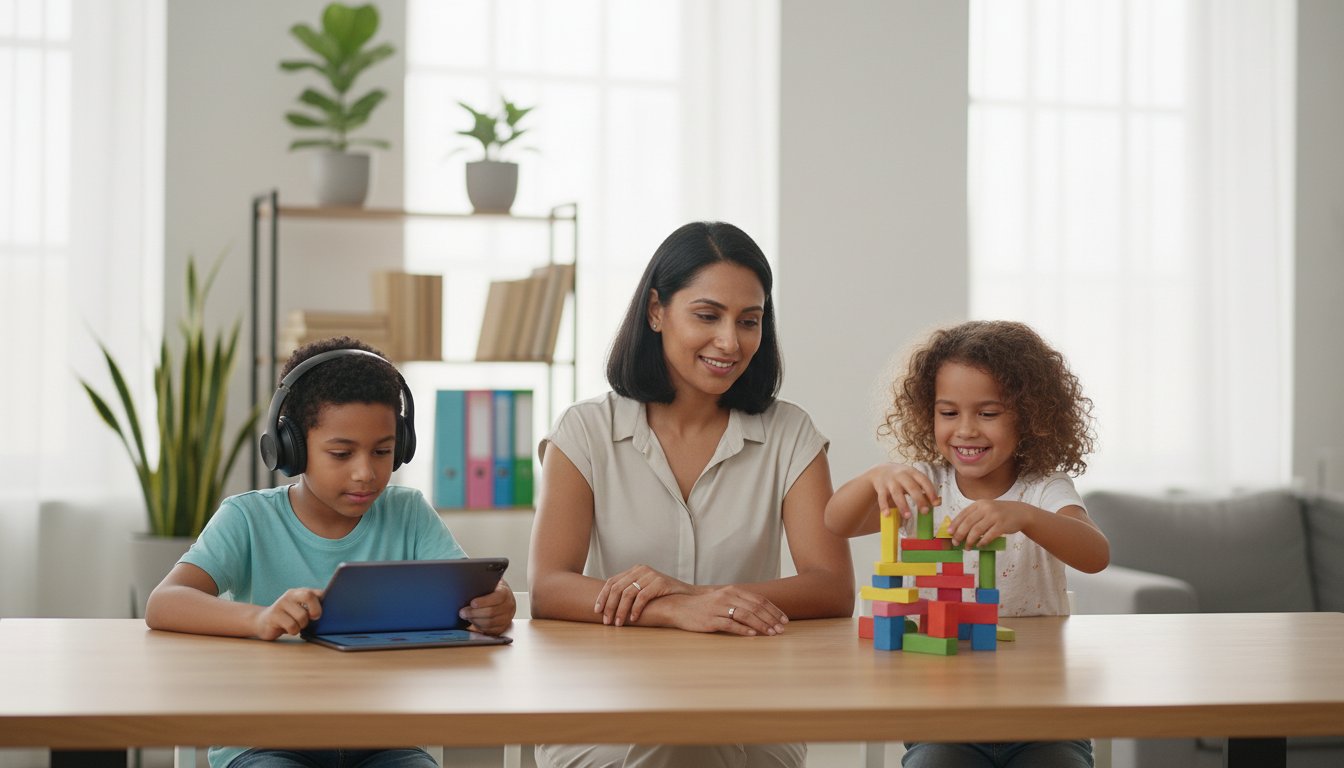
Does this sound familiar? You’ve planned the perfect lesson, but one child is joyfully engaged while another is bored, frustrated, or simply not retaining the information. It’s that sinking feeling that makes you second-guess everything. But you are not failing as a teacher-you're simply facing one of the most common hurdles in family-led education. The secret to transforming your homeschool isn't about working harder; it's about working smarter by successfully managing different learning styles at home.
This simple guide is your roadmap to trading that overwhelm for confidence and connection. Here, you will discover how to easily identify your child’s unique learning style-whether they are a visual, auditory, or kinesthetic learner. More importantly, you’ll get practical, low-stress strategies to adapt your teaching on the fly, without creating separate lesson plans for everyone. Get ready to unlock a more joyful, effective, and peaceful learning environment where every single one of your children can truly thrive.
Key Takeaways
- When lessons feel like a struggle, it's often a style mismatch, not a lack of effort. Identifying how your child learns best is the first step toward joyful connection.
- Quickly discover your child's learning "superpower" with the simple VARK model to understand if they learn best by seeing, hearing, reading, or doing.
- Successful managing different learning styles at home relies on simple, low-prep strategies. Find practical activities you can use today to match your child's natural strengths.
- Stop running multiple "schools" for different kids. Learn to layer activities that engage everyone at once and discover how LearnSpark can adapt lessons for you effortlessly.
Why 'One-Size-Fits-All' Lessons Lead to Frustration
Ever feel like you're explaining a concept perfectly, only to be met with a blank stare? That feeling of talking to a wall is a common frustration for even the most dedicated parents. The good news is, it's not a failure on your part or a lack of effort from your child. It’s often a simple mismatch between how you're teaching and how they are naturally wired to learn.
This is where managing different learning styles at home transforms your entire experience from a struggle into a shared adventure. It’s about discovering how your child best receives and processes information so that learning can finally flow with joy and ease. The goal isn't to label, but to connect.
It's About Preference, Not Ability
Let's clear the air. You may have heard debates around the various theories on learning styles, and it's true we shouldn't put children in rigid boxes. Our goal is simpler and far more practical: to focus on observable preferences. Think of it like this: some people love absorbing stories through audiobooks on a long drive, while others prefer the feel of a physical book. Both get the same story, but the experience is tailored to what feels most natural, making it more enjoyable and effective. This isn't about ability; it's about finding your child's 'on-ramp' to understanding.
The Benefits of a Tailored Approach
When you stop trying to fit your child into a pre-made educational mold and instead tailor the experience to them, the benefits are immediate and profound. You trade frustration for flow, and your role shifts from enforcer to guide. This adaptive approach unlocks:
- Increased Engagement: Lessons become an invitation to explore, not a chore to endure. Watch their natural curiosity spark when information is presented in a way that truly clicks for them.
- Deeper Understanding: When learning flows, information sticks. Your child will not only remember facts but will also grasp complex concepts more deeply because it's processed in their preferred "language."
- Boosted Confidence: Every "aha!" moment builds self-esteem. When children see themselves as capable learners, they develop the confidence to tackle new challenges with enthusiasm.
- Reduced Frustration for Everyone: The entire family dynamic shifts. When learning is joyful and connected, it strengthens your bond and makes your educational journey smoother and more rewarding.
The 4 Core Learning Styles: Identifying Your Child's Superpower
Ever feel like you're explaining something perfectly, but it just isn’t clicking for your child? It’s not about your teaching; it’s about their learning. Understanding how your child naturally processes information is the first step toward successfully managing different learning styles at home. It replaces frustration with connection and turns learning into a joyful discovery.
A simple and helpful starting point is the VARK model, which stands for Visual, Auditory, Read/Write, and Kinesthetic. While most children are a blend of these, identifying their dominant preference-their learning superpower-can transform your approach. This isn't a rigid label, but a guide to help you tailor experiences that spark their curiosity. To get started, we can look at a simple framework that breaks down the four core learning styles and what they look like in action.
The Visual Learner (The Observer)
Visual learners thrive when they can see what they are learning. They absorb information through charts, maps, videos, and demonstrations. Abstract concepts become clear when they are drawn out or represented in a picture.
- You'll notice they: Love diagrams, doodle while listening, and prefer watching a demonstration over hearing instructions.
- You'll hear them say: "Show me how," or "I see what you mean."
- Common traits: Often has a good sense of direction and remembers faces and places easily.
The Auditory Learner (The Listener)
For auditory learners, the world makes sense through sound. They connect with information by hearing it, speaking it, and discussing it. Lectures, audiobooks, and rhyming games are their pathways to understanding.
- You'll notice they: Love storytelling, explain concepts out loud to themselves, and remember song lyrics effortlessly.
- You'll hear them say: "Tell me about it," or "That sounds right."
- Common traits: May hum or talk to themselves while concentrating; excels in group discussions.
The Read/Write Learner (The Note-Taker)
These learners feel most comfortable with the written word. They process information best by reading texts, taking detailed notes, and making lists. For them, seeing it in writing makes it real and memorable.
- You'll notice they: Love to read, make lists for fun, and look up words in a dictionary or online.
- You'll hear them say: "Let me write that down," or "I read somewhere that..."
- Common traits: Enjoys journaling, well-written instructions, and researching topics online.
The Kinesthetic Learner (The Doer)
Kinesthetic learners, or tactile learners, understand by doing. They need to move, touch, and experience their lessons. Abstract ideas become concrete when they can build a model, act it out, or participate in a hands-on experiment.
- You'll notice they: Fidget while sitting still, love to build with blocks or clay, and learn best through experiments or field trips.
- You'll hear them say: "Let me try it," or "Can I build it?"
- Common traits: Has great physical coordination and remembers things they have physically done.
Practical Magic: Simple Strategies for Each Learning Style
You don't need a complicated plan to make learning click. The secret to managing different learning styles at home is having a few simple, high-impact activities ready to go. While the formal evidence on learning styles suggests that rigidly labeling a child is unhelpful, presenting information in multiple ways is a powerful strategy for every learner. Think of these not as boxes, but as tools to unlock understanding and spark joy.
Engaging Your Visual Learner
For children who need to see it to believe it, visual aids turn abstract concepts into something concrete. You can effortlessly bring lessons to life with a few simple tools.
- Make it a Map: Use a whiteboard or large paper to create colorful mind maps for a science lesson or a visual timeline for a history chapter.
- Go Digital: Find engaging educational videos or documentaries that show concepts in action, from the water cycle to ancient civilizations.
- Worldschooling Tip: At a museum, encourage your child to sketch their favorite artifact or focus on the diagrams and visual displays to understand the exhibits.
Connecting with Your Auditory Learner
If your child learns best by listening and talking, you can turn any lesson into a conversation. These learners thrive when information is presented through sound and discussion.
- Press Play: Use podcasts and audiobooks to explore new topics, from historical fiction to scientific discoveries.
- Teach It Back: After learning something new, ask them to explain it back to you in their own words. This is one of the most effective ways to solidify knowledge.
- Make a Jingle: Create simple songs, rhymes, or mnemonics to memorize facts, like the order of the planets or the 50 states.
Supporting Your Read/Write Learner
These learners find comfort and clarity in the written word. For them, taking information in and expressing it through text is the clearest path to understanding.
- Start a Journal: Encourage them to write about their experiences, what they've learned on a trip, or their thoughts on a book.
- Become the Expert: Have them create a short written report or a simple slideshow presentation on a topic they're curious about.
- Worldschooling Tip: When visiting a historical site, give them the guidebook or let them read the plaques to become the family's official tour guide.
Activating Your Kinesthetic Learner
For the child who needs to do, learning is a full-body experience. Movement and hands-on activities are the key to keeping them engaged and helping concepts stick.
- Build to Understand: Use LEGOs, blocks, or clay to build models. Construct a Roman aqueduct, a DNA helix, or the parts of a plant cell.
- Create a Math Adventure: Turn math problems into a scavenger hunt, with each correct answer leading to the next clue hidden around the house.
- Act It Out: Use role-playing to understand historical events or social dynamics. Acting out a scene from the American Revolution makes it far more memorable than just reading about it.
The Multi-Child Challenge: Harmonizing Different Learning Styles
Juggling the needs of a hands-on "Doer" and a thoughtful "Observer" can feel like you're running separate classrooms under one roof. It’s a common source of overwhelm for even the most dedicated parents. But the goal isn’t to triple your lesson planning; it’s to create smarter, more connected learning experiences.
Effective managing different learning styles at home is about designing layered activities where every child finds their entry point to joy and understanding. Instead of separating them, you bring them together around a central theme.
Start with a Universal 'Base Lesson'
Begin with a single, engaging activity that serves as a shared foundation. This core experience should be accessible and intriguing to everyone. For example, if you're exploring Ancient Egypt, your base lesson could be watching a vibrant, 15-minute documentary together. This creates a common pool of knowledge and sparks initial curiosity for the whole family.
Offer 'Style-Specific Extensions'
From that shared base, invite each child to explore deeper in a way that energizes them. This is where you tailor the experience, offering simple, optional pathways that cater to their natural strengths. This approach makes managing different learning styles at home feel effortless and fun.
- Visual: "Could you draw the inside of a pyramid and label the different chambers?"
- Auditory: "Let's talk about what life might have sounded like in an Egyptian market. What noises would we hear?"
- Read/Write: "Why don't you write a short journal entry from the perspective of an explorer discovering a new tomb?"
- Kinesthetic: "Let's build our own pyramid out of sugar cubes or blocks!"
Encourage Cross-Style Collaboration
This is where the magic truly happens. Encourage your children to combine their efforts into a single, richer project. The Read/Write learner can research fascinating facts, the Visual learner can illustrate them, and the Kinesthetic learner can build a model. This not only produces amazing results but also teaches teamwork, empathy, and a deep appreciation for different talents. If planning these activities feels like another item on your to-do list, we can help. See how LearnSpark can create these blended lessons for you.
From Overwhelmed to Empowered: Let LearnSpark Adapt for You
You've explored the unique ways your children learn, from visual maps to hands-on projects. But let's be honest: orchestrating this every single day feels like a full-time job. Teachers have teams and training to do this; as a parent, it's easy to feel overwhelmed. This is the hard way.
What if you could trade that stress for a smarter, simpler approach? Imagine having a personal assistant dedicated to managing different learning styles at home, one that never runs out of creative ideas. This is where technology can truly serve your family.
The Challenge of Manual Personalization
The mental load is real. You're constantly trying to identify learning preferences, plan different activities, and juggle the needs of multiple children at once. It’s exhausting to be the curriculum designer, teacher, and parent simultaneously. This pressure can quickly lead to burnout, taking the joy right out of the shared learning journey you envisioned.
How LearnSpark Effortlessly Creates Tailored Lessons
Instead of doing it all yourself, let an intelligent partner do the heavy lifting. Platforms like LearnSpark use a friendly assistant, SparkAI, to transform how you teach. It understands each child’s unique profile and automatically generates lessons that speak their language.
- For your visual learner: It might create an interactive timeline of historical events.
- For your auditory learner: It could generate a short podcast summarizing a science concept.
- For your kinesthetic learner: It can design a hands-on experiment using household items.
SparkAI weaves these different activities into one simple, coherent lesson plan, making it effortless to engage everyone at the same time.
Reclaim Your Time, Rediscover the Joy
The ultimate goal of managing different learning styles at home isn't just about checking educational boxes-it's about connection. When you're not bogged down by planning, you have more energy for what truly matters: exploring, laughing, and discovering alongside your children. Trade curriculum stress for curiosity. LearnSpark provides the structure so you can enjoy the freedom and be fully present for the adventure of learning together.
Embrace Their Brilliance, Effortlessly
The journey of managing different learning styles at home doesn't have to be a struggle. It’s about trading frustration for connection and discovering the unique way your child sees the world. By recognizing their learning superpower-whether visual, auditory, kinesthetic, or reading/writing-you unlock their natural curiosity and transform education into a shared adventure.
But what if you could do this effortlessly, for every child, in every subject? Imagine having a partner that does the adapting for you, so you can focus on the joy of discovery. This is where LearnSpark comes in. Our LearnSpark technology creates simple, personalized lessons that adapt to each child's unique learning style. With progress tracking that gives you confidence and clarity, you can stop second-guessing and start celebrating their growth.
Join the worldschooling families across the globe who trust us to bring structure and freedom to their journey. Ready to trade overwhelm for joy? Create your first LearnSpark lesson plan for free. Your family’s learning adventure is waiting.
Frequently Asked Questions
Are learning styles just a myth? Should I even worry about this?
While the scientific debate continues, what we know for certain is that every child has unique preferences for how they engage with new ideas. Instead of worrying about rigid labels, think of it as discovering what sparks their curiosity and makes learning joyful. Focusing on their preferred ways to learn builds confidence and connection, which is always the most important goal. You know your child best; this is about empowering that intuition.
What if my child seems to be a mix of two or three different learning styles?
That’s fantastic! Most children are a blend of styles, which is a sign of a flexible, well-rounded learner. Don't feel pressured to pick just one. The goal is to have a diverse toolkit of activities you can draw from. One day, a hands-on project might be perfect for math, while the next, a story or a song might bring history to life. This adaptability is a superpower for lifelong learning and discovery.
How can I manage different learning styles if I have very limited space or resources?
You don't need a dedicated classroom or expensive supplies. Successfully managing different learning styles at home is about creativity, not cost. For a kinesthetic learner, a walk to the market becomes a math lesson. For a visual learner, a library book or a simple drawing can explain a complex idea. The world is your resource. It's about turning everyday moments into simple, powerful learning opportunities, which is the heart of worldschooling.
At what age can I start to identify my child's learning preferences?
You can begin observing your child’s natural tendencies from a very young age. Notice what they gravitate towards during play. Do they love building with blocks (kinesthetic), listening intently to stories (auditory), or poring over picture books (visual)? These early clues are your guide. It's not about formal testing, but about paying attention to what delights them and gently introducing a variety of activities to see what truly sparks their interest.
Can a child's dominant learning style change over time?
Yes, and it's a natural part of their growth! A toddler who is highly kinesthetic might develop a strong visual preference as they learn to read. As children mature, their brains develop and their interests evolve, which can shift how they prefer to learn. The key is to remain flexible and observant. This journey is about adapting alongside your child, continuously finding new ways to connect and support their ever-expanding world with confidence.
How does LearnSpark's LearnSpark know what my child's learning style is?
Our SparkAI doesn't use a one-time quiz to put your child in a box. Instead, it’s an adaptive partner on your journey. It pays attention to the types of activities your child engages with and enjoys most within the platform. Based on these interactions, it gently suggests new lessons tailored to their evolving preferences. This ensures learning always feels personal and joyful, allowing their education to flow naturally from their curiosity.